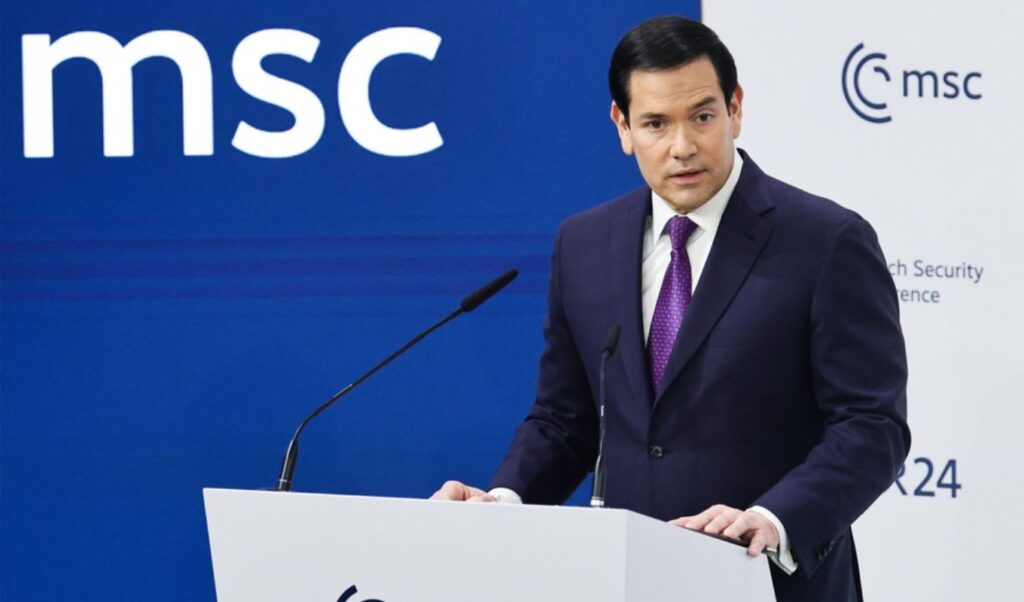
Recognizing the historic significance of the alliance between Europe and America that “saved the world” from past threats, US Secretary of State Marco Rubio sought to send a message of unity in his speech at the Munich Security Conference. “While we are prepared, if necessary, to go it alone, we prefer and hope to move forward together, with our friends in Europe,” Rubio declared.
As he emphasized, American President Donald Trump “demands seriousness and reciprocity from our friends in Europe.” “The reason is because we care deeply. We care deeply about your future and our own,” he added.
“And if we sometimes disagree, our disagreements stem from a deep sense of concern for a Europe with which we are connected, not just economically, not just militarily.” “We are connected spiritually and culturally. We want Europe to be strong,” he noted characteristically.
Among other things, he stated that the United States plans to revitalize “an old friendship and renew the greatest civilization in human history.”
He put an end to speculation that the US might leave NATO, emphasizing that: “In an era of headlines announcing the end of the transatlantic age, let it be clear to everyone that this is not our goal and desire, because for us Americans, our home may be in the western hemisphere, but we will always be children of Europe.” “Our first colonies were built by English colonists to whom we owe not only the language we speak, but our entire political and legal system,” he reminded.
He made special reference to the Scots, Irish and German farmers, who, as he commented jokingly, “dramatically upgraded the quality of American beer.” Speaking also about NATO forces, he declared that “we have bled together and died together.”
At the same time, the US Secretary of State criticized the United Nations for their inability to resolve the conflicts occurring around the world.
Rubio at Munich Conference: “The United Nations have played essentially no role”
“The United Nations have enormous potential,” says Marco Rubio, but adds that “we cannot ignore that today, on the most pressing issues we face, there are no answers and they have played essentially no role.” “It has not solved the problem of the war in Ukraine” and “it was the US that managed to bring the two sides to the negotiating table to discuss a peace agreement.”
Referring to the development of negotiations on Ukraine, he emphasized that “I don’t think anyone in this room would be opposed to a negotiated settlement of the war, provided the conditions are fair and sustainable, and that is what we aim to achieve, and we will continue to try to achieve it.”