An unprecedented plan that could grant Ukraine partial membership status in the European bloc as early as 2027, even before completing the necessary reforms for full membership, is being developed by the European Union. According to ten European officials and diplomats cited by Politico, the initiative aims to strengthen Kyiv’s position within Europe and definitively remove it from Russia’s sphere of influence.
Read: Russia’s message for ending the war in Ukraine: Moscow will need security guarantees
Four years after the Russian invasion and with Ukrainian leadership pursuing EU membership by 2027, a timeline that Kyiv wants included as a condition in any future peace agreement with the Kremlin, this idea signals a substantial shift in the enlargement process. The plan envisions Ukraine gaining a seat “at the EU table” before completing the institutional, judicial, and political changes required for full participation.
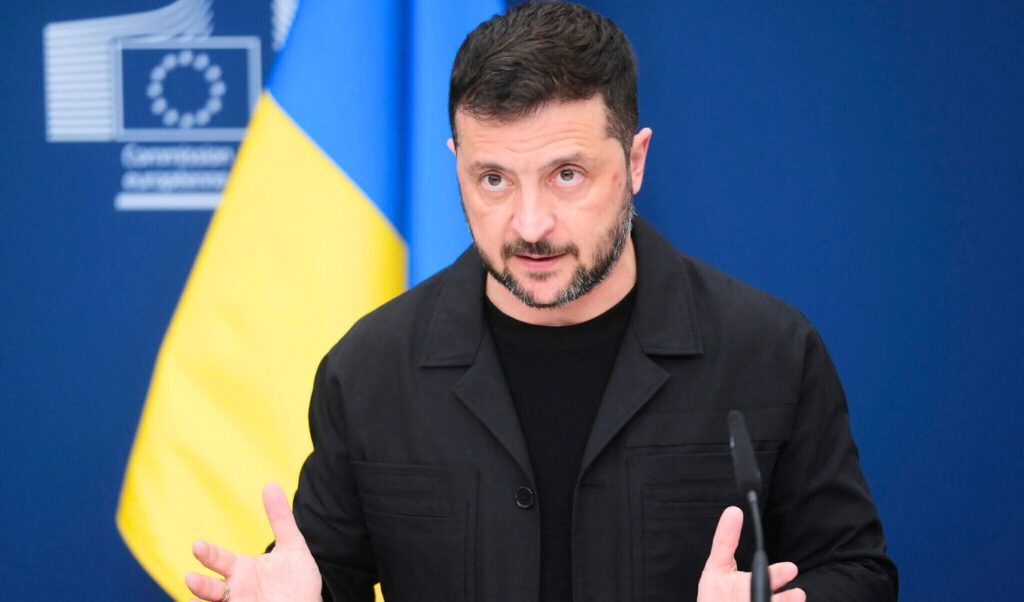
European officials and the Ukrainian government characterize membership as an urgent issue. President Volodymyr Zelensky stated Friday in Kyiv that Russia might attempt to “cut off our path to the EU.” “That’s why we ask for a date to be set. A specific date will be signed by Ukraine, Europe, the US, and Russia,” he said, emphasizing the importance of institutionally securing the country’s European trajectory.
Membership plan “reverse enlargement”
The idea of partial membership recalls the vision of “multi-speed Europe” that French President Emmanuel Macron has repeatedly presented since 2017. In Brussels, the plan has informally been called “reverse enlargement,” as it provides for a country’s integration at the beginning – rather than the end – of the criteria fulfillment process.
According to European officials, this model would give Kyiv political and institutional “oxygen,” allowing it to complete reforms without cultivating the sense that membership is an unattainable goal. At the same time, however, strong resistance remains, primarily from Hungarian Prime Minister Viktor Orbán, who openly opposes Ukraine’s membership.
Five steps for gradual integration
Based on conversations with European and Ukrainian officials, Politico describes five distinct stages that can bring Kyiv under the Union’s umbrella.
Ukraine’s preparation
The EU has begun “accelerating” the process, providing Kyiv with informal guidance on negotiation “clusters,” the legal steps for membership. Details have already been given for three of the six. The goal is to present more at an informal meeting of European Affairs ministers in Cyprus in March, so related work can begin. “There will be no shortcuts in reforms,” European officials emphasize, noting that speed cannot substitute for institutional change.
“EU membership brings benefits only if transformation proceeds through the enlargement process – this is the real power of EU membership,” one official stated. “The European Commission must reconcile these two things: the need to move quickly, but also to implement reforms in Ukraine.” For its part, Kyiv declares it is ready to do what is required. “We will be technically ready by 2027,” Zelensky said Friday. “You’re talking about the end of the war and simultaneous security guarantees. And the EU for us is security guarantees.”
Creating “light membership”
In a recent Brussels meeting, European Commission President Ursula von der Leyen presented alternative models, including “reverse enlargement.” The rationale is not relaxing criteria, but sending a strong political message not only to Ukraine, but also to countries like Moldova and Albania. Despite reservations, officials estimate that Kyiv could accept a solution that institutionally secures the membership path, without constituting a permanent second-class status. “It’s important to send a political message,” an EU diplomat said. “The war of aggression has continued for four years. Ukrainians need support. The EU must provide this support, politically and psychologically.”
A Moldovan official told Politico that the country “wants to join a European Union that functions effectively beyond the 27 member states, and we welcome discussions about the internal reforms needed to make this possible.” Simultaneously, “full membership – with equal rights and full participation in EU decision-making – must remain the clear and final destination.”
Albanian Prime Minister Edi Rama told Politico last month that a creative approach to EU membership was a “good idea” and that his country would accept even temporarily not having its own commissioner.
Waiting for Hungary’s stance
Membership requires unanimity and Budapest’s position constitutes a critical obstacle. European capitals are closely monitoring developments until Hungary’s April elections, hoping for political change. Orbán has characterized Ukraine as an “enemy” and has repeatedly clashed with Zelensky, exchanging harsh statements. Several EU officials said they hope that if Orbán loses the elections, his opponent, Péter Magyar, the conservative opposition leader, could change stance toward Ukraine, given that he promised last year to put the issue to referendum. If Orbán is re-elected, however, the process automatically moves to the fourth step.
The Trump “card”
If Orbán remains in power, some European leaders believe that the only one who could pressure him is US President Donald Trump, with whom he maintains close relations. Given that Ukraine’s EU membership is included in a draft peace proposal, there is hope that Washington will intervene politically. With Ukraine’s EU membership by 2027 included in the 20-point proposal draft for ending the war, the hope is that Trump will call Budapest to close a deal.
According to the peace proposal, the US “commits to ensuring that no one will obstruct” elements of the agreement, Zelensky said in recent days. “We are discussing whether the United States of America will cooperate politically with certain European actors, so they don’t obstruct the agreement.”
Article 7
If all other options fail, the EU could bring Article 7 of the Treaty back to the table, which provides for suspending a member state’s rights. Although such a move is considered extreme and politically dangerous, diplomats acknowledge it remains an “ultimate means” in case of prolonged deadlock. Article 7, which applies when a country is deemed likely to violate the Union’s fundamental values, is the most serious political sanction the EU can impose, as it suspends a member state’s rights, including those concerning new country membership.
The EU, however, does not yet intend to proceed with this move, as it considers such action would benefit Orbán ahead of April’s elections. Nevertheless, capitals are evaluating using this tool if Orbán is re-elected and continues obstructing EU decision-making. Such a move is “absolutely possible,” a third diplomat said.