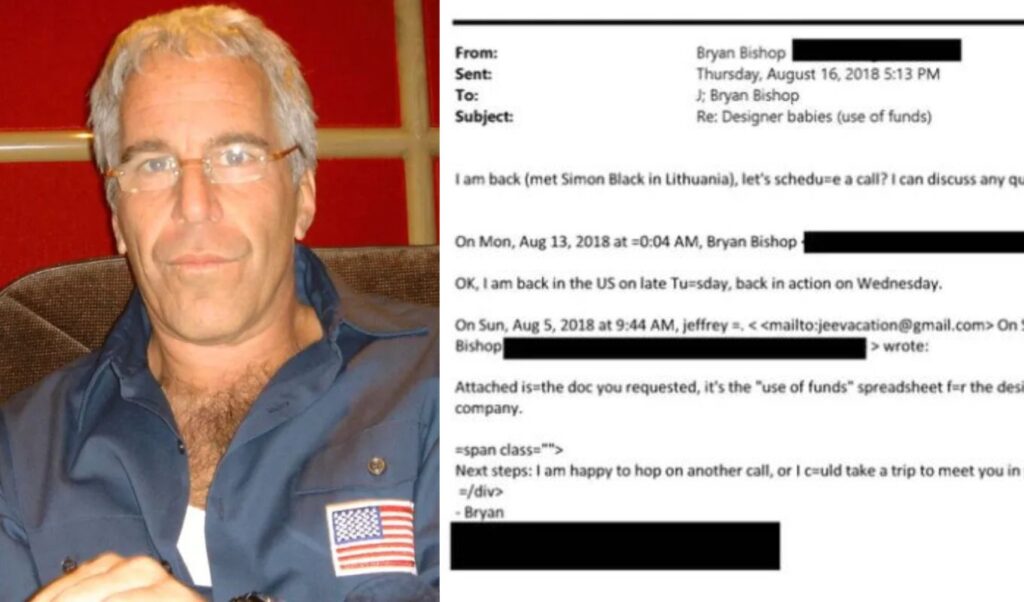
The tentacles of Jeffrey Epstein appear to have extended even into genetics, specifically into cloning, according to the latest revelations from his files that bring shocking new details to light. The notorious financier was found dead in his cell in 2019 while awaiting trial, however, years later, interest in his case has not only not subsided but has intensified, with questions about possible third-party complicity remaining open.
New revelations in Epstein case: Funded human cloning research
US President Donald Trump, despite his known friendship with Epstein in the past, had pledged to release the infamous “Epstein files” to the public, which became a thorny issue for his administration. The handling of the documents sparked fierce criticism, with the case taking on the dimensions of a political show, while there was no shortage of reactions when, in late 2025, files with extensive redactions were made public. The American president has denied any involvement, as have representatives of former President Bill Clinton and Bill Gates.
Emails, dinners and… “designer babies”
The documents in question include, among other things, alleged correspondence between Epstein and Elon Musk, references to dinners with Mark Zuckerberg, claims that Bill Gates had contracted a sexually transmitted disease, as well as confirmation that biohacker Bryan Johnson had communicated with him.
Another story from the technology sector stands out, as according to a Daily Mail report, correspondence between Epstein and Bitcoin programmer Bryan Bishop dating to 2018 is revealed. Bishop allegedly sought funding for a project involving “designer babies” and human cloning. In one of his emails, Epstein characteristically wrote: “I have no problem with the investment. The only problem is if it appears that I’m leading it.”

Bishop responded a few weeks later presenting the funding needs to move beyond the so-called “garage biology” stage, estimating the total cost at up to $9.5 million. The messages mention “more experiments on mice” in a laboratory in Ukraine, while Epstein allegedly commented: “I like it: embryo implantation, wait 9 months. Beautiful ending.”
Bishop’s venture focused on modifying the human germline, with the goal of allowing parents to select characteristics that would be inherited by their children. His team examined instead of direct embryo editing, modifying cells that produce sperm through gene therapy, an approach that has been characterized as “ethically problematic and technically unproven,” with experts warning that it could operate outside the established medical and regulatory framework.
Bishop in subsequent emails mentioned that his team was considering an even more “radical” direction. In a November 2018 message he stated: “My team is working on a new technique that doesn’t involve stem cells in the testicles. Instead, it’s an embryo processing technique, closer to cloning, which doesn’t require injection into the biological father.” Despite evidence that Epstein and Bishop met several times to discuss the plans, it remains unknown how far the matter ultimately progressed.
Epstein’s vision and Bishop’s response to the new files
The latest revelations add to those from a 2019 New York Times report, according to which Epstein was interested in “seeding” humanity with his own DNA, leaving women pregnant at his ranch in New Mexico. The newspaper contained descriptions of tactics Epstein used to “infiltrate elite scientific circles” in order to promote his interest in eugenics and other extreme fields, such as cryonics. Among other things, he allegedly stated that he wanted his head and penis frozen after his death.
Bryan Bishop responded to the publication of the new files by telling the Daily Mail: “We never received funding from Epstein and I’m proud of that.” The newspaper notes that it’s not known whether Bishop was aware of Epstein’s convictions, while he himself refused to comment on anything beyond the content of their communication.