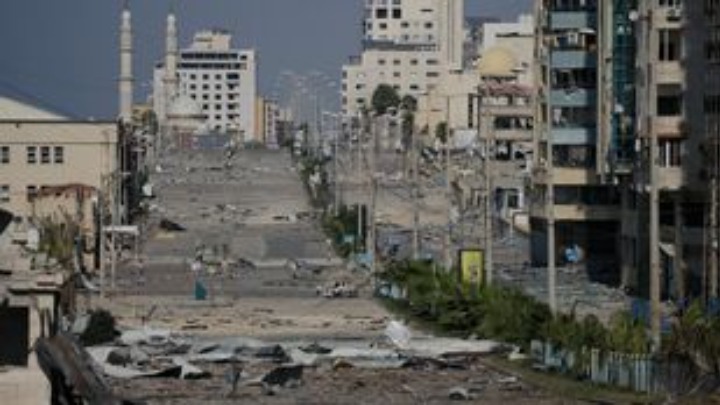
After the ceasefire agreement was signed last October, at least 23 Palestinians were killed on Saturday by Israeli strikes in Gaza, marking one of the highest casualty counts recorded in the Middle East. A day after Israel accused Hamas of new ceasefire violations, strikes hit locations across Gaza, including deadly attacks on an apartment building in Gaza City and a tent camp in Khan Younis, said hospital officials who received the bodies.
Among the victims were two women and six children from two different families. An airstrike also hit a police station in Gaza City, killing at least 11 people and wounding others, said Shifa Hospital director Mohamed Abou Salmiya. These attacks occurred one day before the scheduled opening of the Rafah crossing along the border with Egypt. As all border crossings in the area have been closed almost throughout the war, Palestinians view Rafah as a lifeline for the tens of thousands who need treatment outside the region, where most medical infrastructure has been destroyed.
Gaza Strip: The ceasefire violation
The opening of the crossing, which will initially be limited, marks the first significant step in the second phase of the ceasefire achieved through US mediation. Opening the borders is one of the challenging issues on the agenda of the ongoing phase, which also includes the demilitarization of the Strip after nearly two decades of Hamas governance and the installation of a new government to oversee reconstruction.
These attacks occurred one day before the scheduled opening of the Rafah crossing along the border with Egypt. As all border crossings in the area have been closed almost throughout the war, Palestinians view Rafah as a lifeline for the tens of thousands who need treatment outside the region, where most medical infrastructure has been destroyed.
The opening of the crossing, which will initially be limited, marks the first significant step in the second phase of the ceasefire achieved through US mediation. Opening the borders is one of the challenging issues on the agenda of the ongoing phase, which also includes the demilitarization of the Strip after nearly two decades of Hamas governance and the installation of a new government to oversee reconstruction.
However, Saturday’s attacks serve as a reminder that the death toll in Gaza continues to rise, even as the ceasefire agreement progresses at a slow pace.
Nasser Hospital reported that the strike on the tent camp caused a fire, killing seven people, including a father, his three children, and three grandchildren. Meanwhile, Shifa Hospital reported that the strike on the apartment building in Gaza City killed three children, their aunt, and their grandmother on Saturday morning, while the strike on the police station killed at least 11 officers, including four policemen, and detainees held at the station. Hamas’s Interior Ministry said Palestinian civilians were also killed in the strike.
Hamas characterized Saturday’s attacks as a “new flagrant violation” and called on the United States and other mediating countries to pressure Israel to stop the attacks.
A military official, speaking on Saturday under condition of anonymity according to protocol, could not comment on the specific targets, but said Israel carried out attacks during the night and Saturday morning in response to what the military called ceasefire violations the previous day.
The Israeli military, which has struck targets on both sides of the ceasefire’s yellow line, said attacks since October are conducted in response to violations of the agreement. In a statement issued Friday, the military reported killing three fighters emerging from a tunnel in a buffer zone in Rafah, which is controlled by Israel.
Gaza’s Health Ministry has recorded 509 Palestinians killed by Israeli fire since the ceasefire began on October 10. The Ministry, which is part of the Hamas-led government, maintains detailed casualty records that are generally considered reliable by UN agencies and independent experts.