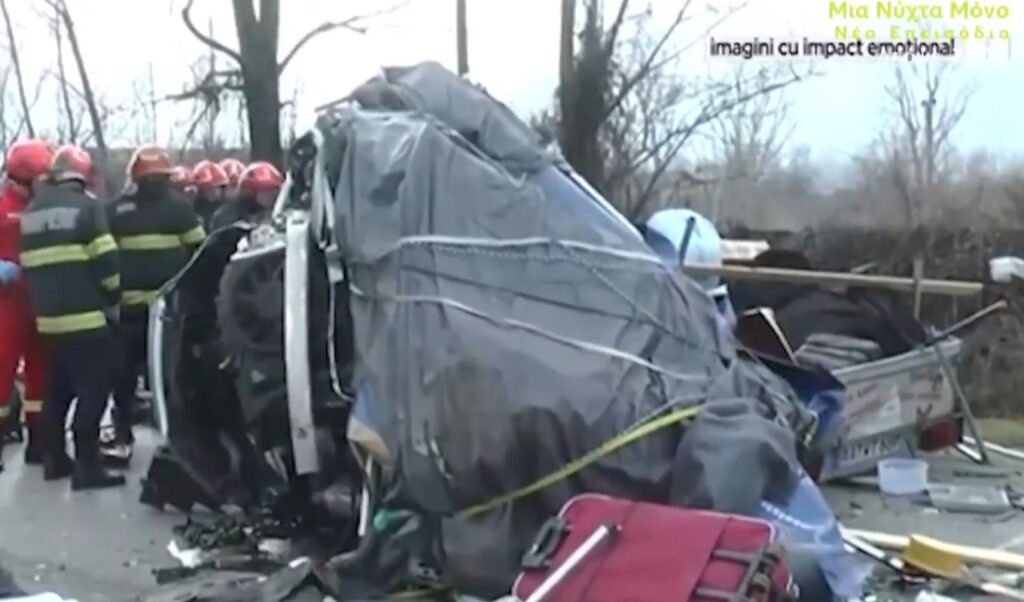
Another accident occurred on the DN6 highway death trap in Romania, where seven Greeks, PAOK supporters aged 28 to 30, lost their lives. The tragic incident occurred on Wednesday (28/01) in the area of Craiova city, quite far from Timișoara. A 68-year-old Bulgarian car driver was killed in the accident.
Fatal crash on Romania’s “death road”
Specifically, the fatal incident occurred when the unfortunate driver, while overtaking a truck, lost control, entered the opposite lane and collided head-on with a semi-trailer, according to reports. The shocking accident shows similarities to the horrific tragedy of PAOK fans. It should be noted that from the violent collision the car was completely destroyed while the man was extracted dead from the vehicle.
Romania’s DN6: why is it called the “death road”?
Drumul Național 6 (DN6) is one of Romania’s main national roads connecting Bucharest with the western Banat region, continuing towards Hungary and Serbia. It crosses important cities like Alexandria, Caracal, Craiova, Drobeta-Turnu Severin, Caransebeș, Lugoj and Timișoara. Despite its importance as a major international axis, DN6 has earned the sinister reputation of “drumul morții” (death road) in Romania. Romanian media covering today’s accident report that in this specific area of Timiș County, over 320 accidents have been recorded in the past year – a terrifying statistic that justifies its terrible nickname.
The “black” statistics: 60-70 deaths every year
According to data from car rental companies and road safety organizations operating in Romania, DN6 has an annual death rate of 60-70 people, making it one of the country’s five most dangerous roads. In the black list of Romanian roads, DN6 ranks behind DN1 (90-100 deaths annually), DN7 (80-90 deaths) and DN2 (70-80 deaths), but ahead of DN17 (50-60 deaths). These five roads account for the majority of fatal traffic accidents in Romania.
To understand the severity of the problem, it suffices to note that Romania holds the sad record of first place in the European Union for traffic accident deaths. In 2024, the country recorded 77-78 deaths per million inhabitants, almost double the EU average of 44 deaths per million. In total, approximately 1,478 people lost their lives in traffic accidents in Romania in 2024, representing 7.4% of all traffic deaths in the EU – a disproportionately high percentage for a country with a population of just 19 million.
Why is DN6 so dangerous?
Experts identify multiple factors that make DN6 particularly deadly:
1. Driver behavior
The main causes of accidents on DN6, according to Romanian traffic police, are:
– Excessive speed
– Dangerous overtaking (as in today’s accident)
– Driving under the influence of alcohol
– High traffic congestion
– Romanian drivers, according to studies, are often careless at the wheel, drive at excessive speed, perform risky overtaking and do not respect traffic lights or signage.
2. Poor road infrastructure
Many roads in Romania, including DN6, are outdated, inadequately maintained and poorly marked. Problems include:
– Inadequate road signage
– Missing or defective guardrails
– Single lanes per direction without median strips
– Absence of emergency lanes
– Intersections within residential areas
3. Lack of highways
Romania lags significantly in developing modern highways. The absence of safe alternative routes forces all traffic – from passenger cars to heavy trucks – to share the same two-way roads, dramatically increasing the risk of head-on collisions. DN6 is a typical two or three-lane national road that crosses cities and villages, without traffic flow separation and with many intersections and level crossings that are not always properly marked.
4. High commercial vehicle traffic
As a major axis connecting Bucharest with the borders of Hungary and Serbia, DN6 hosts enormous volumes of trucks and tankers. The mixing of passenger vehicles moving at high speed with slow trucks on roads without separation creates high-risk situations.
Romania: Europe’s road death champion
The numbers are shocking. Romania maintains the highest road death rate in the European Union, with 77 deaths per million inhabitants in 2024, according to preliminary European Commission data. Comparatively, the EU average was 44 deaths per million, while Sweden – the safest country – recorded just 20 deaths per million. Denmark follows with 24 deaths. At the other end of the scale, Romania and Bulgaria (74 deaths/million) have nearly quadruple the rates of the safest countries. Despite a 4% improvement from 2023 and 21% from 2019, Romania remains the EU’s most dangerous country for driving.
The roadside crosses
One of the most shocking features of Romanian roads is the thousands of crosses lining the roadsides. Each cross represents a lost life – an eternal reminder of the mortality lurking at every turn. Local communities and victims’ families tend to these crosses, keeping alive the memory of their loved ones. Each year, new crosses are added while older ones fall due to rain and time – a silent but eloquent witness to the ongoing tragedy.
The cost of the “drumul morții”: over 2,000 deaths annually
Overall, over 2,000 people die every year on Romanian roads, with over 40,000 seriously injured – the most in Europe in absolute numbers for a country of this size. In 2025, according to Romanian Police, 3,950 accidents were recorded nationwide resulting in the death of 1,293 people and serious injury of 3,125 people by year’s end.
The main causes of serious traffic accidents in 2025 were:
– Illegal crossing (16.1% of total)
– Failure to adapt speed to road conditions (15.3%)
– Failure to yield right of way to vehicles (9.5%)
– Other dangerous roads in Romania
DN6 is not the only “death road” in Romania. Other equally dangerous roads include:
– DN1 (Bucharest – Oradea): The longest and most deadly road in the country with 90-100 deaths annually. It crosses the Prahova valley, one of Romanians’ favorite destinations for weekends and winter holidays, passing through mountain resorts Sinaia, Busteni, Azuga and Predeal.
– DN7 (Pitesti – Sibiu): Passes through the Carpathian Mountains with 80-90 deaths annually. Dangerous curves, excessive speed and difficult weather conditions contribute to accidents.
– DN2 (Bucharest – Moldova): Connects the capital with Moldova and the border with Ukraine in the northeast, with 70-80 deaths per year.
– E85/DN2 (Bucharest – Ukraine border): Referred to as Romania’s deadliest road in certain studies, with nearly one in three fatal accidents in the country occurring on it.