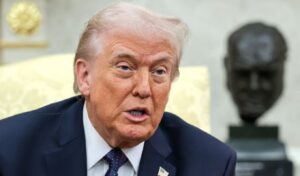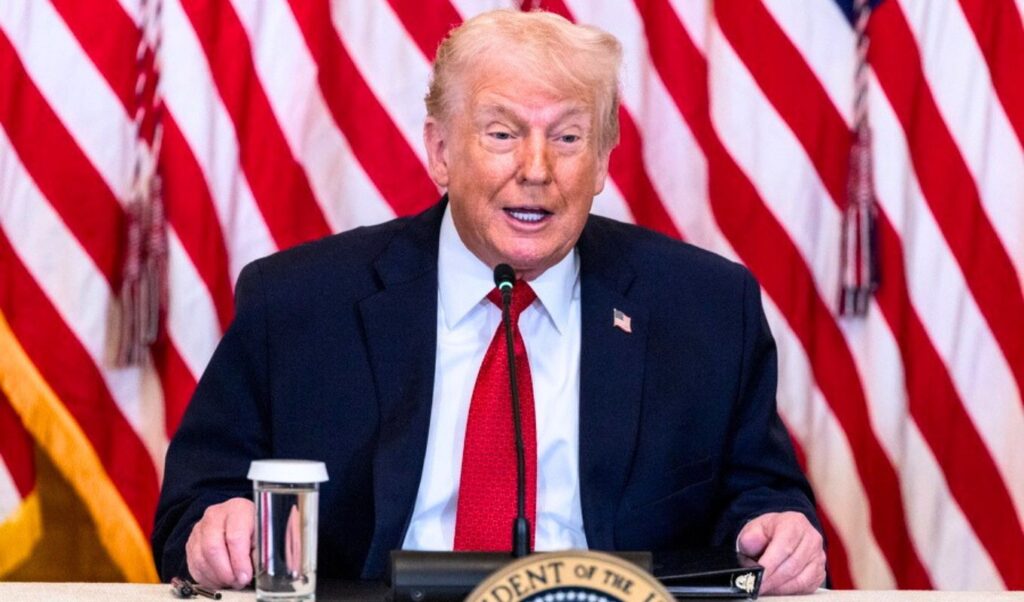
European circles appear to be growing concerned about the psychological state of Donald Trump following recent contacts with the American president. According to reports, Slovakia’s Prime Minister Robert Fico allegedly told his interlocutors on the sidelines of last week’s Summit that his meeting with Trump left him shocked by the image he presented.
Read: Trump – Erdogan phone call: Relations between Ankara – Washington, Syria and Gaza on the agenda
Politico: Fico used the word “dangerous” to describe the impression he got from Trump
According to a report by Politico, the Slovak Prime Minister used the word “dangerous” to describe the impression he got from US President Trump during their tete-a-tete at Trump’s Mar-a-Lago estate in Florida on January 17. Fico’s comments are particularly significant, as he is considered one of Europe’s most pro-Trump politicians. After the Mar-a-Lago meeting, he expressed support for Washington’s approach to the Russia-Ukraine war. A year ago, Fico spoke at the Conservative Political Action Conference (CPAC) and told Americans that “your president provides great service to Europe.”
White House spokeswoman Anna Kelly stated: “This is absolutely fake news from anonymous European diplomats trying to appear important. The Mar-a-Lago meeting was positive and productive.” Meanwhile, a senior US official described the Trump-Fico meeting as normal and pleasant, without awkward moments, with a relaxed and humorous atmosphere.
In contrast, European diplomats reported that Fico emerged “traumatized” from the meeting, describing Trump as “out of his mind” in private meetings, while concerns in the EU are generally growing about the American president’s unpredictable behavior.
However, it’s worth noting that these private concerns contrast with the public image Fico presented, who in his Facebook post spoke of a relationship of mutual respect and trust, focused on discussions about Ukraine and the EU crisis, and avoided references to controversial statements or actions by Trump.
Concerns about the US president’s health “are becoming an increasingly frequent topic of discussion at all levels,” said an EU official involved in political processes in Brussels and in contacts between European states, according to Politico’s report. Trump, 79, has repeatedly and vehemently denied suffering from any condition affecting his cognitive functions, stating this week to New York Magazine that he does not suffer from Alzheimer’s disease.
“I’m not going to do that, okay?”
One year after Donald Trump’s return to the White House, European governments continue to grapple with how to address his policies on a range of key issues, from the war in Ukraine and allegations of supporting far-right forces, to obstacles to free trade and the US stance toward European defense.
Earlier this month, Trump threatened to impose new tariffs on eight European countries, including France, Germany and the United Kingdom, claiming they are blocking his efforts to take control of Greenland – a semi-autonomous territory belonging to Denmark, an EU and NATO member. He didn’t even rule out acquiring it through force, something he later walked back.
In his speech in Davos, Switzerland, the US president demanded “immediate negotiations” for acquiring Greenland, while ruling out military intervention. “We probably won’t get anything, unless I decide to use overwhelming force and power, in which case we would be, frankly, unstoppable. But I’m not going to do that, okay?” he said characteristically.
After the speech, he claimed to have reached a framework agreement on Greenland with NATO Secretary General Mark Rutte and withdrew his threat, although details of the alleged agreement have not yet been made public. During the extraordinary European Council session last Thursday (22/01/2026), French President Emmanuel Macron and German Chancellor Friedrich Merz —the two dominant political figures of the EU— pointed out to their partners that, despite the climate of consensus, the European Union must reduce its dependence on the US in the security sector.
Speaking after the meeting, European Commission President Ursula von der Leyen implied that the leaders concluded that a “steady” but “non-escalating” stance toward Trump constitutes an effective strategy, which they should continue to follow.