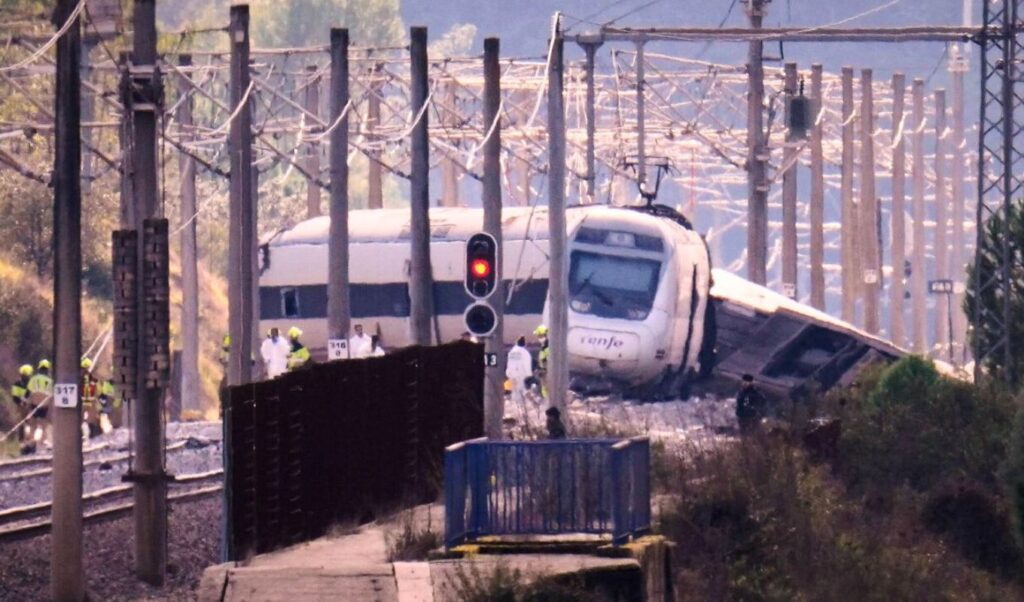
Significant evidence is emerging from the investigation into the causes of the high-speed train derailment that occurred on Sunday in Spain, claiming the lives of at least 39 people. According to Reuters, citing a source with knowledge of the initial findings, specialists discovered a broken connector on the railway tracks.
After the derailment, the train cars collided with a train traveling from the opposite direction, dragging it off the tracks and onto an adjacent slope. The incident is recorded as one of the most serious railway accidents to have occurred in Europe in recent decades.
The tragedy unfolded near the city of Adamuz, in the province of Córdoba, approximately 360 kilometers south of Madrid, on a section of the network where high-speed trains operate.
During the on-site inspection, technicians discovered wear in the connector that joins the individual sections of the rail, known as a fishplate. According to the same source, the findings show that this particular damage was not recent, but had existed for a significant period of time.
As noted, the defective connector had caused the creation of a gap between the rail sections, which was gradually expanding as trains continued to pass through that particular line.
The source, who requested anonymity due to the ongoing investigation, stated that technicians consider the broken connector a determining factor in accurately establishing the causes that led to the deadly accident.
The Spanish Railway Accident Investigation Commission (CIAF), which has taken over the comprehensive investigation, did not immediately respond to requests for comment. Similarly, the railway network manager Adif and the Spanish Ministry of Transport, which oversees CIAF, did not comment.
Renfe president Álvaro Fernández Heredia told radio station Cadena Ser that it is still too early to draw conclusions about the causes, noting however that the accident occurred under “strange conditions” and that the possibility of human error has almost been ruled out.
Spain train crash: Initial inspection findings
According to a source with knowledge of the investigation, the first cars of the train operated by Spanish company Iryo passed over the gap in the railway track, however the eighth and final car derailed, dragging along the seventh and sixth cars.
Iryo is a private railway operator, with the Italian state-controlled group Ferrovie dello Stato as its main shareholder.
The source referred to a photograph showing the gap in the rail, which is also included in material released by the Guardia Civil. The area has been marked with incident numbers by police and photographed by forensic experts and investigators.
Spanish Prime Minister Pedro Sánchez and Transport Minister Óscar Puente were among the officials who visited the accident site on Monday morning. Sánchez canceled his trip to the World Economic Forum in Davos following the accident.
Puente stated that the Iryo train was less than four years old and that the railway line had been completely renovated last May.
According to the same source, the train manufacturer, Hitachi Rail, conducted an inspection of the train on January 15 as part of routine maintenance, without detecting any anomalies.
The train is a Frecciarossa 1000 model, the same one used on Italy’s high-speed network.