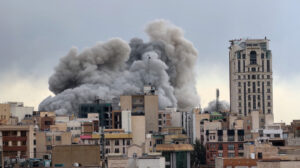
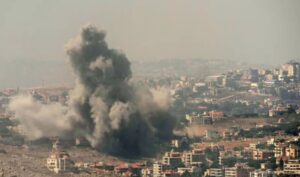
Images of the Iranian revolution of 1979 are repeating themselves in the streets of Tehran and the major cities of this Middle Eastern country. Large demonstrations against the Islamic Republic and the theocratic regime of Ali Khamenei, with hundreds of deaths, according to international networks. The situation remains chaotic with citizens watching in shock. Once again our neighborhood is in flames and Greece will be called to pay a share of the consequences.
Read: Violent repression in Iran: 598 dead, over 10,000 arrested – “US ready to help,” Trump wrote (Video)
Eftychidis tells parapolitika.gr: Any crisis in Iran will lead to closure of the Strait of Hormuz and destabilization of the region – What will happen with Turkey’s role
According to international relations expert Thrasos Eftychidis who spoke to parapolitika.gr “any crisis in Iran will lead to the closure of the Strait of Hormuz. It will lead to increases in oil prices, but also destabilization in the region is not ideal, since Iran borders Turkey and as you understand there will be an upgrade of Turkey’s role in the region.” The escalation of the uprising is intensifying while unpredictable dimensions are also taken by Donald Trump’s warning of possible military intervention in the country, with Tehran taking up the gauntlet and warning that it will attack American military bases in the Middle East if the United States launches a strike.
Patrick Theros tells parapolitika.gr about Iran: If America bombs and especially if more Iranians are killed by the bombings, it will help the mullahs stay in power
Former Greek-American diplomat Patrick Theros, who served in Middle Eastern countries, argues to parapolitika.gr that “if America wants the revolution to succeed and expel the theocratic regime, it must not remain uninvolved. If it intervenes, it may save the clerics as the rebels will rally against America. The Iranian is a patriot. He loves his country, it is a country like ours with 3,000 years and more of history. It’s one thing to overthrow the leader, another to overthrow the government and another to help a foreigner defeat them. It’s obvious that the clerics must go. They have destroyed Iran, they have destroyed it economically, politically, they have brought it into a very difficult position with all its neighbors. If America bombs and especially if more Iranians are killed by the bombings, it will help the mullahs stay in power.” And if the US is considering the possibility of military intervention, Iran seems ready to retaliate, as happened last June during the Israeli-Iranian military confrontation, with an attack on the Al Udeid air base in Qatar, following the dropping of heavy bombs by the US on three Iranian nuclear facilities. According to Mr. Theros, the way Iran can damage America and globally is to close the Strait of Hormuz and hit the exports of other Persian Gulf countries. To hit, let’s say, all the ports from which oil leaves, all the oil and natural gas facilities in the Persian Gulf. The Iranians say that “if I can’t export, no one will be able to export.” The Iranians say it and the opposing countries believe it. Right now I’m sure that all the Persian Gulf countries are begging Trump not to intervene.”
“Difficult equation”
International relations expert Thrasos Eftychidis also considers that an American military operation is difficult. As he tells parapolitika.gr “what is happening in Iran is a difficult equation. Essentially, an intervention would be possible if the demonstrators – in quotes demonstrators, because in many cases agents of other powers also act – managed to control some city with an airport, so that the Americans could intervene. Otherwise, the regime will not fall through bombings. The Americans understand this too, while the situation is getting continuously more difficult. At this moment it seems that such a situation is forming that can really facilitate revenge from the Islamic Revolution and there are already some who are working on plans for an intervention in Iran. It won’t be an easy story. Despite the volume of demonstrators, there is also a large mass that supports the regime, there are the Revolutionary Guards who don’t seem willing to change sides. Therefore, in any case, an intervention in Iran will lead, if nothing else, to tremendous bloodshed.”
One of the most significant difficulties, according to analysts, is that at this moment there are not many reliable successor situations. The choice of Reza Pahlavi who maintains excellent relations with United States circles (who are promoting his return) although it seems the most likely, does not appear to have support in Iran. For many Iranians, the memories from the Shah’s period of governance and the ways he handled the population are still fresh. The coming days appear to be an unsolvable equation.