A seismic shift in the political landscape of Iran is being observed recently, with accumulated social anger and suppressed feelings seeking release, during a period when the country, where a deeply theocratic regime has been established, shows signs reminiscent of even the prelude to a social revolution. After all, this year has demonstrated destabilizing conditions for the regime of Ayatollah Ali Khamenei, initially during the 12-day war between Israel and Iran, then with the US attack on Iranian nuclear facilities, and now with enraged protesters seeking a new era after a prolonged period of political, economic and social exhaustion. How difficult is it to ultimately “uproot” the Khamenei network?
A short time ago, perhaps even a year ago, some analysts would have answered from difficult to impossible, but recent developments could be characterized – if nothing else – as disruptive beyond rapid-fire as they constitute direct challenges to the entire power network of the Iranian country. In a period of increased challenges and reshuffles in the Middle East, Iran appears to have entered a transition trajectory, all this after developments in Syria with the fall of Bashar al-Assad, which for many was equivalent to liberation, and after the new realities that were formed in Gaza. Some analysts even maintain that citizens are “grasping” history from 1979, when the revolution created facts and a normalcy that was to bring – in many cases – darkness.
Iran: What lies behind the demonstrations
What exactly is happening in Iran and why have enraged protesters poured into the streets? The wave of protest rose less than two weeks ago with shopkeepers, known in Iran as the backbone of support for the Islamic Republic, appearing outraged by the collapse of the currency. Later, students also followed the path of protest, coming out to demonstrate in various cities across the country.
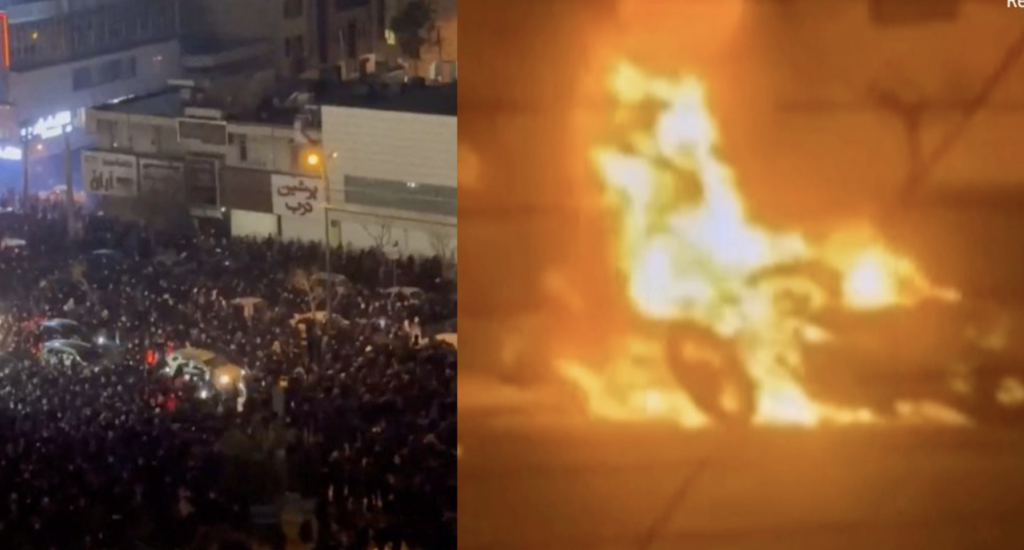
As revealed in footage from videos circulating around the world, the current protests are the loudest and most massive since 2022, with anger not only related to economic issues. The protesters, specifically, are now shouting slogans against the entire clerical leadership and Supreme Leader Khamenei himself, which constitutes a direct challenge to the theocratic regime.
Iran has faced many problems in recent years, something that has sharpened spirits: a combination specifically of economic crisis, political repression and social unrest, as well as international tensions due to its nuclear and ballistic missile programs.
Iran’s leadership has habitually acted with repressive methods against protesters for many years, with security forces ready to act and authorities able to move quickly to close banks, schools and public bodies, while strictly controlling the flow of news from state media.
Internet shutdown
Iranian officials increasingly blame “foreign enemies,” as they call them, especially the US and Israel, as they try to contain the unrest.
With the internet shutdown, the main narrative coming out of Iran at the moment comes from state media and officials. Many protesters in Iran, however, amid the turmoil and with the need for political overthrow now being clearly articulated, are calling for the return of Reza Pahlavi, the exiled son of Iran’s last Shah. But who is Reza Pahlavi and how much support does he have?
The possibility of Reza Pahlavi’s return
When the 1979 revolution overthrew his father’s monarchy, Pahlavi and his family were left stateless, but now, at age 65, he seeks to once again play a role in shaping his country’s future.
From his home in Washington, he called on the people of Iran to take to the streets and previously stated that he was ready to help lead a transitional government in case of the collapse of the Islamic Republic.
Since then, he has described a 100-day plan for an interim government, telling journalists: “This is not about restoring the past… this is about ensuring a democratic future for all Iranians.”
During his years in exile, Pahlavi has made many attempts to create opposition coalitions. However, most of them have faced internal disagreements and limited resonance within Iran.
His supporters see him as the only opposition figure with recognition and long-term commitment to peaceful change, while his critics say he remains worryingly dependent on foreign support.
While the Iranian government presents him as a threat but protesters at the same time chant slogans in his favor, it is impossible to calculate his real support without an open political space and reliable polls.
How these demonstrations differ
In the past, it should be noted, most mass protests took place outside the capital, Tehran, but this time they are also taking place in Tehran.
If Tehran residents take to the streets en masse, this will encourage the rest of the country’s population to do the same and this could by itself constitute a real turning point.
Iranian human rights organizations report, meanwhile, that more than 40 people were killed during the demonstrations, a fact that shocks global public opinion.
Why citizens are demonstrating
US-led sanctions have paralyzed Iran’s economy. The value of the Iranian currency has fallen sharply against the US dollar and this has created an unsustainable situation for many.
Also, quite a few appear dissatisfied with social restrictions and apparently there is deep anger about political impunity, including corruption.
There are, therefore, many different reasons why citizens are taking to the streets and it seems that many of them have nothing to lose.
The Iranian government has cut off millions of Iranians from communication with their families, both inside and outside the country.
At the same time, recent developments in the Middle East have reshaped the political environment for Tehran, plunging it into decline. Simply put, Iran now has fewer allies it can rely on as well as fewer channels for transferring oil revenues abroad.
Protests are sweeping across Iran tonight with more cities joining by the minute despite violent regime crackdown. Videos are of the protests in Astara, Rasht, Khorramdarreh (Zanjan) and Mehran (Ilam) – people chant “we don’t want a clerical state!”#IranProtests#اعتراضات_سراسری pic.twitter.com/x708VX7mQ6
— Ali Javanmardi (@Javanmardi75) January 7, 2026
Protests over soaring inflation in Iran have spiraled into the biggest unrest in three years, with demonstrations reported in every province and rights groups documenting dozens of deaths https://t.co/n1EFuZ7rMf pic.twitter.com/SL3cf5aW8n
— Reuters (@Reuters) January 9, 2026
When checking vids of #IranProtests bear in mind the ppl protesting are facing live bullets & shotguns from regime’s forces. If arrested, they risk torture, & execution by hanging in gallows.
(a protestor holding @PahlaviReza‘s portrait – Tehran, tonight)pic.twitter.com/ezCJj9OqgV
— Hadi Nili (@HadiNili) January 10, 2026
🇮🇷 #Iran: More intense footage from the ongoing chaos across the country.
1. An Iranian protester throws a Molotov cocktail at a government building in the Sattar Khan area of Tehran.
2. A police station on Zahedi Boulevard in Tehran was overrun by protesters and burned to the… pic.twitter.com/jtxlaMBwQw
— POPULAR FRONT (@PopularFront_) January 10, 2026
Burning headscarves in Tehran tonight.
Iranians are also setting fire to possessions of the regime forces, including cars, mosques, and their homes.
They are sending Khamenei a message.
But they are also trying to send the world a message.
Please help spread it. pic.twitter.com/pTIrAMzVFu
— dahlia kurtz ✡︎ דליה קורץ (@DahliaKurtz) January 10, 2026
CIVIL UNREST: Cars burn and protests erupt nationwide as Iran plunges into a digital blackout.
With demonstrations spreading to every province and 44 reported dead, fires have raged in the streets as the Iranian regime moves to stifle dissent by cutting off internet and phone… pic.twitter.com/lKhCyqiLn0
— Fox News (@FoxNews) January 9, 2026