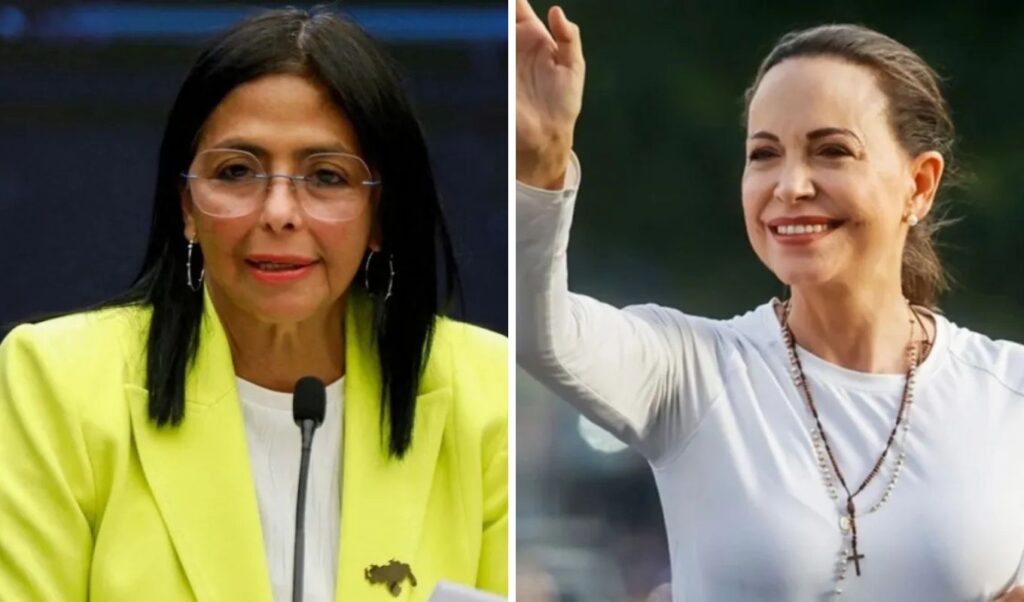
With the choice of Delcy Rodríguez to lead as transitional president of Venezuela, in the aftermath of Nicolás Maduro’s arrest, the BBC addresses in its analysis, attempting to answer the reasons why Washington decided to support the “daughter of a former Marxist rebel and deputy of the overthrown dictator Nicolás Maduro,” instead of opposition leader María Corina Machado, who is considered by the West to have won the 2024 presidential elections.
Among the many questions that dominate from the dramatic events of last weekend in Caracas – and there are many – one that doesn’t stop being of concern is the one regarding the woman with glasses who now leads what American officials call the “interim authorities” of Venezuela. Why Delcy? What is it that has caught the attention of the Trump administration about Delcy Rodríguez, daughter of a former Marxist rebel and deputy of the overthrown dictator Nicolás Maduro?
And why did Washington decide to support a declared “Chavista” revolutionary to remain in power, instead of supporting the opposition leader, María Corina Machado, whose opposition movement is widely believed to have won the 2024 presidential elections? The answer to why the US decided to keep a “declared Chavista” in power, according to a former US ambassador to Venezuela approached by the BBC, is simple.
Venezuela: “They have preferred stability over democracy”
“They have preferred stability over democracy,” says Charles Shapiro, who served as George Bush’s ambassador to Caracas from 2002 to 2004. “They maintained the dictatorial regime without the dictator. His thugs are still there.” “I think it’s extremely dangerous.” However, the alternative solution, involving radical regime change and supporting Machado’s opposition movement, would entail other risks, such as potential internal disputes among opposition members and the alienation of Venezuelans – perhaps up to 30% – who voted for Maduro.
In the “dramatic” press conference he gave on Saturday morning, US President Trump shocked many observers when he characterized Nobel Peace Prize holder Machado as “not respected” within Venezuela, while describing Rodríguez as “gracious.” “I was particularly surprised when I heard President Trump exclude María Corina Machado,” Kevin Whitaker, former deputy head of the US embassy mission in Caracas, told the BBC. “Her movement was elected by a large majority… and so, by excluding Machado, the entire movement was essentially excluded.” The speed and apparent ease with which Maduro was removed and Rodríguez took over led some observers to assume that the former vice president might have been aware of the plan.
“The high-level sources for the Venezuela operation could be Delcy Rodríguez herself”
“I think it’s very telling that we attacked Maduro and the vice president survived,” former CIA officer Lindsey Moran tells the British outlet. “It’s obvious there were high-level sources. My immediate guess was that these high-level sources were in the vice president’s office, if not the vice president herself.”
However, Phil Gunson, senior analyst at the International Crisis Group living in Caracas, argues to the British outlet that the conspiracy theory doesn’t hold up to careful examination, given that enormous power still lies in the hands of Venezuela’s Defense Minister, General Vladimir Padrino Lopez, and hardline Interior Minister Diosdado Cabello, both loyal allies of Maduro.
“Why betray Maduro?” – The warning report for Washington and “regime change” in Venezuela
“Why betray Maduro, leaving herself defenseless, internally, against those who actually control the weapons,” says Gunson. Instead, the decision to support Rodríguez came after warnings that elevating Machado could lead to dangerous levels of instability.
In October, an ICG report warned that “Washington must be careful about regime change.” “The risks of violence in any post-Maduro scenario should not be underestimated,” the report warned, noting that elements of the security forces could launch a guerrilla war against new authorities. “We warned government people that this wouldn’t work,” says Gunson. “Violent chaos will prevail, it will be your mistake and you will take responsibility.”
On Monday, the Wall Street Journal reported the existence of a classified US intelligence assessment that reached the same conclusions and decided that Maduro regime members, including Rodríguez, were better positioned to lead an interim government.
The White House has not publicly commented on the report, but made it clear it intends to work with Rodríguez in the immediate future.
“This suggests a harsh realism on the part of the Trump administration,” Henry Ziemer, fellow at the Americas Program at Washington’s Center for Strategic and International Studies, tells the BBC. However, the challenges, he says, have just begun.
“Arresting Maduro was the easy part. The broader reconstruction of Venezuela, the goals for oil, drugs and democracy… will take much more time to implement. For now, however, Rodríguez appears to be someone the Trump administration feels it can work with.” “She has made some economic reforms,” says Gunson. “She has realized the need for economic opening and is not opposed to the idea of foreign capital return.”
Ziemer agrees that Rodríguez may not struggle to execute Washington’s orders regarding welcoming American oil companies, offering greater cooperation in drug fighting, and even weakening Venezuela’s relations with Cuba, China and Russia, especially if this means gradual lifting of American sanctions.
“I think she can achieve this,” he says. “But if the US demands real progress toward a democratic transition, this becomes much more difficult.” For now, this doesn’t appear to be high on Washington’s priority list.
In statements to the press on Wednesday, Foreign Secretary Marco Rubio spoke of a three-stage plan for Venezuela, starting with stabilizing the country and trading 30-50 million barrels of oil under US oversight. The plan would lead to what Rubio called a “reconciliation process,” including amnesty for opposition forces, release of political prisoners, and rebuilding civil society.
“The third phase, of course, will be the transition,” he said, without giving more details.
What Trump said about elections in Venezuela
Article 233 of Venezuela’s Constitution provides for new elections within 30 days from when the president becomes “permanently unable to perform his duties,” which seems to apply when Maduro is in a New York jail awaiting trial.
However, in his NBC News interview on Monday, President Trump stated that no elections are planned. “We must first fix the situation in the country,” he said. “You can’t have elections.”
Gunson says Washington’s decision not to pursue regime change in the short term may be logical, but the absence of medium-term or long-term prospects is disappointing. “Trump may gain something from this, but Venezuelans don’t,” he says. “Ordinary Venezuelans pay the price as always.”
With the Trump administration talking about prospects for international oil companies to reinvest in Venezuela’s corrupt and dying oil infrastructure, Gunson says reality may be more complex. “Nobody will come here with the tens of billions of dollars required… for the recovery process to begin, if the government is illegitimate and there’s no rule of law,” he says.
Delcy Rodríguez: Trump’s dedazo
When former Venezuelan leader Hugo Chávez appointed Nicolás Maduro as his successor, shortly before his death in 2013, this move was described as Chávez’s “dedazo,” a Spanish slang expression meaning “pointing with the finger,” a personal anointing that bypasses usual democratic process.
Ambassador Shapiro sees a parallel situation with Delcy Rodríguez’s rise to power. “This is Trump’s dedazo,” he says.