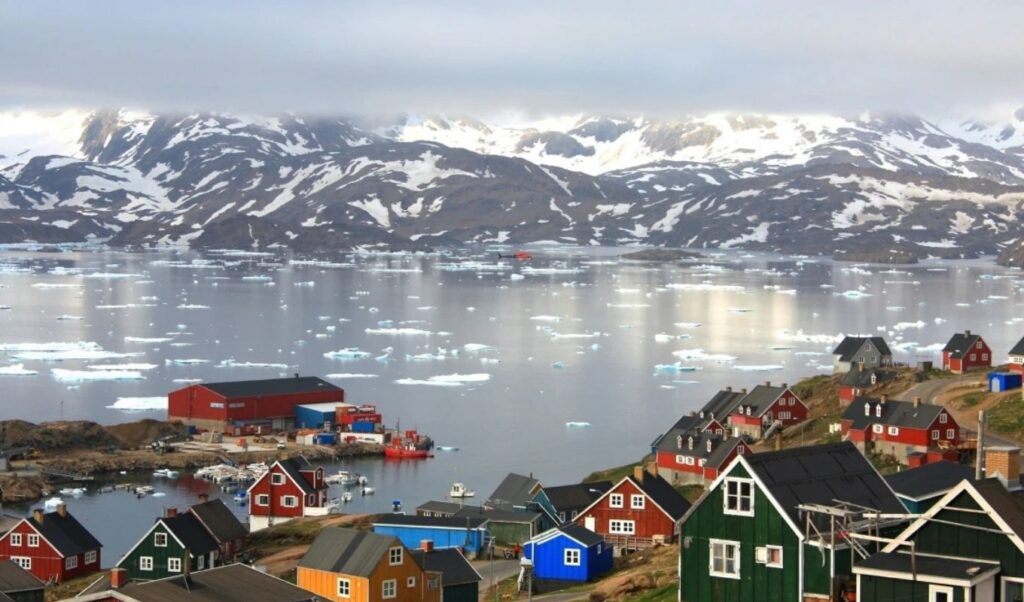
The autonomous island of the Arctic circle, Greenland, has been in Donald Trump’s crosshairs since the very beginning of his second presidency. While the goal of annexing it to the United States may seem unrealistic to most, the recent public statements by the American president leave little room for doubt about his intentions. Yesterday, his close associate Steven Miller declared quite clearly to CNN that Greenland rightfully belongs to the United States and no country “is going to militarily oppose the United States over Greenland’s future.”
Danish Prime Minister Mette Frederiksen appeared to take Trump’s intentions very seriously and sent yet another message across the Atlantic that “the Kingdom of Denmark and Greenland have repeatedly stated that they do not wish to become part of the United States,” while warning President Trump that annexing Greenland would not be an easy matter: “If the US chooses to attack another NATO country, then everything ‘stops’ including NATO and, by extension, the security that has been built since the end of World War II,” the Danish prime minister conveyed to both America and Europe.
Klapsis to parapolitika.gr on Greenland: We’re talking about a blatant violation of sovereignty, which is moreover announced in advance
International Relations Professor Antonis Klapsis estimates to parapolitika.gr that Trump’s threats cannot be implemented, especially unilaterally, because this would presuppose a direct confrontation with Denmark and by extension with almost the entire Western world. As he says, “I don’t think there’s a country in the Western world – perhaps there are one or two exceptions – that would applaud such an action. Because we’re talking about a violation of sovereignty, which is blatant. And what’s particularly striking is that it’s being anticipated, announced in advance.”
However, in the last two days President Trump mentioned in a series of interviews, either in “The Atlantic” magazine or in conversations with journalists that “we need Greenland, absolutely,” invoking national security reasons as well.
Within this developing environment, the leaders of France, Germany, the United Kingdom, Italy, Spain, Poland and of course Denmark issued a statement against Trump’s declarations, emphasizing that only Denmark and Greenland decide on matters concerning them. What room for reaction do EU member countries have, however, as they appear increasingly unable to impose themselves against Trump’s ambitions and his policies?
“It seems very difficult for Trump to actually do this”
According to Mr. Klapsis, the European Union cannot but react: “I think it will react, although Greenland is technically not EU territory, it belongs to Denmark but not to the European Union. It has a special status. But in any case, because it would be directed against a member state of the European Union, I assume the reaction will be more decisive, without this meaning, to avoid any illusions, that the European Union has a mechanism to be able to impose its view militarily. It has neither a unified army nor a unified foreign policy, so it won’t be as simple as it sounds. However, it seems very difficult for Trump to actually do this. He’s somewhat unpredictable.” Nevertheless, President Trump, regardless of whether he will implement his plans, appears to have succeeded in imposing the doctrine of power in international diplomacy. As his close associate Steven Miller bluntly stated: “We live in a world, in the real world… that is governed by power, that is governed by violence, that is governed by authority. This is the iron law of the world since the beginning of History,” he said, implying that for the Trump administration, the rules of International Law have no correspondence in the new order of things.
According to International Relations Professor Antonis Klapsis, it is now revealed that we have entered a new phase of the international system. “A phase where rules will matter less and less, power will matter more and more. Not that in the past we spoke only with rules and power had gone for a walk, but there was an appearance of legitimacy in most cases at least.”