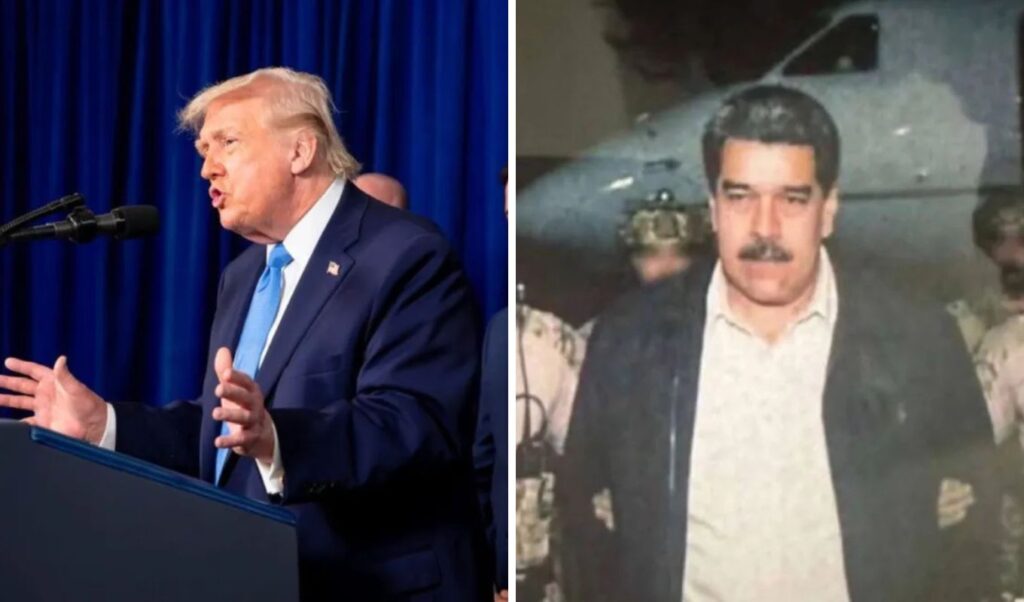
Donald Trump claims that the United States wants to “govern” Venezuela following the capture of President Nicolás Maduro. However, without military presence on the ground, the American plan that seems to be emerging relies on working with the existing government.
In his repeated statements following the American military operation, Trump returns to the idea that the US intends to temporarily “govern” the country of 30 million inhabitants, which faces a deeply devastated economy.
Nevertheless, Washington appears minimally to completely unprepared to take control on such a scale: the American embassy in Caracas remains closed, there is no known American military presence on the ground, while the American president himself has limited himself to vague references that his government “will take action.” Even the invasion of Iraq in 2003 – which cost George W. Bush’s US intense international criticism – had at least been planned more systematically, with the creation of a Coalition Provisional Authority that would function as a transitional government.
US: “We will control Venezuela’s politics”
For now, Donald Trump says Washington is working with Delcy Rodríguez, the former vice president of Nicolás Maduro who was sworn in yesterday Monday as interim president by the country’s institutions, threatening her that she will have a “worse” fate if she doesn’t comply with American demands, which focus on US access to Venezuela’s oil reserves.
“It’s not that we’re going to govern – we’re going to control the politics” of Venezuela, US Secretary of State Marco Rubio clarified on Sunday on NBC. The Cuban-origin US Foreign Minister has long considered Nicolás Maduro’s power illegitimate and supports the opposition in Venezuela, which claims it won the 2024 presidential elections – and which Washington recognized as the winner at the end of Joe Biden’s term.
However, in the hours following the spectacular American intervention, Donald Trump rejected María Corina Machado, an opposition figure and recent Nobel Peace Prize winner. “She has neither the necessary support nor the respect in her country,” he assessed.
“The only solution for Machado to be installed in the presidential palace and govern the country would be a massive American military presence, which would be very bloody, would have little chance of survival, and would create enormous domestic political problems for Trump,” one of whose arguments during the electoral campaign was a non-interventionist stance, says Mark Jones, Venezuela specialist at Rice University in Texas.
Delcy Rodríguez, who was in contact with the United States during the American attack according to journalistic information, initially delivered an aggressive speech on Saturday calling Nicolás Maduro the “only president” of a Venezuela ready to “defend itself.” Her tone changed quickly — on Sunday she spoke of a “cooperation agenda.”
“On one hand, she must appear outraged by what happened. At the same time, she must appear open to promoting pro-American policies that will be very difficult for her regime to accept, since for 27 years it considered the United States a sworn enemy,” explains Ryan Berg, researcher at the Centre for Strategic and International Studies in Washington.
But the move won’t be easy, predicts the former second-in-command of the American embassy in Caracas, before it closed in 2019.
Delcy Rodríguez “benefits from Trump and Rubio’s offer and says ‘sure, we’ll cooperate’,” but she’s only doing it “to buy time and consolidate her position” domestically, Brian Naranjo tells the French Press Agency, estimating that she won’t be Washington’s “puppet.”
Because, to control Venezuela as it hopes, Washington will also need to secure support from other important figures in Maduro’s regime like Vladimir Padrino López, who controls the military, Mark Jones emphasizes.
Some of the American demands, such as those related to drug trafficking, may be easy for Delcy Rodríguez to satisfy. Others, like breaking with Cuba, may be much more difficult to accept for a government rooted in the tradition of leftist former president Hugo Chávez.
“This group will resist with all its strength because the idea that Venezuela will become a state subservient to the US is the opposite of the Bolivarian revolution,” summarizes the Latin American country specialist.