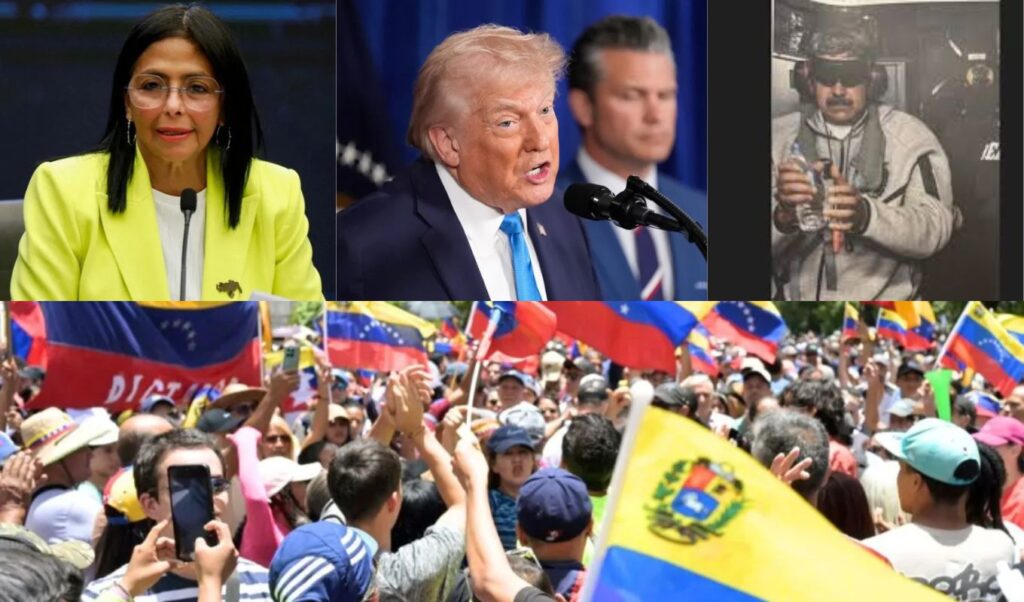
South America resembles a minefield with the political upheaval in Venezuela triggering associations and stirring up stories of past invasions, as the international community’s attention automatically shifts from the chronicle of a foretold rupture to a new era in the Bolivarian Republic following the arrest and removal of Nicolás Maduro. In Caracas, the picture is taking shape differently, based on the overthrow after a series of years, with Delcy Rodríguez, until recently vice president and oil minister in Venezuela, taking over as interim president of the country. At the same time, the US states that their move does not equate to war in Venezuela and that the interim president, who is supported by Venezuela’s military, will pay a heavy price if she does not do “what is right.” With the next day in Venezuela remaining uncertain and comparisons of this American operation with the Iraq invasion of 2003 becoming increasingly frequent in recent hours, US officials primarily reject this correlation and focus on the fact that Venezuela must transition to a regime of democratic normalcy and that the war against narco-terrorism continues. Meanwhile, Maduro and his wife from the detention center in New York where they were transferred, with photos from the arrest circulating worldwide, appear before American Justice on Monday, with the charges against them relating to criminal-terrorist organization and mass drug trafficking.
Beyond the initial reading and the war against drug cartels, however, the major issue is what Trump really seeks and what Venezuela’s role is regarding oil reserves. It is still not clear who would be acceptable to the US to govern Venezuela and bridge the otherwise destroyed diplomatic relations. Another important question is how Latin American countries will react, what the future consequences will be, and what the impact of the regime change in Venezuela will be on oil prices.
Venezuela: The next day and oil prices
It should be noted that oil prices have been falling for a year, recording a decline of about 20% in 2025, as global demand decreased due to economic slowdowns, leading to oversupply. It is likely that the prospect of a peace agreement between Russia and Ukraine will have a greater impact on prices than the promise of more Venezuelan crude oil in the coming decades.
Today, however, Venezuela produces less than one million barrels per day, which are almost entirely exported to China and the United States, which have granted oil company Chevron a license to operate in the country. Venezuela’s oil infrastructure has been degraded due to lack of investment and there has been a parallel exodus of specialized personnel from the domestic industry, all under Maduro’s leadership. Donald Trump states that American oil companies will spend billions to reverse this declining picture, but the course correction will take time.
It is worth noting, however, that according to International Energy Agency data, Venezuela’s subsoil contained about 303 billion barrels in 2024, representing approximately 19.4% of global reserves.
Previous US interventions
Looking back in time, the case of US intervention in Venezuela recalls the Guatemala case when President Árbenz, who was labeled a communist, was eventually overthrown in 1954 by right-wing rebels supported by the CIA.
Returning to the present, Delcy Rodríguez, Venezuela’s new president, has connected the American operation with accusatory language about “American imperialism.”
The US president, for his part, states that the US will “administer” Venezuela “until we can achieve a safe, proper and prudent transition,” something that encounters reactions not only from Latin American countries and China but also concerns from Europe as well as Democratic opposition, with Kamala Harris indirectly but clearly speaking of violent handling.
How the war with Maduro began
The interventions in Venezuela come after a US pressure campaign against the Maduro government, which the Trump administration accuses of flooding the US with drugs and gang members.
Trump specifically accused Nicolás Maduro for some time of the influx of hundreds of thousands of migrants from Venezuela to the US. In fact, Trump accused Maduro of “emptying prisons and psychiatric hospitals” and “forcing” prisoners to migrate to the US.
Trump has also focused on combating the influx of drugs – especially fentanyl and cocaine – into the US. He has designated two Venezuelan criminal groups – Tren de Aragua and Cartel de los Soles – as Foreign Terrorist Organizations (FTO) and has claimed that the latter is led by Maduro himself.
Analysts have pointed out that Cartel de los Soles is not a group with specific hierarchy, but a term used to describe corrupt officials who have allowed cocaine trafficking through Venezuela.
Trump also recently doubled the reward for information leading to Maduro’s arrest and announced he would designate the Maduro government as terrorist.
Maduro – for his part – vehemently denied being a cartel leader and accused the US of using the “war on drugs” as an excuse to try to overthrow him and get a share of Venezuela’s vast oil reserves.
How pressures on Venezuela escalated
Since the start of Trump’s second term last January, pressure on the Maduro government has intensified. In September, US forces began targeting ships they accused of carrying drugs from South America to the US. Since then, more than 30 attacks on such ships have been carried out in the Caribbean and Pacific, resulting in the deaths of more than 110 people.
The Trump administration argues it is engaged in a non-international armed conflict with alleged drug traffickers, whom it accuses of waging illegal war against the US.
In October, Trump said he had authorized the CIA to conduct covert operations inside Venezuela. He also threatened ground attacks against those he described as “narco-terrorists.”
He reported that the first of these attacks had been carried out on December 24, without giving more details, simply stating it targeted a “port area” where ships allegedly carrying drugs were being loaded.
Before Maduro’s arrest, Trump repeatedly stated that the now-deposed president “is not a friend of the US” and that “it would be smart of him to leave.”
He also increased economic pressure on Maduro, declaring a “complete naval blockade” on all oil tankers entering and leaving Venezuela that have been subject to sanctions. Oil, it should be noted, is the main source of foreign income for the Maduro government.
The US has also deployed a massive military force in the Caribbean, aimed at stopping the flow of fentanyl and cocaine to the US.
On December 15, Trump signed an executive order characterizing fentanyl as a “weapon of mass destruction,” arguing it is “closer to a chemical weapon than a drug.”
However, fentanyl is mainly produced in Mexico and reaches the US almost exclusively through land routes from the southern border.
Venezuela is not cited as a source country for fentanyl smuggled into the US.
The rise and fall of Maduro
Nicolás Maduro rose to power under the leadership of former leftist and deceased president Hugo Chávez and the United Socialist Party of Venezuela (PSUV).
Maduro, a former bus driver and union leader, succeeded Chávez in the presidency after the latter’s death in 2013.
During the 26 years that Chávez and Maduro were in power, their party had gained control of key institutions, such as the National Assembly, much of the judiciary, and the electoral commission.
In 2024, Maduro was declared the winner of presidential elections, although results gathered by the opposition showed that their candidate, Edmundo González, had won by a large margin.
González had replaced the main opposition leader, María Corina Machado, in the elections after she was banned from running.
At the present time, however, Venezuela resembles quicksand, with the person who will officially assume the presidency and be connected to the transition to the democratic era remaining a puzzle, while the possible escalation of reactions to Maduro’s removal causes terror in the global community, as does the trajectory of oil prices raising concerns.