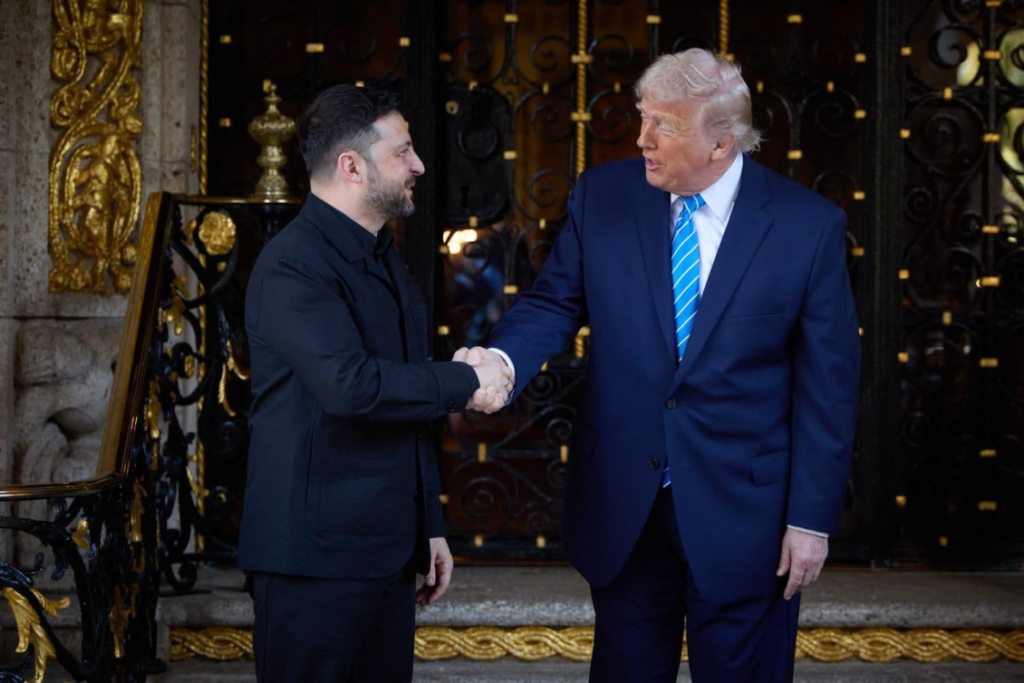
The critical moves in the Ukrainian diplomatic “game” appear to be making progress. The proceedings in Florida and the culmination of diplomatic efforts to defuse the war crisis in Ukraine did not leave a bittersweet taste this time after the tête-à-tête conducted at the leadership level. The political thriller of recent days, which culminated in Palm Beach, seems to have receded after bilateral contacts between the US and Ukrainian leaders, Donald Trump and Volodymyr Zelensky, describing the meeting as “great” and “fantastic.” Moreover, the Ukrainian side indicated that the 20-point plan has been almost fully agreed upon, at 90%, with the US president stating that the security guarantees Ukraine seeks are close to 95% implementation. However, as American leadership acknowledged, certain “red lines,” such as territorial issues, remain on the table and continue to undermine the climate between the US-Russia-Ukraine triangle, reminding us how fragile peace plans can be.
In the Kremlin camp, it has become clear that Russia has not yet agreed to any peace plan, nor to holding a referendum, something Ukraine seeks, saying it is crucial for resolving the territorial issue. Although Trump is intensifying pressure on his Russian counterpart, Vladimir Putin, and insists the latter desires peace despite Russian missile attacks on Kyiv, nothing yet predicts when and how any peace treaty implementation will begin. As international media report, Russia’s stance and the critical issues of territories and security guarantees could prove to be time bombs in the diplomatic efforts’ agenda.
It should be noted that Trump recently appeared angry regarding Ukraine and Russia’s delays in peace efforts. However, what will become of the eastern part of Donetsk remains unclear, with the US planning to turn the region into a demilitarized economic trading zone. Kyiv, for its part, emphasizes that such a thing could only happen if Russia withdrew from the region, which would require a referendum. Trump, however, indicates that Putin is not allowing peace so Ukrainians can hold a referendum on territorial decisions.
Trump & Zelensky meeting: The future of territories and possible Ukraine visit
The American president has described Donbas as the mother of all battles, as an unsolved issue, yet has noted that improvement has been made toward reaching an agreement. Zelensky insists that differences with Russia remain, while Trump notes that Russia will help in a Ukraine reconstruction plan, adding that he intends to visit Ukraine after reaching an agreement.
The leadership-level meeting took place at a critically important moment when Russia had intensified attacks on energy infrastructure, caused chaos in Kyiv and surrounding areas with missile strikes, while Ukraine had also delivered significant strikes in neutral waters during the previous period. It’s worth noting that compared to the two previous meetings between US and Ukrainian leaders, this contact seemed to “deliver” more tangible results.
Meanwhile, Russia controls all of Crimea, which it annexed in 2014, about 90% of Donbas, 75% of Zaporizhzhia and Kherson regions, and parts of Kharkiv, Sumy, Mykolaiv, and Dnipropetrovsk regions.
Timeline of Trump-Zelensky meeting and diplomatic contacts – What preceded it
Entering the meeting, Donald Trump assured that Ukraine would receive “strong” security guarantees in case of a peace plan to end the war that began almost four years ago with Russia’s invasion of Ukraine. “There will be security guarantees. These will be strong. And European countries are heavily involved,” the US president said, welcoming around 8:30 PM Greek time his Ukrainian counterpart, Volodymyr Zelensky, at his Florida residence to discuss the plan. “I don’t have a deadline. You know what my deadline is? To end the war,” he added, responding to journalists’ questions, stating that negotiations are in their “final phase” and that both Zelensky and Russian President Vladimir Putin are taking the peace plan “seriously.” “I believe both the Ukrainian and Russian presidents want to achieve an agreement,” the American president said.
Zelensky’s “message” to Washington
Earlier, Zelensky announced that he had a “detailed” phone conversation with Keir Starmer, noting that a critical factor in ending the Russian invasion is the stance that Kyiv’s partners will maintain, “preparing the ground” for the meeting with Donald Trump. “These are some of the most intense – in the diplomatic field – days of the year and much can be resolved before the new year, and we’re doing everything toward this direction, but it depends on our partners whether significant decisions will emerge. That is, our allies who help Ukraine and those who pressure Moscow, so Russians feel the consequences of their own aggression,” he said initially. “It’s important that sanctions against Russia work, that all forms of political pressure for its aggression be applied, that Ukraine receives anti-aircraft missiles and that we all finalize the forms of steps that will end this war and guarantee our security,” the Ukrainian president emphasized.
The call to Putin
Before the meeting with Zelensky, Donald Trump announced via social media that he had a phone conversation with his Russian counterpart, Vladimir Putin. “Just had a good and productive phone conversation with Vladimir Putin,” the American president characteristically stated. Washington and Moscow “share the view” that a temporary ceasefire proposed by the EU and Ukraine would only result in “prolonging the war,” stated Kremlin foreign policy advisor Yuri Ushakov. Donald Trump and Vladimir Putin had a phone conversation in the afternoon, almost an hour before the meeting with Volodymyr Zelensky. The phone conversation took place in a “friendly atmosphere” and lasted 1 hour and 15 minutes, Ushakov emphasized.