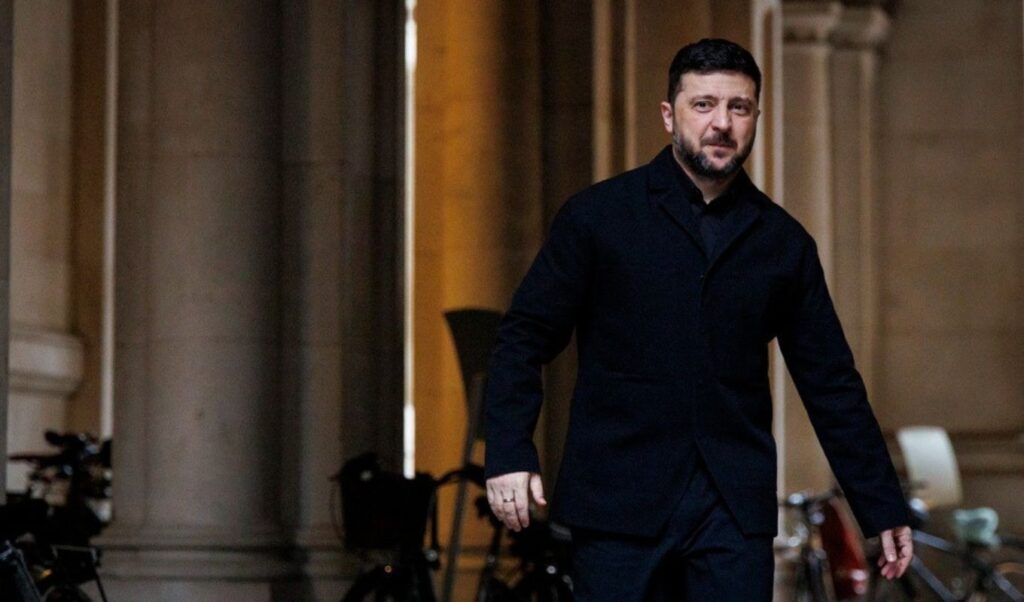
Ukrainian President Volodymyr Zelensky appears to be backed against the wall, with Donald Trump’s message (in his Politico interview) regarding holding elections and questioning the existence of democracy in the country resonating strongly in Kyiv. A timeline of 60-90 days has been put on the table, alongside (once again) references to security guarantees.
As The Guardian reminds us, Zelensky’s term expired in May of last year, but Ukraine’s Constitution prohibits holding elections during wartime. Even opposition politicians emphasize that security conditions do not allow elections at this time. “It would only cause damage,” stated MP Serhii Rakhmanin from the Holos party.
Zelensky emphasized that the two main issues are the ability to vote for soldiers, millions of displaced people, and those living in occupied territories, as well as the legal possibility of holding elections under martial law. He has reached out to allies for advice on election security and to parliamentarians for possible legislative amendments.
The Ukrainian president returned from a tour of European capitals, intensifying consultations to develop a counter-proposal to the peace plan currently on the table, aiming to improve terms for Kyiv as much as possible.
Zaluzhny waiting in the wings
In any case, if elections are held and he decides to “enter the race,” former general and ambassador to the United Kingdom, Valery Zaluzhny, appears to be the heavy favorite. The “Iron General” has not lost his popularity, and it may not have been coincidental that – according to a Guardian report – J.D. Vance approached him just three days after Zelensky’s tumultuous White House visit last February (nor an alleged meeting in the Alps in late July, according to a Russian Intelligence Service report involving US and British representatives, though without Zaluzhny himself present, with information suggesting Washington and London’s preference for the “General”).
Financial Times: Trump’s “Christmas deadline” ultimatum to Zelensky and Ukraine’s dilemma
Meanwhile, Donald Trump’s envoys appear to have given Volodymyr Zelensky just days to respond to a proposed peace agreement requiring Ukraine to accept territorial losses in exchange for unspecified US security guarantees, according to officials briefed on the talks cited by the Financial Times.
The Ukrainian president told European counterparts that during a two-hour phone call on Saturday, he faced pressure from Trump’s special envoy Steve Witkoff and the US president’s son-in-law Jared Kushner to make a quick decision. A person familiar with the timeline proposed to Kyiv told the FT that Trump hopes to reach an agreement “by Christmas.”
Zelensky, according to officials, told the American envoys he needed time to consult with other European allies before responding to Washington’s proposal, which Kyiv fears could fracture Western unity if the US proceeds without European support.
One Western official described the Ukrainian side as trapped between territorial demands it cannot accept and an American side it cannot reject. “To be honest, the Americans are seeking a compromise today,” Zelensky told reporters in a WhatsApp briefing Monday evening, according to the Financial Times.
It’s worth noting that over the weekend, Trump’s son Donald Jr. stated in a Doha press conference that Zelensky is prolonging the war because he fears losing power otherwise. He also implied that Trump might “walk away” from Ukraine if the war doesn’t end soon. “It’s not right. But it’s not entirely wrong either,” the American president responded when asked about his son’s statement, as The Guardian notes.
CNN: Trump-Europe rift a gift to Putin
These developments occur as the “rift” between Trump and Europe appears to be deepening, even in strategic terms, which constitutes a “gift” to Putin, who has invested in the Russian-American channel to escape the “Western” deadlock. After all, Washington’s positioning regarding the “need for dialogue” with the Russian side to build “constructive, good” relations didn’t sound bad at all to Moscow’s ears, as Dmitry Peskov said on Monday.