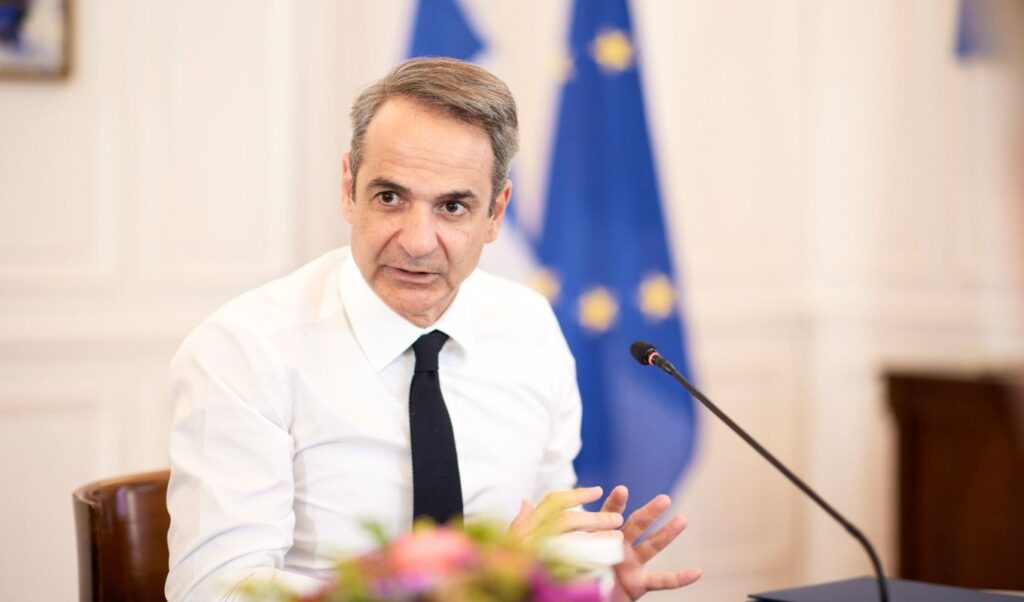
Greek Prime Minister Kyriakos Mitsotakis has outlined the core of New Democracy’s pre-election agenda, centering on social policy and income growth while firmly upholding fiscal discipline as a counterweight to what he branded as reckless vote-buying promises. Speaking during his meeting with President Konstantinos Tasoulas, Mitsotakis addressed cost-of-living protections, referenced new provisions under the Katseli Law, and highlighted key measures included in the Finance Ministry’s omnibus bill. “It is the government’s duty to support society,” the Prime Minister declared, while firing fresh criticism at the opposition for making promises that bear no relation to economic reality. He called on citizens to remain cautious and skeptical toward uncosted commitments that far exceed what the national budget can sustain. This position — one Mitsotakis is expected to repeat frequently until the spring of 2027 — forms part of a broader government strategy set to unfold ahead of the Thessaloniki International Fair. Central to this strategy is the activation of the Fiscal Council, an independent authority, in the role of fiscal arbiter. In practical terms, the government is calling on PASOK and SYRIZA to submit their economic proposals to the Fiscal Council so that the authority can assess whether their promised benefits fall within budgetary limits.
Mitsotakis’s message
Mitsotakis left no room for misinterpretation, sending a clear message: support for citizens will continue, but strictly within the bounds of economic stability and what the economy can realistically sustain. He emphasized that the New Democracy government will continue to reject any return to the deficit-fueled practices that pushed the country into years of crisis. Instead, every euro returned to society will be the product of surplus public revenues, cracking down on tax evasion, and the country’s broader growth trajectory. In doing so, the Prime Minister’s office is working to dismantle the opposition’s pressure campaign for handouts — such as PASOK’s proposal for free public transport for young people in Athens and Thessaloniki — labeling these as irresponsible and dangerous to macroeconomic stability. “The government must legislate and take initiatives based on the actual state of public finances. That is why we do not promise measures we cannot deliver, and we ask citizens to be extremely careful and skeptical toward uncosted commitments that may sound appealing but far exceed the budget’s capacity,” Mitsotakis said, making clear jabs at the opposition and reminding the public of the heavy price Greece paid for nurturing such inflated expectations. “I believe that one of the reasons there is distrust toward the political system stems from the fact that, in the past, political forces promised citizens things that were plainly impossible to deliver,” he added.
Mitsotakis also spoke about the Finance Ministry’s omnibus bill and highlighted specific provisions, including a €150 payment per child, to be disbursed within the coming weeks, and an increase in permanent support for pensioners from €250 to €300, due in November. “We are in a position to implement such measures with fiscal security, precisely because our economic trajectory is positive and because our policy of fiscal discipline is delivering tangible results. In simple terms, we are returning the dividend of collective growth back to society — always, I must stress, within our means,” the Prime Minister stated.
Price de-escalation
At the same time, the economic team is counting on market normalization driven by a ceasefire in the Middle East to ease social pressures without needing to open the public coffers. The optimism expressed by the Prime Minister to the President of the Republic regarding the gradual decline in prices — particularly in the energy sector — represents a pivotal element going forward. The government’s defense against populist spending is further articulated through a philosophy of targeted measures. As Mitsotakis told Tasoulas, the state is choosing to direct available resources toward those social groups most in need, such as families with children, low-income pensioners, and borrowers who have kept up with their loan repayments. A prime example of this approach is the new legislative arrangement for non-performing loans under the Katseli Law.
“The government has exceeded expectations and sends a clear message with its decision: it is creating legal certainty for all compliant borrowers by also applying the principle of retroactivity,” Mitsotakis noted. President Tasoulas also alluded, in no uncertain terms, to the dangers of populist promises by recalling the country’s near-bankruptcy. “This cannot happen again. The government is absolutely right to do this — every government must protect fiscal stability and discipline. The word ‘discipline’ may often feel burdensome to a Mediterranean people, but it was the absence of discipline that led us to the tragedy of bankruptcy,” the President of the Republic said.
Published in Apogevmatini