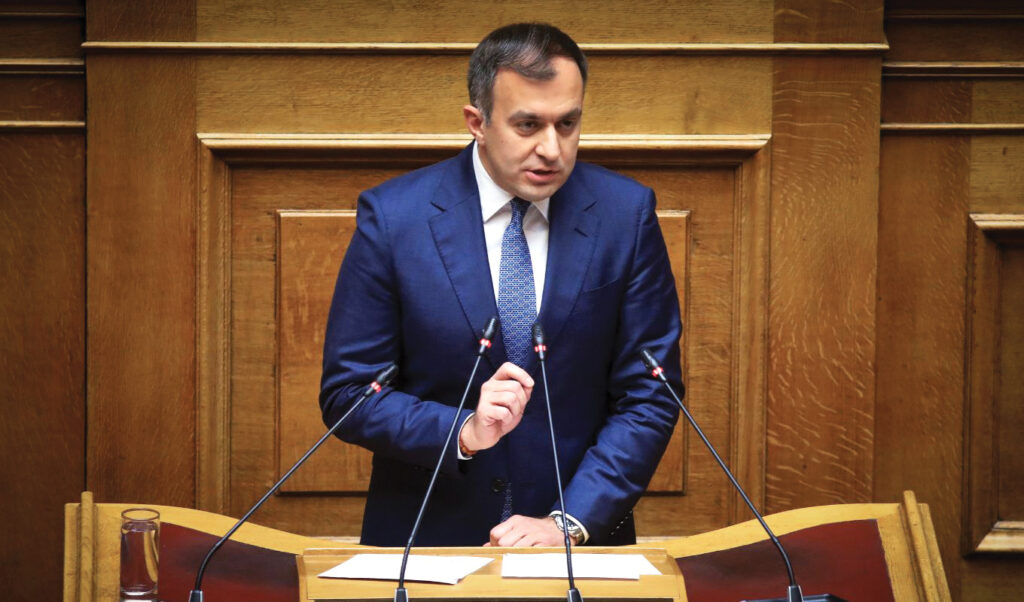
Greece’s Deputy Foreign Minister Tasos Hatzidvasiliou was once again unequivocal in his position on the potential supply of U.S. defense equipment to Turkey, speaking in an interview with ERT. The deputy minister made clear once more that only Congress has the authority to approve such a procurement, regardless of what the U.S. administration may want. Responding to remarks by Vice President JD Vance, who raised the issue of Turkey receiving F-35 jets, Hatzidvasiliou stated categorically: “Any defense procurement from the U.S. to Ankara must go through Congress.” He reiterated, in response to a related question, that “the Congressional filter exists.”
According to the deputy foreign minister, this means that Turkey must be in compliance with its obligations — potentially including those indirectly tied to Greece — both legal and institutional, before Congress could grant approval, assuming the existing sanctions are first lifted.
Hatzidvasiliou: Greece’s first F-35s are coming in the years ahead
He recalled that until 2019, Turkey had participated in the F-35 program as a co-producer, but the sanctions imposed during the first Trump administration removed it from the program. “The reality in 2026 is that Turkey, due to the sanctions and its choice to acquire Russian missile systems, remains continuously outside the program,” he noted. At the same time, he pointed out that Greece is already well into the process that will lead to the acquisition of its first F-35 fighter jets in the coming years.
Hatzidvasiliou argued that Ankara continues to push revisionist claims, but stressed that the Greek government has clearly raised issues such as the Turkish casus belli threat. He also referred to European negotiations on funding Turkish defense capabilities, noting that Greece successfully secured the principle of unanimity for the participation of third countries in relevant mechanisms.
He further emphasized that Greece continues to strengthen its armed forces. “We have today the most modern and well-protected armed forces,” he said.
Gerapetritis’s diplomatic initiatives
Commenting on developments following the Iran-U.S. ceasefire, the deputy foreign minister noted that Greece has already established a distinct role in the region. He recalled that, as a non-permanent member of the UN Security Council, Greece has taken initiatives on issues ranging from the humanitarian situation in Gaza to broader developments across the Middle East. He specifically highlighted the diplomatic initiatives undertaken by Foreign Minister Giorgos Gerapetritis.
“Greece has managed to prove that it is a reliable partner and ally,” he said, referring to the support the country has provided to both European partners and Arab nations in the region.
He also welcomed the agreement taking shape between Iran and the United States, stressing that de-escalation is essential for both international security and the global economy.
When asked whether Greece could participate in a naval monitoring mission in the Strait of Hormuz, Hatzidvasiliou noted that Greece is already actively involved in the European “Aspides” operation in the Red Sea. He explained that Greece has a direct interest in freedom of navigation given its powerful shipping presence. “If the war ends and there are safe conditions and a specific agreement in place, Greece would consider participating,” he said, while clarifying that the moment for such decisions has not yet arrived.
Hatzidvasiliou: “The negotiations over the new EU budget are critical”
The deputy foreign minister placed particular emphasis on the significance of negotiations over the new EU Multiannual Financial Framework, which will determine the resources allocated to member states in the next programming period.
As he explained, from July 1st Greece joins the trio of successive EU Council presidencies alongside Ireland and Lithuania, taking on an active role in European deliberations. “The discussion on the Multiannual Financial Framework must be concluded within 2026,” he stressed.
According to him, Greece is pushing for strong funding in the areas of cohesion policy, the Common Agricultural Policy, fisheries, and infrastructure — all within a tough negotiation between countries seeking increased resources and the so-called “frugal” states.
In closing, he linked the negotiations to the national elections of 2027, arguing that the country will need a strong government to negotiate its European funding for the next period and to lead the Greek presidency of the European Union.
Hatzidvasiliou on Avramopoulos: “Justice must do its job”
Asked to comment on the case involving Dimitris Avramopoulos, Hatzidvasiliou underlined that the substance of the case must be examined and that justice must be allowed to run its course. He noted that, based on what has come to light, the participation in the particular board of directors had been declared and approved by the European Commission, while the related income had been declared and taxed.
He made particular mention of the former commissioner’s stated intention not to stand in the way of a potential waiver of his parliamentary immunity.
“His public statement from the very first moment — that he would not be an obstacle to the lifting of immunity — does him credit. Everything will take its proper course,” he said, adding that premature judgments before the case follows its institutional path are unhelpful.