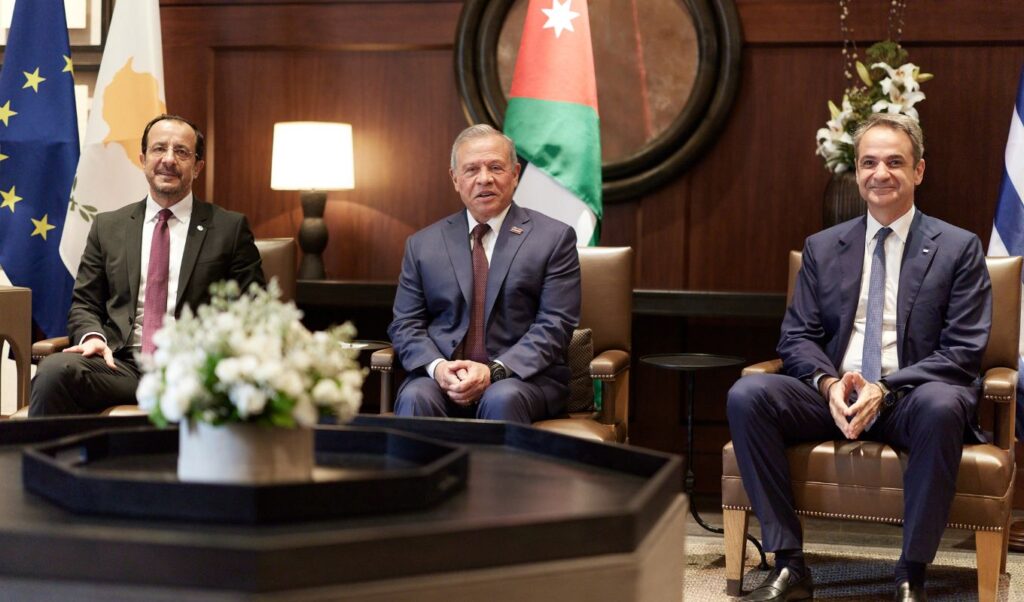
Greece’s aspiration to function as a guardian of regional security, during a period of unprecedented geopolitical fluidity in the Middle East, is signaled by Prime Minister Kyriakos Mitsotakis’ presence at the Trilateral Summit held on Wednesday in Amman, Jordan.
Trilateral summit in Jordan: Focus on Strait of Hormuz and free navigation
At the center of expanded talks between Kyriakos Mitsotakis, Nikos Christodoulides and King Abdullah were the “open fronts” that threaten international stability, with the main topic being ensuring freedom of navigation in the Strait of Hormuz. All three countries aligned from the start in favor of maintaining the previous status quo, namely free navigation. Foreign Minister Giorgos Gerapetritis once again expressed our country’s commitment to implementing the rules of International Law and Maritime Law and noted that “Greece has expressed its readiness to contribute to appropriate efforts aimed at ensuring free passage through the Strait of Hormuz, when conditions permit.”
Tasos Chatzivasiliou: “Greece does not accept regime change in the Straits”
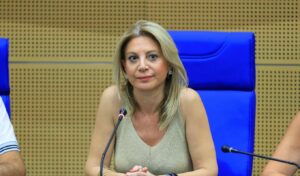
Serres MP and Secretary of International Relations of New Democracy, Tasos Chatzivasiliou, speaking to parapolitika.gr clarifies our country’s position on this issue that has the attention of the entire international community. According to Mr. Chatzivasiliou, “the Strait of Hormuz must open under previous conditions. Greece does not accept a change of regime in the Strait of Hormuz. For the international community, any imposition of transit fees through the Straits is inconceivable. For Greece, free navigation is fundamental, as has been shown by the discussion we are having in the UN Security Council. Greece has taken initiatives in the Security Council as a non-permanent member for free navigation.”
Developments in Lebanon and Gaza on the agenda
Key points on the agenda also included developments in Lebanon and Gaza. All three countries favored direct talks between Lebanon and Israel for a comprehensive peace agreement. Our country shows particular interest in the full implementation of the second phase of the peace plan for Gaza, as provided for in the UN Security Council resolution.
IMEC corridor restart on the table
The trilateral summit also addressed the re-examination of the IMEC trade corridor operation, for which Jordan is an integral part of the plan. King Abdullah of Jordan has expressed strong interest in the corridor’s operation, as he believes it will function as a “natural bridge” connecting Jordan (as well as Gulf and Middle Eastern countries) with Europe.
Greece’s role as IMEC’s European “gateway”
According to Mr. Chatzivasiliou, “IMEC has particular significance because Greece can and should be the natural terminus of IMEC in Europe. Greece places the IMEC corridor high on its priorities, because it believes we need alternative commercial routes and other types of passages between East and West and we categorically believe that our country by nature and position can be the entry point of IMEC into Europe. Moreover, Greece, beyond its geographical position, has political stability and international credibility, elements necessary for implementing such an important international project.”
Greece and Cyprus invest in “stability forces” role
Athens and Nicosia aim through their participation in bilateral and trilateral cooperation with Middle Eastern and Gulf countries to emerge as stability forces in the region and gain geopolitical and economic benefits, investing in energy transition and economic cooperation, while simultaneously addressing common challenges such as migration or even climate change.