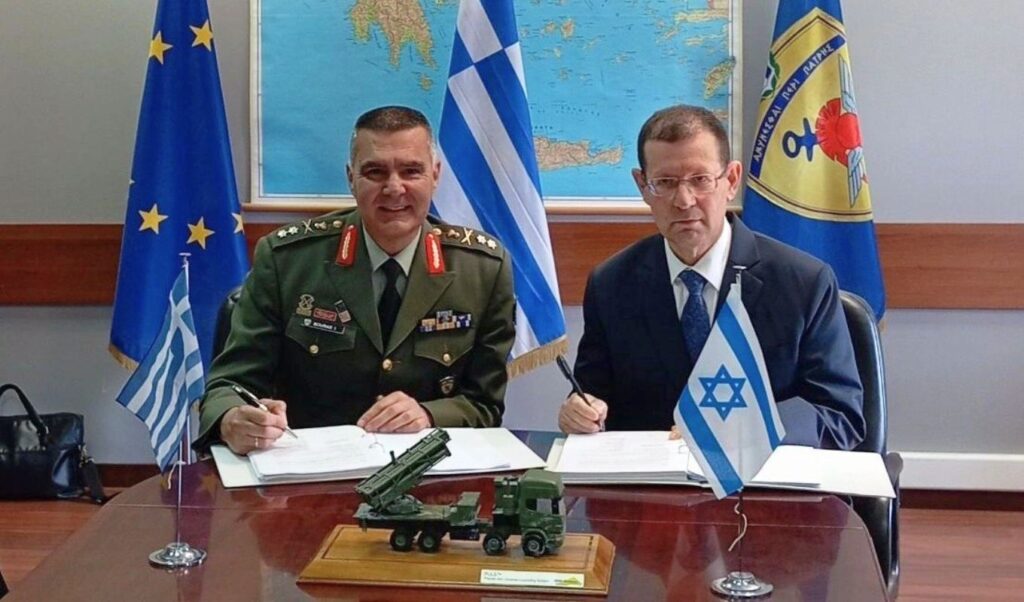
The strategic cooperation between Greece and Israel is significantly deepening through a landmark defense agreement that provides for the procurement of the advanced rocket artillery system PULS by Elbit Systems, with a total value of approximately $750 million. This move reflects the strong defense ties between the two countries, while also fitting into Israel’s broader strategy to strengthen its geostrategic alliances while boosting its economy.
Read: PULS missile launcher agreement signed – Part of “Achilles’ Shield” defense network (Images)
The Greece-Israel cooperation also aims to foster a spirit of mutual industrial support. Beyond equipment acquisition, the agreement includes active industrial collaboration, with the Greek government promoting the production of subsystems by Greek defense industries. The goal is to ensure that Greece’s defense sector will acquire critical know-how and actively participate in project implementation.
Ambassador Andreas Papastavrou explains to parapolitika.gr the contribution of the PULS system to the country’s defense capabilities. As he states, “it is a system that, apart from Israel, is also used by Denmark, Azerbaijan, Rwanda, Serbia, the Netherlands, Kazakhstan, and India, which has placed a massive order. From what we understand, it fits within the overall framework of ‘Achilles’ Shield,’ that is, this holistic defense doctrine, which was recently approved by the Greek Parliament.”
Greece’s new defense cooperation with Israel had been under negotiation for the past two years. However, its signing coincided with Israel’s involvement in war. Could there be repercussions for our country due to the military conflict in the Middle East?
Greece and Israel’s “strategic” position
International relations expert and military academy professor Giannis Papafloratos argues that the Athens-Tel Aviv relationship is strategic because it strengthens us against Turkey’s major revisionist threat. As he notes, “Israel, although at war with Iran, continues normally to sign arms sales agreements. It hasn’t stopped, and there are a series of states signing agreements with it, without any of them currently imagining they are being involved in a war. It’s what the Americans call business as usual, however cynical what I’m saying may sound.”
However, many are raising alarm bells. For Ambassador Andreas Papastavrou, the timing is very difficult because, as he points out, “Israel is not simply at war, it is in an aggressive war, which of course it considers defensive, while others consider it aggressive. We’re entering a different logic. However, this defensive system is not intended for offense, it is intended for the country’s defense, and this parameter is important.”
The impact of the close Greece-Israel defense cooperation has provoked reactions in Turkey, with Turkish analysts leaving open the possibility of even a “Greek-Turkish war.” According to Mr. Papafloratos, Turkey’s reactions against our country are, as always, directed at the domestic audience. “The fact that the Turks are reacting shows they want to demonize Israel domestically. The Turks, who don’t have the best intentions, are annoyed when they see that Greece is now acquiring a weapons system that will certainly hinder them—along with the weapons systems we have—from achieving their plans. For domestic consumption reasons and because they want to replace Iran at the helm of the Muslim world, they consider it a brilliant opportunity to take the reins and have been attacking Israel for some time. You saw what happened in Constantinople. They believe that with this rhetoric, first, they divert public opinion’s attention from the dismemberment danger they currently face, because we might be talking about regional redrawing here, and turn public opinion against the permanent enemy, namely Greece. And second, to tell Muslims that ‘look, I condemn Israel and those who cooperate with Israel.'”
It’s worth noting that the contract signed for the PULS rocket artillery delivery extends over four years for implementation, followed by a ten-year support and maintenance period, demonstrating long-term cooperation between the two states. Also noteworthy is that despite current military challenges, Israeli industries have increased their production, proving their superiority in military equipment.