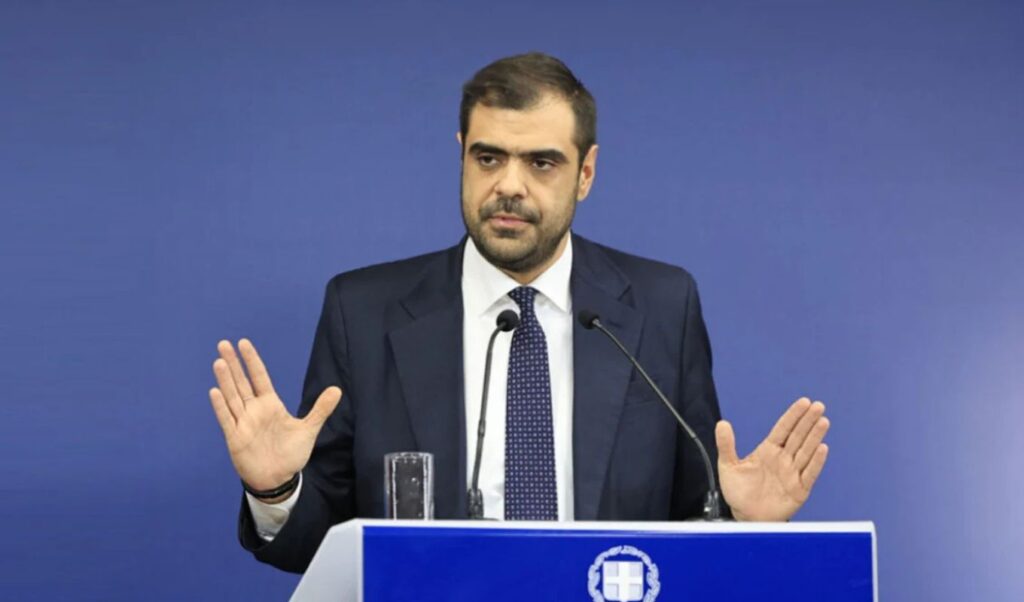
Government spokesperson Pavlos Marinakis provided clarifications on the Prime Minister’s proposal for minister-MP incompatibility after the 2027 elections, stating that “perhaps we should also discuss reducing the number of MPs.”
“We’re talking about a proposal that will be discussed pre-election, but the change will come after the elections. Although the Constitution provides for passing a law, the proposal must be included in the broader constitutional revision. It involves suspending parliamentary status for an MP who is selected as minister by the Prime Minister. They would be replaced by the next in line, and if there’s a reshuffle and they leave, they return to their MP position.”
“In this context, perhaps we should also discuss reducing the number of MPs so we don’t have 350 parliamentary offices instead of 300 – everything is under discussion,” Mr. Marinakis said during the political editors’ briefing, noting that the incompatibility change aims to strengthen the MP’s role.
“This isn’t a move to tackle the clientelist state – that’s done through policies like faster pension processing, digital government, and OPEKEPE’s transition to AADE. We’re not talking about an executive law; we’re saying it will be integrated into the broader constitutional revision discussion. I recommend that anyone with positions or proposals should present them at the right time,” Pavlos Marinakis concluded on the matter.
He also mentioned that regarding OPEKEPE, the European Prosecutor’s Office has been investigating related cases across Europe since 2020. In Greece, there have been 97 immunity waivers in recent years, while Greece has paid 30 billion euros over the past 30 years. You tackle the clientelist state with policies; you tackle personal illegal behaviors through Justice.
Meanwhile, Mr. Marinakis emphasized that the fuel pass platform for fuel subsidies opens this afternoon for eligible recipients, and announced that measures to reduce industry costs will be revealed.
He also highlighted that 220 schools will be upgraded with summer construction work, and said live classes for university entrance exam candidates will begin after Easter.
Greece is taking a step toward its energy future, Mr. Marinakis declared, utilizing clean energy from renewable sources, while orange dynamic pricing for consumers has begun implementation.
The Prime Minister will chair a meeting on market conditions due to Middle East developments, the government spokesperson also noted.
Pavlos Marinakis’s opening statement
“Good afternoon and Happy Holy Week,
With his message to citizens a short while ago, the Prime Minister referred to the latest developments in the OPEKEPE case.
Regarding sending the case file to Parliament requesting immunity waiver for 11 New Democracy MPs, he stressed that immunity waiver, following constitutional amendments made during ND’s tenure, is the rule rather than the exception, and emphasized that his party’s MPs honor themselves with their decision to request immunity waiver.
Kyriakos Mitsotakis pointed out that the European Prosecutor’s Office was established in 2020 with government support, and that the material underlying its requests results from lawful wiretaps implemented without interference by Greek prosecutorial authorities.
Additionally, Kyriakos Mitsotakis emphasized that he will defend the presumption of innocence and asked the European Prosecutor’s Office, once MP immunity is waived, to proceed with all proper investigative actions and determine if and against whom it will press charges, while noting that none of the MPs are accused of financial gain.
The Prime Minister referred to the major reform now being implemented with OPEKEPE’s transition to AADE, which will benefit every honest farmer and livestock breeder.
He also stressed: “Enough with the hypocrites who ‘suddenly discovered’ that favoritism in this country started in 2019. Such clientelist relationships have accompanied the Greek state since its establishment. They’re among the main reasons for our national lag compared to Europe. (…) Since 2019, I’ve been fighting to transform Greece into a modern European state where you won’t need to personally know your MP to be treated with dignity by the Public sector.”
Furthermore, the Prime Minister made special reference to the trust crisis facing institutions and political personnel overall – a “challenge” as he characterized it that “concerns all liberal democracies.” “I must,” he said, “evaluate the situation not only as a lesson from negative experience but also as a new starting point in the battle against the ‘deep state.’ Thus,” he continued, “I will propose for discussion in public dialogue a new package of institutional reforms, beyond our Constitutional Revision proposals. Among them, minister-MP incompatibility, with minister replacement in Parliament by the first alternate for as long as they participate in the Ministerial Council, and simultaneous upgrading of the MP’s role. Obviously, the above proposals will be put to consultation with society for implementation after the next national elections. They will also form part of the commitments we’ll undertake if the people trust us again. And certainly, they signal my personal decision that our homeland definitively win the war against the bonds of its past,” the Prime Minister emphasized.
From this afternoon until April 30, citizens can submit applications for the Fuel Pass through the specially configured vouchers.gov.gr platform.
Fuel Pass III constitutes a citizen support measure against fuel price increases due to the war situation in the Middle East, aiming to cover part of fuel consumption costs for April and May 2026.
The support corresponds to 36 cents per liter and affects 3 out of 4 vehicle owners.
Each beneficiary can choose either digital debit card issuance or deposit of the amount into their bank account.
Money is credited within 48 hours of application submission, whether the beneficiary chooses digital card or account deposit. However, it’s noted that those applying on Holy Wednesday will be paid after Easter due to banking holidays.
Meanwhile, since last Wednesday, diesel fuel is subsidized by 20 cents per liter.
The diesel subsidy and announced 15% fertilizer value return aim to reduce production and transportation costs.
Shortly after 2:00 PM, Environment and Energy Minister Stavros Papastavrou, Development Minister Takis Theodorikakos, and Deputy Environment and Energy Minister Nikos Tsafos will meet with SEV President Spyros Theodoropoulos. They will subsequently announce measures to reduce industry energy costs and support investments for energy upgrades.
More than 220 schools nationwide will be renovated this summer through the “Marietta Giannakou” program, while extensive interventions in over 430 schools were already implemented within 2025.
The Prime Minister announced that Special Schools will have priority among educational units included in this year’s “Marietta Giannakou” program.
Meanwhile, parental counseling begins through the “Connected parents” program on topics like addictions, internet, and changes during pre-adolescent and adolescent years.
During Easter school holidays, university entrance exam simulation tests will be posted on the Public Digital Tutorial Center and asynchronous support platform for General, Vocational & Unified Special Vocational High Schools, aiming to intensify and optimize student preparation for university entrance exams. After Easter, live review classes for candidates will begin, continuing until one day before each university entrance exam.
The Digital Tutorial Center offers free, quality student support, especially for university entrance exams. From next school year, by decision of Education, Religious Affairs and Sports Minister Sofia Zaharaki, live classes extend to 1st and 2nd High School grades, while AI will provide real-time personalized exercises during live classes to meet each child’s individual needs.
The Education Ministry’s goal is ensuring every child, regardless of residence or socioeconomic conditions, has access to quality educational support, practically strengthening equal opportunities.
Greece takes a substantial step toward its energy future. With the first two energy storage units becoming operational, totaling 16 MW capacity, electrical system stability is practically enhanced and the path opens for greater clean energy utilization from renewable sources.
These first two storage units, integrated into the system, provide critical flexibility, facilitate increased renewable penetration, limit renewable production cuts, and contribute to peak demand coverage.
Additionally, gradual integration of additional storage projects is planned for further electrical system stability and efficiency enhancement.
Successful integration of the first storage systems results from coordinated actions by the Environment and Energy Ministry, RAE, ADMIE, the Renewable Energy Sources and Guarantees of Origin Administrator, and the Hellenic Energy Exchange.
Simultaneously, dynamic (orange) pricing implementation began for consumers. Through these, citizens can adjust electricity consumption during cheaper hours and benefit from electricity market price fluctuations.
After Easter, the “Neighborhood Nannies” program platform reopens for both new applications and caregiver registration.
The program offers substantial support to families with infants and toddlers, helping parents balance family and professional life.
It started as a pilot in 62 municipalities, covering 2,400 children and leading to 925 agreements, now expanding nationwide.
Financial support reaches up to 500 euros monthly for parents with full employment or freelancers and up to 300 euros for those with part-time employment or job seekers.
Notably, income criteria don’t apply to families with three or more children.
Shortly, the Prime Minister will chair a meeting at the Maximos Mansion on Greek market conditions due to the Middle East crisis.”
Subsequently, answering journalists’ questions, he commented that the minister-MP incompatibility proposal begins now as discussion, but its implementation is placed after elections and must be included in the planned constitutional revision. Tackling the clientelist state happens through developing digital forms like faster pension processing; the incompatibility change aims to strengthen the MP’s role.
He also mentioned that regarding OPEKEPE, the European Prosecutor’s Office has been investigating related cases across Europe since 2020. In Greece, there have been 97 immunity waivers in recent years, while Greece has paid 30 billion euros over the past 30 years. You tackle the clientelist state with policies; you tackle personal illegal behaviors through Justice.
MPs have an obligation to convey legitimate and lawful requests – it’s different from promoting illegal requests.