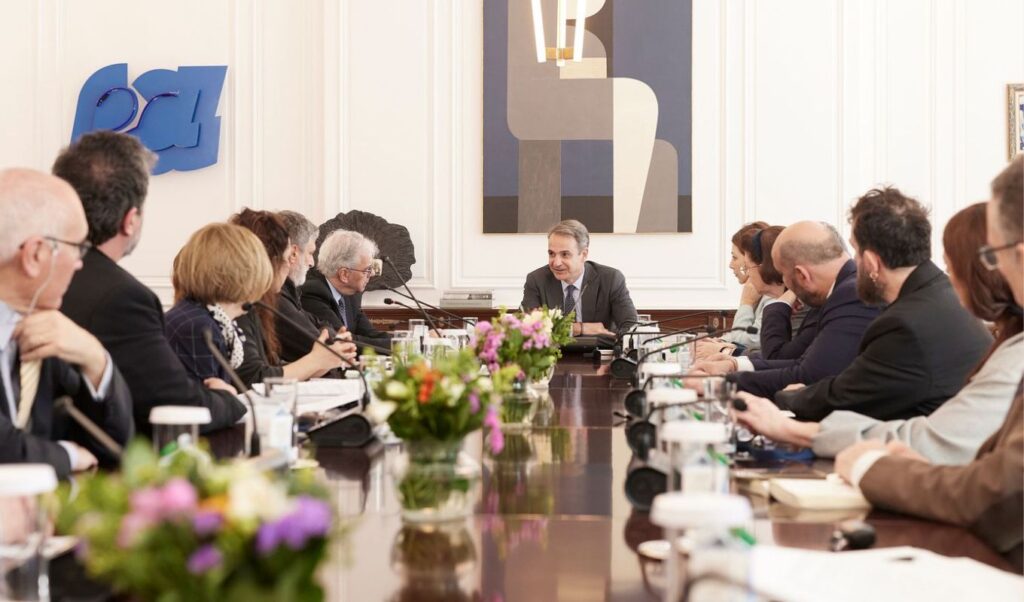
Prime Minister Kyriakos Mitsotakis chaired a meeting at the Maximos Mansion regarding the establishment of the Higher School of Performing Arts (HSPA). This establishment, which was legislated last week, represents the first public Higher Education Institution created in our country for teaching dramatic, dance, and musical arts.
Kyriakos Mitsotakis on HSPA: substantial response to decades-old demands
As noted during the meeting, the establishment of HSPA and the comprehensive reform of artistic education set, for the first time, clear rules in a field that operated for decades with institutional ambiguities regarding study levels, their academic continuity, and the position of study titles in the public sector. “We are in the pleasant position that something which constituted a commitment of ours, we are now able to implement. I remember from when I first entered politics this discussion about artistic education, which essentially operated without any institutional framework, with thousands of young people investing time, effort, talent in theater, dance, music and not having the recognition they deserved. I think this is finally changing. With this Higher School of Performing Arts, the performing arts acquire for the first time what was always sought: a serious university substance, with studies, with research potential, mainly with development prospects,” the Prime Minister stated at the meeting’s opening.
Complete academic pathway
In this context, starting from the 2027-28 academic year, HSPA will be able to enroll students and provide a complete academic pathway, from undergraduate to doctoral level, providing institutional recognition and university substance to artistic studies. The new law also resolves the chronic issue regarding the unclear connection of artistic studies with professional rights in the public sector, through establishing a new personnel category in the public sector titled “Artistic Education,” for employees who either practice artistic work or serve as educators in the arts field. “We substantially respond, with actions, to a decades-old demand,” emphasized Kyriakos Mitsotakis. “This is a reform of substance, not a reform of impressions. I think here we essentially draw a dividing line with the past, we solve pending issues from the past, but mainly we give prospects to young children interested in culture, in performing arts, to have clear visibility about how they will move, what their professional path will be, what their qualifications will be, what value the degree they will receive from a Greek university will have.”
Close cooperation with the artistic community
Thanks to the reform, the accumulated experience and knowledge in artistic education is utilized, as under the university umbrella of the new institution will operate Departments of five historic public entities in the field: the Dramatic Arts Department of the National Theatre, the Dance Department of the Greek National Opera, the Dance Department of the State School of Dance, the Dramatic Arts Department of the State Theatre of Northern Greece, and the Music Department of the State Conservatory of Thessaloniki. Beyond connection with the arts field and its historic institutions, the new School will preserve the particularities that exist in arts teaching compared to other knowledge fields, through functional provisions included in the law, which emerged from two years of consultation with representatives of the artistic community. For this reason, admission to HSPA Departments will be through special examinations, including mandatory auditions of candidates for their live evaluation. The selection of Special Artistic Personnel will be based primarily on the work of artistic personalities who will assume positions, recognizing their prestige. Additionally, the new institution will have a 9-member Artistic Council offering advisory services without compensation, five members of which will be nominated by the five historic artistic education institutions. Special emphasis was placed on next steps for rapid formation of the new institution’s transitional Administrative Committee and preparation for curriculum development. From all sides, the importance of good cooperation and understanding between the government and the artistic community was emphasized, something reflected in the legislation for HSPA’s establishment. During the discussion, the importance of creative activities in minors’ lives, especially at younger ages, was also highlighted.
“We now have a very big discussion about our children’s and adolescents’ problems, addiction to Social Media, addictive behaviors that, unfortunately, all these algorithms consciously promote and I was thinking that, ultimately, the answer mainly for younger children cannot be other than sports and art,” the Prime Minister noted. “That’s why I think we should -we’ve discussed this with the Minister- and we’ll need your help both as individuals, but now and tomorrow, as a Higher School, how we’ll revisit artistic and musical education,” added Kyriakos Mitsotakis. “To know at least that there are some answers connected with timeless human nature, which especially in this conjuncture we have one more reason to support.”
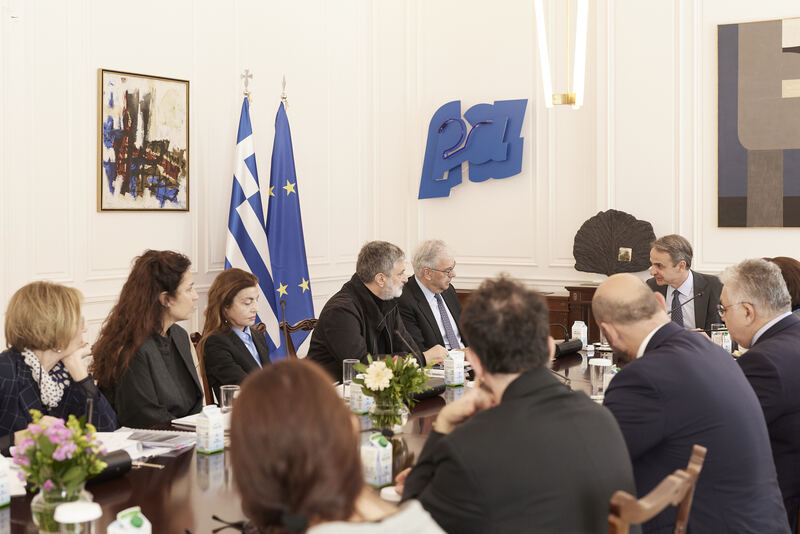
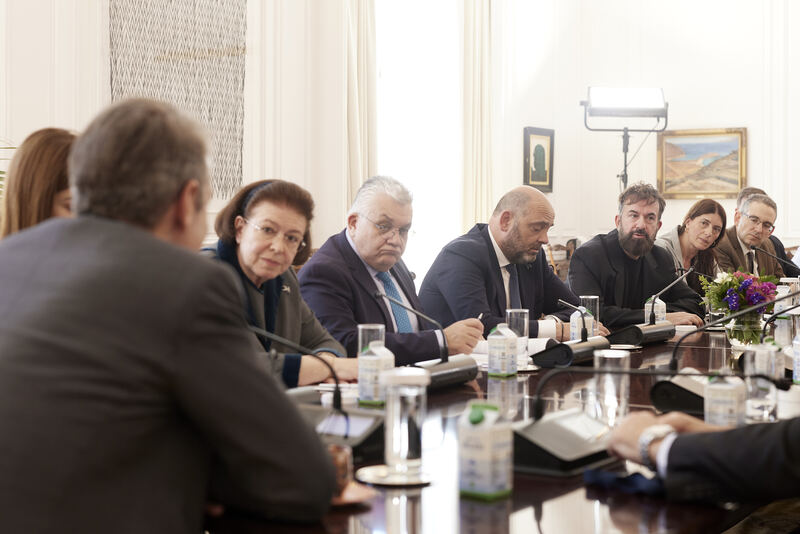
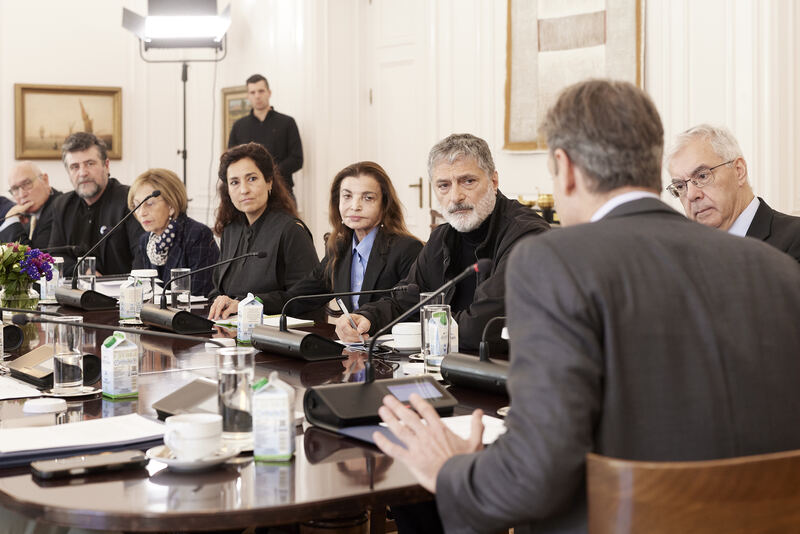
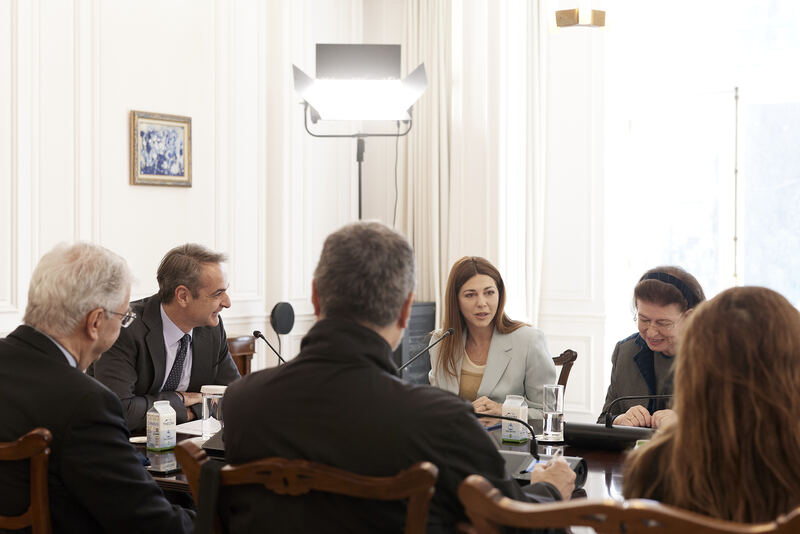
The Prime Minister’s complete introductory remarks:
“Beautiful day and beautiful meeting, I think, today’s, because after a very great effort -and I want to congratulate both co-responsible Ministries- we are in the pleasant position that something which constituted a commitment of ours, we are now able to implement. I remember from when I first entered politics this discussion about artistic education, which essentially operated without any institutional framework, with thousands of young people investing time, effort, talent in theater, dance, music and not having the recognition they deserved. I think this is finally changing. With this Higher School of Performing Arts, the performing arts acquire for the first time what was always sought: a serious university substance, with studies, with research potential, mainly with development prospects. I think what has value to discuss further -because this is not a fragmentary intervention, it has many aspects which must and are addressed through our initiative, whether we speak about clear correspondence of titles or about the way we will integrate artistic education into the national qualifications framework-, the important thing is to create career pathways and leave no one behind. So, we substantially respond, with actions, to a decades-old demand. I think we do it with seriousness and consistency. I want to thank all of you, because I think there has been excellent cooperation to reach this point. This is a reform of substance, not a reform of impressions. I think here we essentially draw a dividing line with the past, we solve pending issues from the past, but mainly we give prospects to young children interested in culture, in performing arts, to have clear visibility about how they will move, what their professional path will be, what their qualifications will be, what value the degree they will receive from a Greek university will have. From a university now, from a Higher Education Institution, which will now be the 25th university our country will have“.
Sofia Zacharaki
Education, Religious Affairs and Sports Minister Sofia Zacharaki stated:
“We welcome you and thank you very much for the opportunity to be here. The establishment of the Higher School of Performing Arts is indeed a historic milestone for artistic education in our country and now we move from legislation, which brought us particular joy, as you saw, we had broad parliamentary support and this particularly delighted us and now from legislation we proceed to implementation and formation. So, in prioritization, priority for the new school is to quickly acquire administrative base, academic identity, modern study programs and stable connection with the historic institutions in the field. The Higher School is indeed the first big step -I made it clear in Parliament that we’re talking about the basis of discussion, very important but it’s the basis- and we’ll discuss a broader reform, now integrated for artistic education in the Education Ministry after years of cooperation with the Culture Ministry, with which there was harmonious coexistence, targeting and delimitation of our basic provisions in the law. In today’s meeting with the Prime Minister we’ll formulate a clear roadmap, concrete steps for the Administrative Committee’s formation and next steps, so that the reform proceeds with planning, seriousness and we see in 2027 the beginning of the School’s operation and first students with special examinations, as we’re talking about a distinct and special process, which I must tell you we surround with much care and respect“.
Lina Mendoni
Culture Minister Lina Mendoni noted: “Mr. President, as Sofia mentioned, the establishment of the Higher School of Performing Arts constitutes a major reform in our homeland’s cultural development. A country that has very strong and international footprint in contemporary creation and which until the day before yesterday -literally the day before yesterday- did not have the stable, public, institutional body recognizing this reality. Thus, your government, and with your personal will, transformed a decades-old vision into a plan and the plan into reality. What is very basic, besides the continuity Sofia emphasized, is to say that precisely because of strong political will, the “Artistic Education” category was institutionalized in the Public sector, which is extremely important, as it’s done in the most institutionally correct way: with clear regulatory mapping of artistic education titles’ positions in the state’s administrative and service system. Therefore, something that was until the day before yesterday in a “gray zone,” at this moment acquires its proper position and full rights. And finally, what is very important is that the law, in absolute cooperation with the Education Ministry -and indeed our cooperation was excellent all these years-, provides for the institution of program contracts between the Education Ministry, Culture Ministry and five institutional public entities, ensuring continuity in both infrastructure use and resource use, whether material or human, which is very important, because it doesn’t disconnect. This School is not theoretical, it’s a School that creates people connected to the stage. Therefore, the fact that through program contracts, the Ministries and entities are in complete harmony, guarantees precisely this result“.
Nikos Papaioannoy
Deputy Education Minister responsible for higher education Nikos Papaioannoy stated:
“Naturally I’ll agree completely with everything the President and both Ministers said. I have nothing to add. In the time, the year and a half I’ve also been in the Ministry -the President honored me-, we had excellent cooperation, we discussed very much. However, what for me at this moment matters, is to set the roadmap for transforming the law into practice. So, that is, to discuss administrative organization with the temporary Administrative Committee, then to discuss academic organization, institutional formation and academic function. I think all of us will cooperate perfectly so that this new university begins operating in practice, which is a decades-old demand”.
Deputy Culture Minister Iason Fotilas stated:
“When I was a teenager I had, timidly, expressed the desire to my father to engage in theater and acting in my life. He somewhat “heavily,” sternly told me: “My child leave the theaters and arts and focus on finishing a university.” Thanks to you, from today a child can do both in Greece”.
Representatives of the five historic artistic education institutions stated, among others, on their part:
Chariton Stavropoulos, President of Greek National Opera: “The Greek National Opera always considered the law is in the right direction, that it puts a proper end to all this “anarchy” that existed until now in artistic development. We believe very much in this bill, we’ll be close, we’ll help as much as we can”.
Giorgos Koumentakis, Artistic Director of Greek National Opera: “We would like to express our really warm thanks for the, I believe, historic decision you made to proceed with establishing the Higher School of Performing Arts and its implementation. Naturally there are difficulties, but difficulties exist to be solved. Your initiative not only upgrades -I believe this steadfastly- the prestige of performing arts, but also shields the future of contemporary culture. With this bill you offer young generations academic foundations that didn’t exist until now and the prospects they deserve”.
Ersi Pitta, Vice President of National Theatre:
“We can today express our satisfaction because all suggestions we made, concerning specific articles of the bill, were heard and accepted, so we want to thank the leaderships of Culture and Education Ministries. We hope that with this School’s establishment, which will ensure the upgrading of studies concerning art, this will contribute so that art finds the position it deserves, the position it should have, within society”.
Argyro Chioti, Artistic Director of National Theatre:
“We reached discussing this bill, which really defines a new era. We on our part will be alongside, step-by-step, to pass through this transitional period and reach where we all desire”.
Giannoula Karympali-Tsiptsiou, President of State Theatre of Northern Greece:
“We are very happy, because after years of institutional pending issues, performing arts finally acquire university shelter, with the establishment of the Higher School of Performing Arts”.
Asterios Peltekis, Artistic Director of State Theatre of Northern Greece:
“This moment is very important and significant. I’m very moved because I was here three years ago in the first discussions and I see today completing with truly outrageous speeds for our country a bill, something which is very hopeful and very significant, and we thank you very much for the support and immediacy in all this process. It’s a tremendous achievement I believe”.
Nikos Avdellas: President of State Conservatory of Thessaloniki
This opportunity we had this time to cooperate and unite all contemporary art institutions is a great achievement.
Georgios-Ioulios Papadopoulos, Director of State Conservatory of Thessaloniki:
“We are grateful for what happened. We’ll work with you to implement it in the best way. We are here to help with all our forces and support what happened.
Konstantinos Rigos, President of State School of Dance:
“Much work has been done both by the government, the Ministers and by art people. It’s important that we find ourselves at one table all together and discuss over a law that was voted and is reality. The next steps are very difficult, very important and must be done with great care. For us, the state dance school it’s a tremendous step. It’s truly an ideal day today”.
Evangelia Kapetanea, Director of State School of Dance:
“The establishment of the Higher School of Performing Arts is a step that the arts field has been waiting for many years. The meeting was attended, from the government side, by Education, Religious Affairs and Sports Minister Sofia Zacharaki, Culture Minister Lina Mendoni, Deputy Minister responsible for higher education Nikos Papaioannoy, Deputy Culture Minister Iason Fotilas, Prime Minister’s General Secretary Stelios Koutnatzis and Prime Minister’s Advisor on culture issues Elena Mavromichali”.