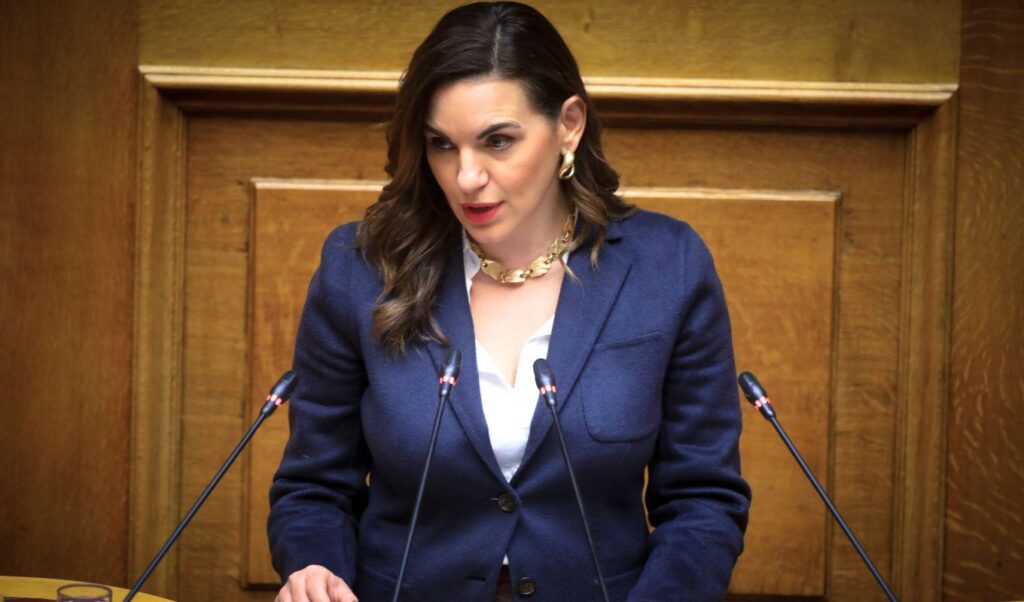
“Greece has truly not been affected at this stage by geopolitical developments. And I say this based on the data. We see some cancellations mainly from Israel, which is due to objective circumstances. We also know that Israelis, as soon as – what we all hope for – the military conflict ceases, they are the first who will come to Greece, as they consider Greece a safe country,” stated Tourism Minister Olga Kefalogianni, speaking on ERT news Radio 105.8 and the show “Morning Routes” with Vasilis Adamopoulos, about the effects of the war raging in the Middle East on our tourism, the country’s “heavy industry.”
“The message we send outward is that Greece remains a country of stability, a country of security and certainly a reliable country, because this is of great importance during periods of uncertainty,” she emphasized simultaneously.
“We have been in constant contact from the first moment with international players in the tourism market, with tour operators, with airlines. And the truth is that there is an assessment that this war will affect our competitors, so it could potentially create some conditions that Greece could exploit. However, we are not at this stage close to that, in the sense that all of us right now, as long as this war continues, it creates a condition that certainly requires seriousness, composure and confidence in our capabilities on our part, but on the other hand we understand that psychology is affected.
I must tell you though that, because we have tools and monitor on a weekly basis with the Institute of the Hellenic Chamber of Hotels, Greece has truly not been affected at this stage by geopolitical developments. And I say this based on the data. We see some cancellations mainly from Israel, which is due to objective circumstances. We also know that Israelis, as soon as – what we all hope for – the military conflict ceases, they are the first who will come to Greece, as they consider Greece a safe country,” the Minister noted characteristically.
Kefalogianni: “2026 had started as an exceptional year for Greek tourism”
“2026 had started anyway as an exceptional year for Greek tourism,” she noted. “I say this based on the messages we had already received from the tourism exhibitions we attended at the end of the year in London in November. Already in some of our very popular areas and destinations, such as Rhodes where I was the day before yesterday, Corfu, the tourist season has begun, the first flights have already arrived, we already have the first visitors,” she added. At this moment, the Minister explained, there appears to be a very large increase, from the first official results data of January and February, before the war broke out, that 2026 recorded a very large increase compared to 2025, which was already a record year.
“So, I want to say that we had already started with a very large increase. We have already opened in the known, popular destinations. I think that at this moment things are good. But I repeat, we are always with composure, we certainly monitor the situation. At this moment there is no reason for concern. It does not create any reason for concern.
More so, speaking with all domestic and international players in the market, the concern has to do with the indirect effects that the war can have on tourism as well, just as it exists in the economy generally, so also in tourism. That is, how the rise in fuel prices can affect airline tickets, can affect, so it can indirectly affect tourism,” Ms. Kefalogianni added.
“The government is taking measures at the central level”
Specifically regarding the economic impact of the war due to rising fuel costs on tourism products, such as transportation tickets or tourism businesses, when asked if the ministry is considering any measures, Ms. Kefalogianni said the following: “In the first phase, the government is taking measures at the central level anyway. These measures being taken are substantial and absolutely necessary because they respond to the real needs that society has and obviously the effort does not stop here because the pressures on daily life exist and we know them very well. It is important though that the government intervenes with a plan and with consistency, as we have already seen from the announcements made by the Prime Minister himself and by the competent ministries and with a clear intention to support citizens.
You heard it yesterday from the Prime Minister himself about the emergency measures to support citizens, he pointed them out in the Cabinet meeting as well because of course, as long as the conflict in the Middle East is prolonged, continues, it certainly creates an environment which is uncertain and that is where the government comes and intervenes substantially, where it can and must intervene.
Here I must also point out to you, I think this has already been said in public dialogue and within the Cabinet, what both the Prime Minister and the Finance Minister, who is also president of the Eurogroup, pointed out, that if the military conflict happens to continue, then measures are not enough to be taken only at the national level, that there should be initiatives taken at the European level. And this, you understand why it must happen. We always operate within a framework, as we say that as Greece we respect international law, so we respect the rules of fiscal stability imposed by Europe and we do not want to be the country that will deviate from these rules. We are rather among the countries that could be at the forefront of pressure toward a direction of adopting rules and measures from Europe. I think this has value, because at the end of the day what interests us is to support all Greek women and all Greek men. And it is good that this is not done only at the national level, but that we are given the margin for this to happen with decisions from Europe.”
“Tourism is always a sector that is sensitive and vulnerable to international developments, to exogenous factors and that is why continuous monitoring and certainly readiness is required. Greece has certainly proven in recent many years that it has resilience to crises. We have gone through many crises, we have emerged victorious, so there is both knowledge and maturity to deal with any situation.
Let’s not forget also that we come from an exceptional year for Greek tourism. 2025 closed as the best year of all time with a remarkable increase in revenue and I want to give particular emphasis to this, because it is the first time we saw a greater percentage increase in revenue of the order of 10%, compared to arrivals which were of the order of 4%. So, this shows that we are improving in qualitative indicators. It shows that we have an extension of the tourist season, we no longer talk only about the peak period. We talk about very large increases both in the first five months of the year, but mainly in the last three months of the year.
Look at the statistics a bit. December was over 50%. So, we are talking about very, very large increases in the winter months, in the off-peak months. So, Greek tourism has begun to win this big bet that we had set from the beginning, of a more balanced development throughout the year and gradually in all regions. I say this because, let’s not forget that apart from the current situation which is now certainly this geopolitical condition that I will tell you next, how much it affects us, there is also the strategy we follow and to which we are committed,” Ms. Kefalogianni described.