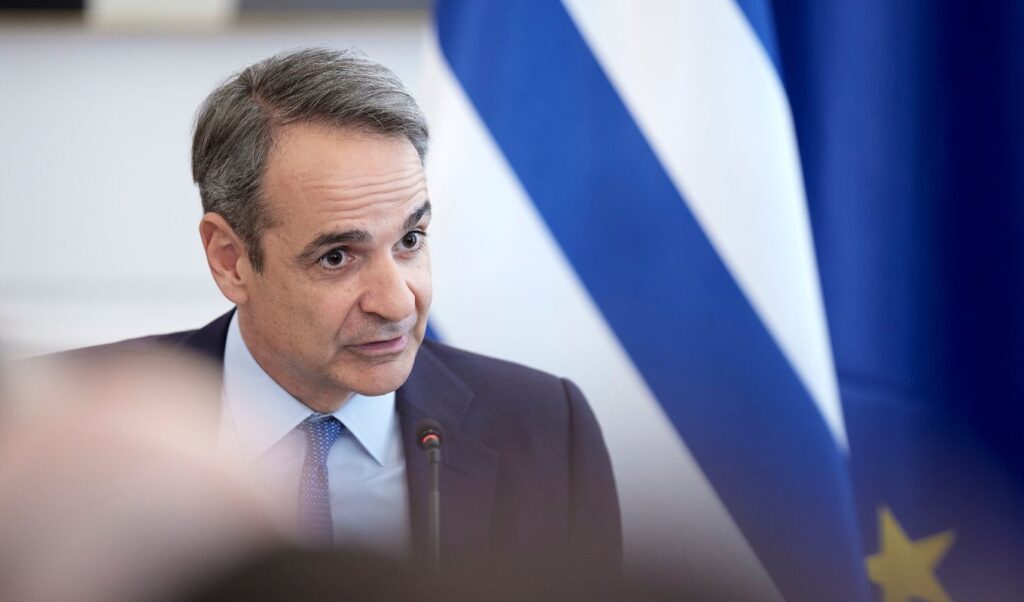
Prime Minister Kyriakos Mitsotakis addressed the ongoing situation in the Middle East, with the war raging and its impacts primarily on the economy, during his opening remarks at the Cabinet meeting at the Maximos Mansion. As he initially stated: “Obviously, I would have liked my introduction to today’s session to be somewhat more optimistic, however, unfortunately, the prolonged conflict in the Middle East continues, maintaining an uncertain global environment. With fuel price fluctuations feeding inflation, which in turn causes chain reactions that impact not only our country, but every economy, every society”.
Mitsotakis on Middle East: We will contribute through the UN and through EU
“I think uncertainty is now the only certainty and this obviously requires constant vigilance on our part. Thus, after the first measure we took, which concerned the cap on profit margins for fuel prices, as you know, four new measures were implemented at the national level. Our purpose here is very clear. On one hand, we want to contain the rise in diesel prices, because this significantly burdens transportation and production costs for businesses. We want to provide targeted support, and we are doing so for the majority of Greek households through a two-month card, we strengthen households against increases in gasoline prices. We have our farmers in mind and we are essentially providing a fertilizer subsidy that will be valid from March 15. And of course, a significant intervention in ferry tickets to ensure that their prices, at least for Easter, will move approximately close to last year’s prices. These are four barriers against this external crisis, to avoid as much as possible their transformation into a source of horizontal price increases, which will ultimately be paid by the consumer” the Prime Minister added.
Subsequently, just before giving the floor to the Foreign Minister to provide a general briefing on developments in Iran’s war, Kyriakos Mitsotakis stated: “You know very well that from the first moment Greece was present diplomatically, both bilaterally and multilaterally and at the European level. I think this briefing is absolutely useful. What is happening in the Middle East directly affects developments in our homeland, beyond the economic impacts we have already discussed, whether we talk about the Hellenism of Cyprus, whether we talk about free navigation -an issue that will come to public dialogue regarding the situation in the Strait of Hormuz-, or whether we talk about energy security”.
In conclusion, he added: “All these are aspects of the crisis that directly affect us. That’s why Greece is and will be present whether in the Security Council -the Minister will tell us later about the discussions taking place at this level-, or in the European Union, or bilaterally and multilaterally through the very important strategic relations that our country has now developed with all the countries of the Middle East and the Gulf. In such a complex situation, therefore, this national strength that is projected beyond our borders, I think, should be forged by internal stability and unity. And I think it’s important that we have the strength to distinguish the big and serious issues of a changing world, with developments that directly concern us, from the small and less important matters of our partisan microcosm”.