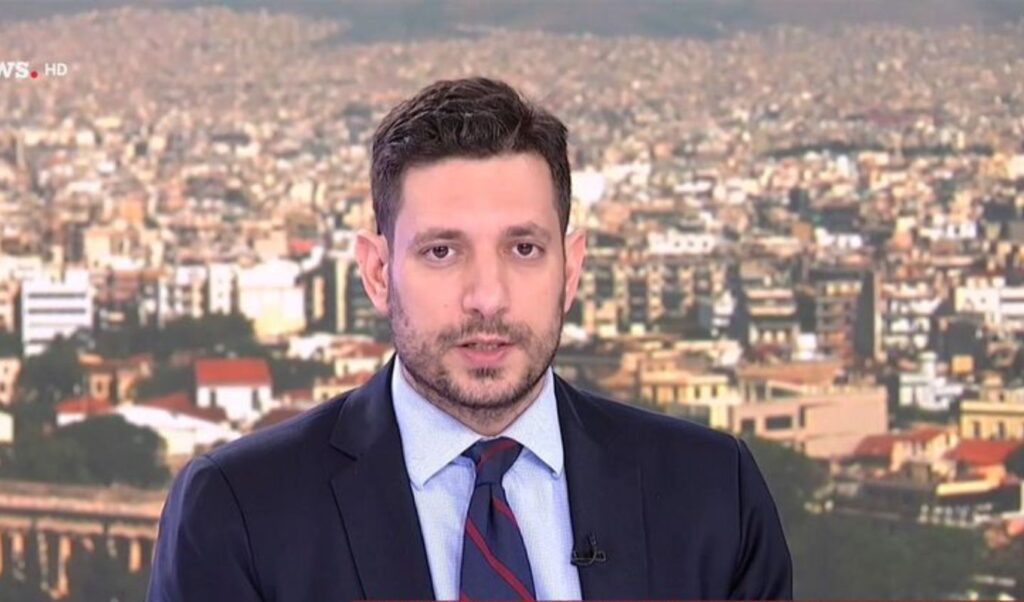
Deputy Transport Minister Konstantinos Kyranakis spoke in strong terms, commenting on the first day of the trial for the Tempi tragedy, alleging an attempt to undermine the proceedings. He also referred to ongoing interventions that, as he claimed, are being implemented to upgrade the Greek railway network. Speaking Tuesday on ERTnews, he characterized the start of the judicial process for the deadly train accident as particularly significant, noting that “the trial has finally begun,” while adding that there had been recorded attempts to delay it in the preceding period.
In the same context, commenting on the scenes of tension and disorder from the first day, he emphasized that “procedures must not be allowed to be sabotaged” and that Justice must function “without blackmail and pressure.”
Kyranakis on Konstantopoulou: There are political figures who want to be at the center even in such a sensitive procedure
He appeared particularly sharp toward Zoe Konstantopoulou, whom he accused of attempting to turn even such a sensitive procedure into a field for personal promotion. “There are political figures who want to be at the center even in such a sensitive procedure,” he said, adding that the president of Course of Freedom “believes that even in court, where the relatives who lost their children should have the first word, she must be the protagonist.” According to him, “she tried once again to create a problem.”
The deputy minister insisted that the trial must proceed “with terms of seriousness and dignity,” without interventions that distort the procedure and shift focus away from the victims’ relatives and the search for truth. With this specific statement, the government attempts to incorporate the scenes from the first day into a broader political narrative about an attempt to derail a trial with heavy institutional and social weight.
“New trains, new infrastructure, new stations”
Konstantinos Kyranakis also presented the government’s plan for railway modernization, describing it as a “triptych” with axes of “new trains, new infrastructure, new stations.” As he said, for the new trains component, an agreement has already been signed with the Italian side, with an investment of 308 million euros, while for the first time a contract termination clause is provided in case of non-implementation of the investment. According to him, 23 trains have already started test runs, with the first expected in early 2027 and full completion by the end of the same year.
Regarding infrastructure, the deputy minister mentioned that works on the Athens-Thessaloniki axis are expected to be completed by summer 2026, before the arrival of new trains. As he claimed, the entire axis will have full remote control, signaling and new safety systems, while real-time precise train location technology will also be integrated, ensuring immediate response to failures or violations.
“The network’s operation in 2019 was based almost exclusively on manual procedures. Today we have reached 80% of remote control and by summer we will reach 100%,” he said characteristically, attempting to demonstrate that the railway’s image has already changed substantially after the accident. In the same vein, he emphasized that new tools have been added that allow “real-time precise location of trains,” as well as recording of communications and violations.
He made special reference to stations, noting that extensive renovation interventions are planned for Athens, Thessaloniki and Attica suburban stations, which – as he admitted – are currently in poor condition. The goal, he said, is to substantially improve the passenger experience and restore a sense of reliability and safety to the system.
“Very important steps have been taken so that such a tragedy is not repeated”
Konstantinos Kyranakis also focused particularly on personnel and their evaluation method, claiming that changes have been made in training and staffing of critical positions. “We have moved from theoretical to practical training, with evaluations and psychometric tests. If someone is unsuitable, they must be removed before an accident happens,” he said. He also noted that new digital shift recording systems are being implemented, so that “phenomena of data falsification are not repeated.”
As the deputy minister said, the judicial investigation for Tempi must proceed unobstructed, but at the same time the effort to reform the railway cannot remain on the sidelines. “Daily work is being done to change the railway’s image. It may not create noise, but it is critical for safety,” he said, attempting to shift the discussion from political confrontation to managing the next day.
Concluding his intervention, he argued that the changes underway respond both to society’s demands and to the victims’ families’ request that such a tragedy not be repeated. “Very important steps have been taken so that such a tragedy is not repeated,” he noted, connecting the government responsibility narrative with that of reformist continuity in the transport sector.