
The war in the Middle East dominates the GPO poll for iefimerida.gr for March 2026. Military operations in the Middle East continue to cause great concern among Greek citizens who cannot see either their end or their outcome. Following are the detailed conclusions of the March 2026 poll as recorded and analyzed by GPO Research Director Antonis Papargyris.
GPO research conclusions for March 2026 for iefimerida
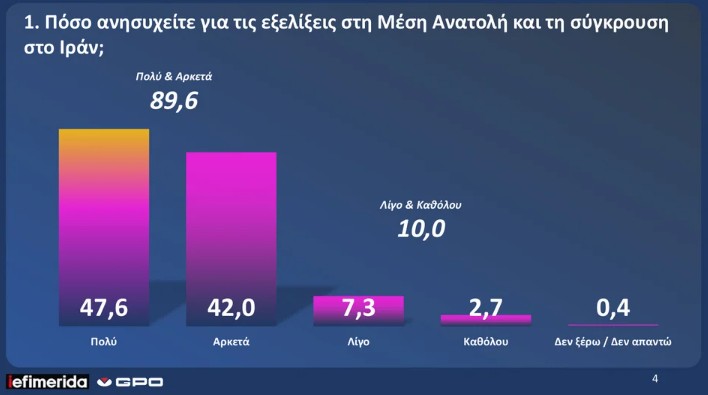
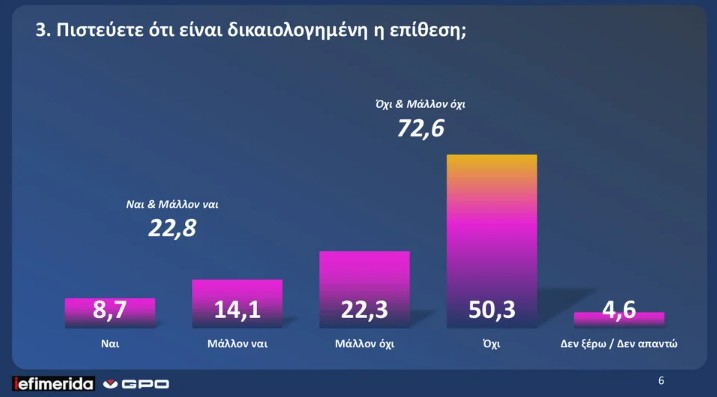
How citizens judge Greece’s stance on the Middle East war
During the first weeks of the war we had focused more on the impact of Greek actions and the truth is that recent developments have significantly strengthened the country’s diplomatic and military profile.
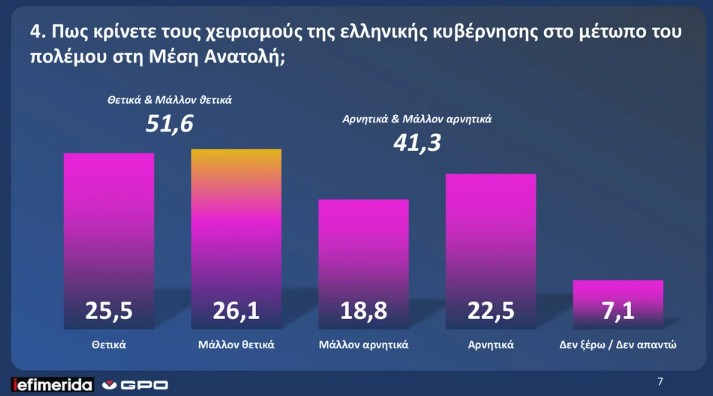
Citizens disagree with US-Israel attack on Iran
As conflicts continue, it becomes clear that Greek public opinion, like most European ones, strongly disagrees at 73.7% with the attack launched by the US and Israel and does not consider the attack against the Iranian regime – however harsh and oppressive – justified and legitimized under international law principles.
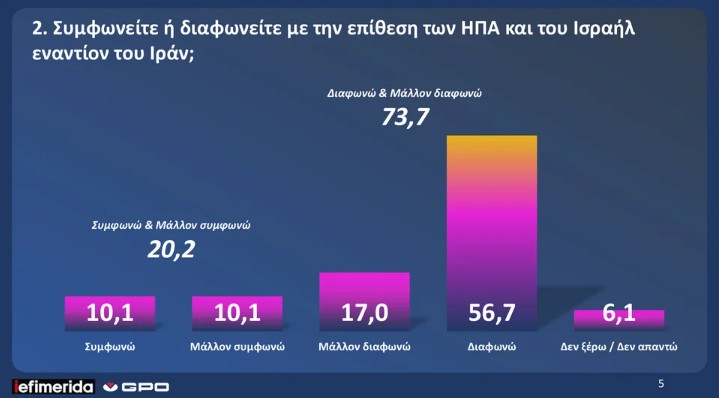
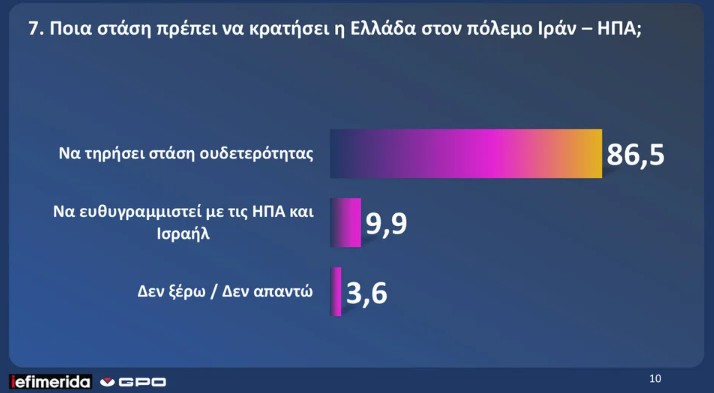
Moreover, 81% believe the war is being waged to control the region’s economic interests rather than to prevent Iran’s potential nuclear development, which is why 86.5% demand that the Greek government maintain a neutral stance and not align with US and Israeli interests.
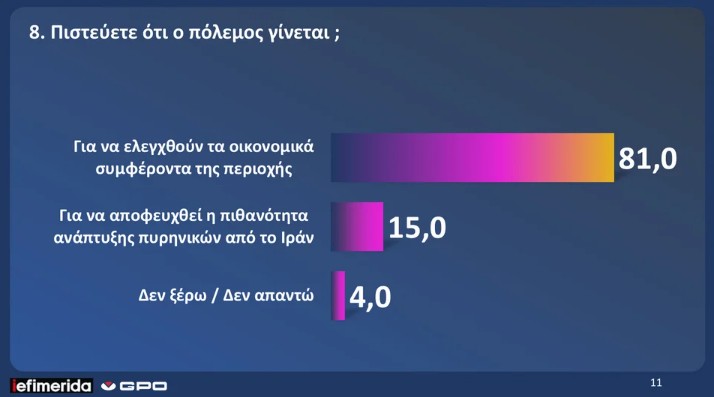
The Greek side has currently ruled out further participation in military operations, aligning with the majority of citizens who, as mentioned, do not wish the country’s involvement in a war they do not justify with economic dominance goals rather than those proclaimed by President Trump and the Israeli government.
More than 7 in 10 agree with providing Cyprus protection umbrella
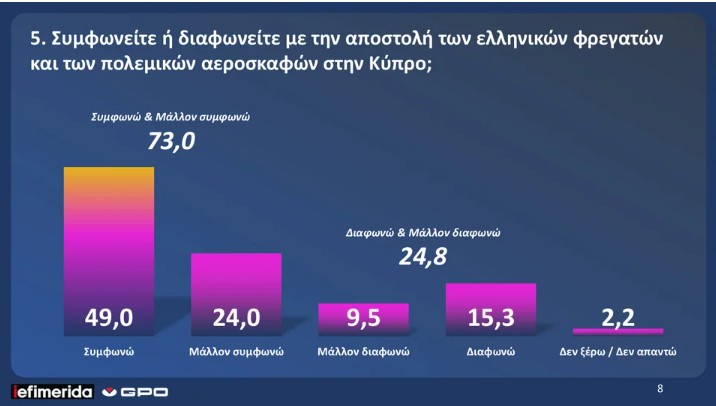
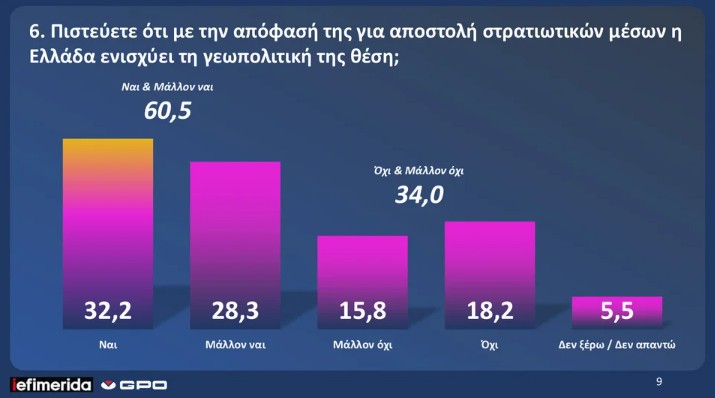
Conversely, providing a protection umbrella to Cyprus is considered rather self-evident and is applauded by 73% of citizens, as the deployment of Greek frigates and warplanes is perceived as defensive actions with deterrent character that simultaneously strengthen the country’s geopolitical position according to 60.5%, a view shared by significant segments of voters beyond New Democracy.
The most important problem remains high prices
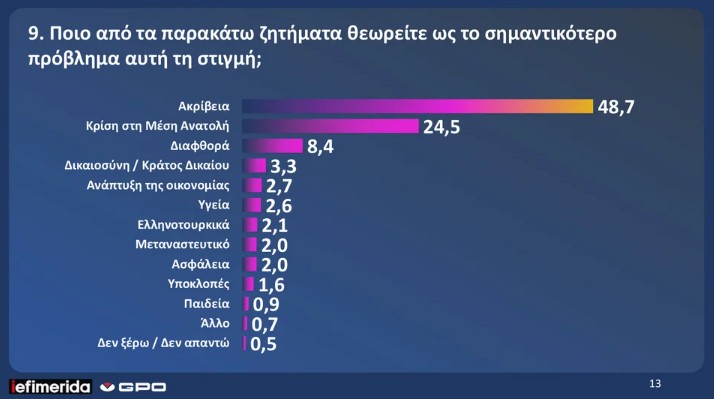
On the domestic front, high prices at 48.7% continue to be considered the most important problem right now, while as expected, the Middle East crisis concerns 24.5% of the total. The two responses work in combination as the greatest concern from the war front relates to its economic impacts and the effect of ongoing conflicts on citizens’ daily lives.
Positive response to government measures imposing profit caps
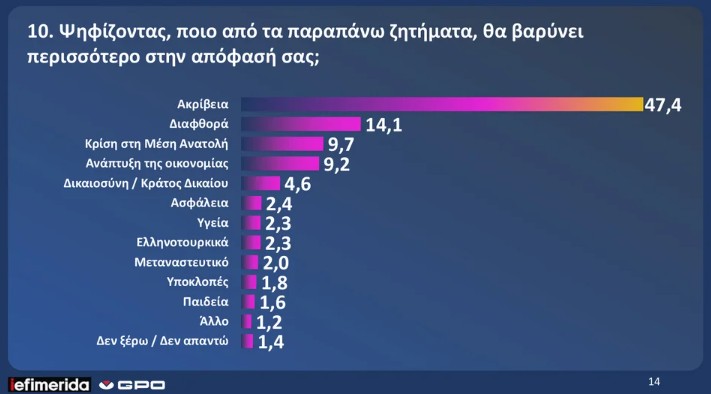
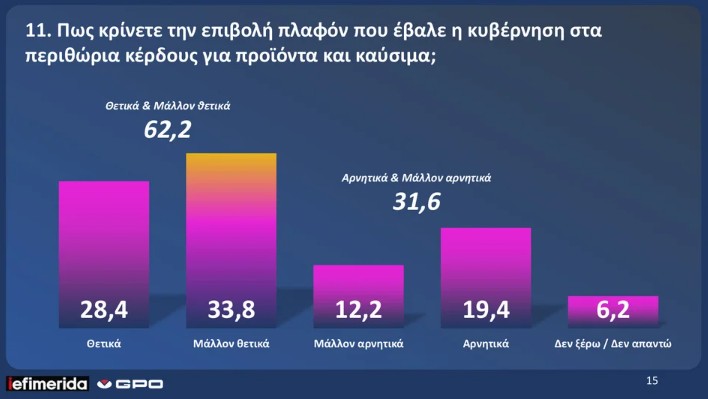
In this direction, the government’s first measures, specifically imposing caps on profit margins for products and fuels, are judged positively and rather positively by 62.2% of the total. As a voting criterion, besides addressing high prices, handling corruption issues is also positioned with 14.1% of the total stating this will be the issue weighing most heavily on their final political choice.
Majority desires government change in elections
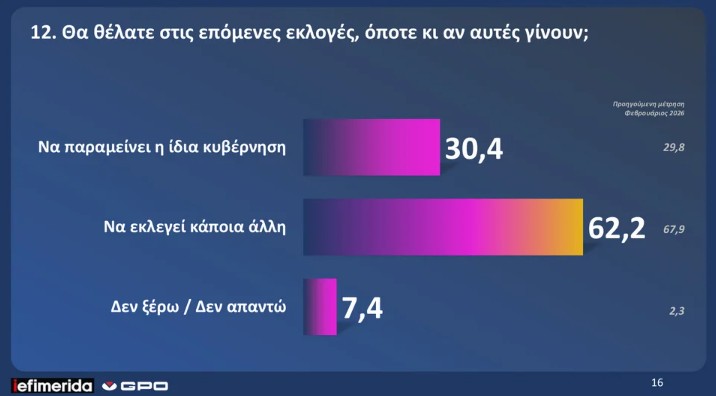
After a long period, the percentage of those wishing the current government to remain after the next elections exceeds 30%, specifically detected at 30.4%, with the large majority desiring government change remaining strong at 62.2%, though reduced from February’s survey and politically fragmented.
Stagnation for Tsipras, decline for Karystianos
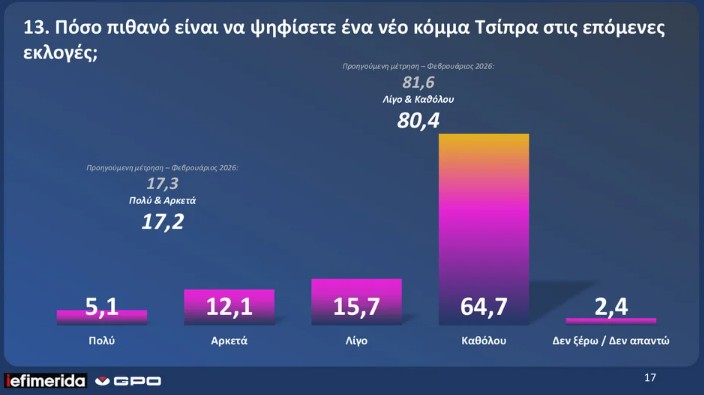
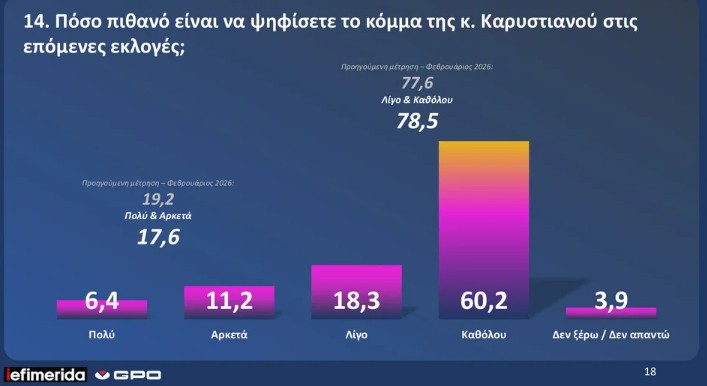
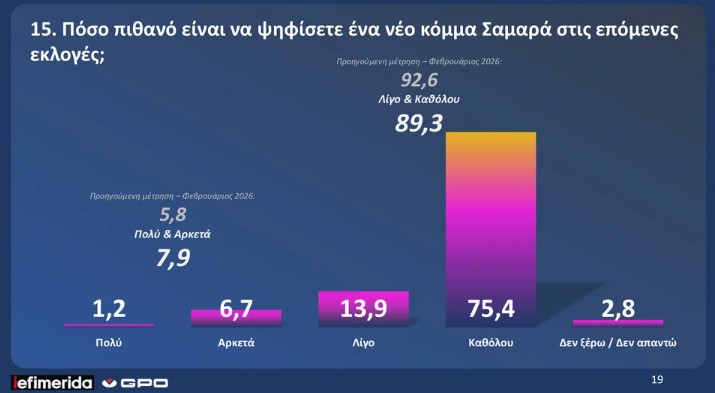
Stagnation is recorded in potential voting for Tsipras’s upcoming party, decline for Karystianos, while an increase is noted in voting probability for Samaras’s party. However, in all three cases, the indicator that significantly declines is strong probability, where percentages for Tsipras from February’s 7.9% are now at 5.1%, for Karystianos from 8.1% to 6.4%, and for Samaras from 1.6% to 1.2%. It appears that months of discussion and waiting for new party formations rather limits their momentum.
New Democracy rises in voting intention
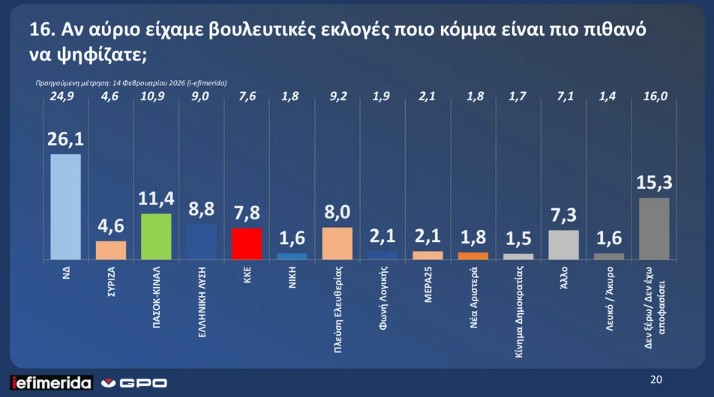
The impact of government initiatives on the Middle East front is reflected in a positive change in voting intention, where New Democracy gains 1.2% compared to February and now stands at 26.1%. Small rise of 0.5% for PASOK which, despite recent internal political turbulence, is reflected just before its congress at 11.4% at a relative safe distance from other parties. Larger decline recorded for Plefsi Eleftherias from 9.2% to 8%, smaller for Greek Solution moving to third place with 8.8% today from 9% last month, while KKE shows small increase from 7.6% to 7.8% for March. SYRIZA remains stable at 4.6% with the percentage declaring voting intention for another party remaining relatively high at 7.3%. Finally, 15.3% of the electorate continues to declare undecided.
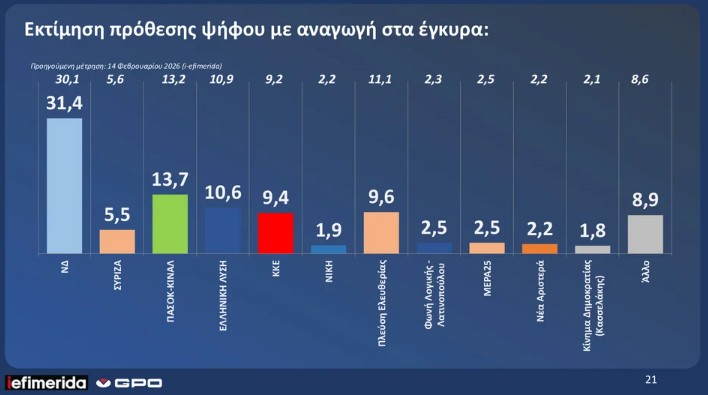
New Democracy at 31.4% in vote estimation
In vote estimation, New Democracy gathers 31.4%, increasing its percentage by 1.3% compared to GPO’s February measurement. PASOK also records a small increase of 0.5%. Party percentages in vote estimation in GPO’s March measurement for iefimerida:
- New Democracy: 31.4%
- PASOK: 13.7%
- Greek Solution: 10.6%
- Plefsi Eleftherias: 9.6%
- KKE: 9.4%
- SYRIZA: 5.5%
- Voice of Reason: 2.5%
- MeRA25: 2.5%
- New Left: 2.2%
- NIKI: 1.9%
- Democracy Movement: 1.8%
- Other: 8.9%
Full GPO poll for iefimerida HERE