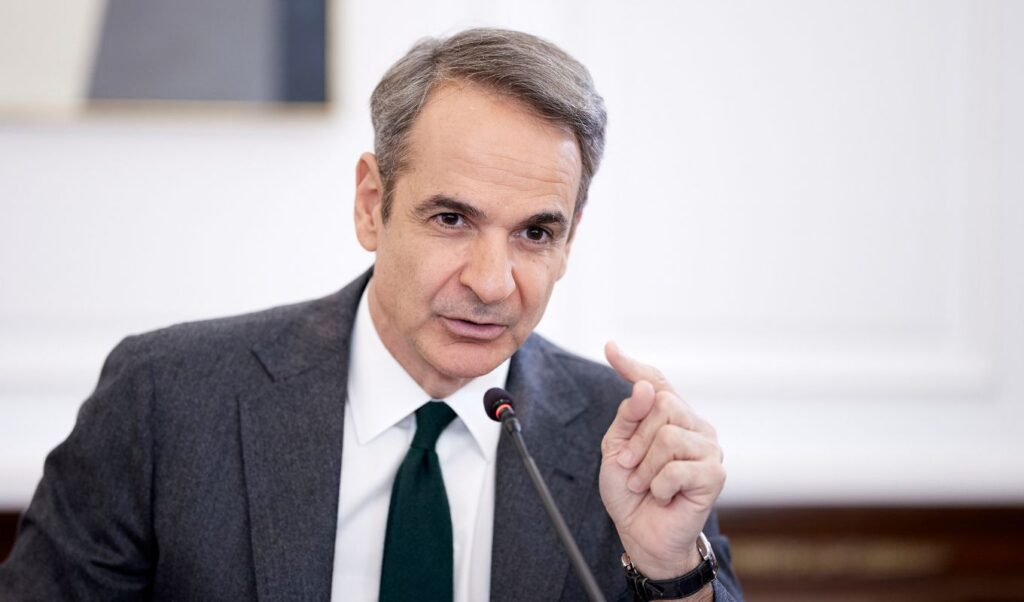
With the Middle East war now entering its fourth week and airstrikes and naval attacks escalating, Kyriakos Mitsotakis is convening the Government Council for National Security (KYSEA) today at 11:00 AM for a comprehensive briefing on all developments. The migration issue is clearly occupying the government, although there are no signs yet of increased flows due to the war. “It is obvious that if we find ourselves in such situations of instrumentalization, there is always the factor of force majeure, which we experienced last summer when we suspended asylum procedures,” stated Migration Minister Thanos Plevris, adding that “if we find ourselves in such situations, it is certain that the measures we will take will be tougher than those of last summer.”
Kyriakos Mitsotakis is coordinating with Giorgia Meloni and other European leaders to ensure timely and effective coordination so that Europe is not caught off guard as it was in 2015 during the refugee crisis that followed the Syrian crisis. Strengthening the protection of the EU’s external borders is at the center of this effort. It is no coincidence that as a result of the discussion that had preceded on Thursday afternoon in Brussels, the EU Summit conclusions included the provision that “based on lessons learned from the 2015 migration crisis and to avoid a similar situation, the EU is ready to fully mobilize its diplomatic, legal, operational and financial tools to prevent uncontrolled migration movements towards the EU and to maintain security in Europe.”
On the operational front, the presence of Greek armed forces in the Eastern Mediterranean for Cyprus’ defense is already being assessed positively, with two frigates and two pairs of F-16 fighter aircraft, as well as the effective operation of “Greek” Patriots in Saudi Arabia. After the Brussels Summit ended late Thursday evening, Kyriakos Mitsotakis characterized as “extremely positive the fact that in the case of the attack on Cyprus, many European countries, led by Greece, rushed to assist Cyprus by providing air and naval support, so that Cyprus feels completely secure.” In his customary Sunday Facebook post, the prime minister noted that “the solidarity shown by Greece and other EU member states towards Cyprus proved that Europe can be united. However, it must also be ready – we must have a clear and implementable roadmap in case European territory is attacked,” while setting the tone for government policy amid this war by saying that “Greece continues to act responsibly, strengthening stability and security in the region.”
Beyond the KYSEA agenda, but at the top of the government’s agenda, is mitigating the economic impacts that the war inevitably causes. Mr. Mitsotakis again asked Brussels to present “a specific toolkit capable of providing temporary and targeted support to households and businesses,” while committing that “in the coming days, additional interventions will follow to support industry and address energy costs.” It is worth noting that in the Summit conclusions text, “the European Council calls on the Commission to continue reporting to the Council on the potential impact of recent developments on the EU regarding energy security and energy prices, supply chains and migration, and to propose measures as appropriate.”
Specifically regarding fuel, it calls on the Commission “to present without delay a toolkit of targeted temporary measures to address recent sharp increases in imported fossil fuel prices due to the Middle East crisis.” As Kyriakos Mitsotakis subsequently noted, this reference “opens the door for more flexibility in taking measures, both national and European, to address this emergency crisis.”
Since the Commission’s toolkit includes the notorious escape clause, this will allow Greece to exceed the agreed spending limit and either reduce the special consumption tax on fuel (less likely scenario) or activate the so-called fuel pass (more likely scenario). In any case, the government maintains a wait-and-see stance in light of developments and carefully weighs its options.