As military operations in the Middle East escalate and the war enters its fourth week since its onset, the Maximos Mansion is focusing attention on three main fronts: mitigating the economic impacts that war inevitably causes, containing potentially increased migration flows, and strengthening the country’s geopolitical footprint.
War escalates in the Middle East: The front of Greek armed forces presence in the Eastern Mediterranean
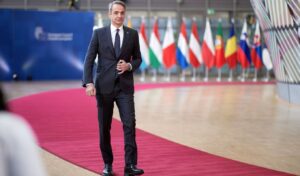
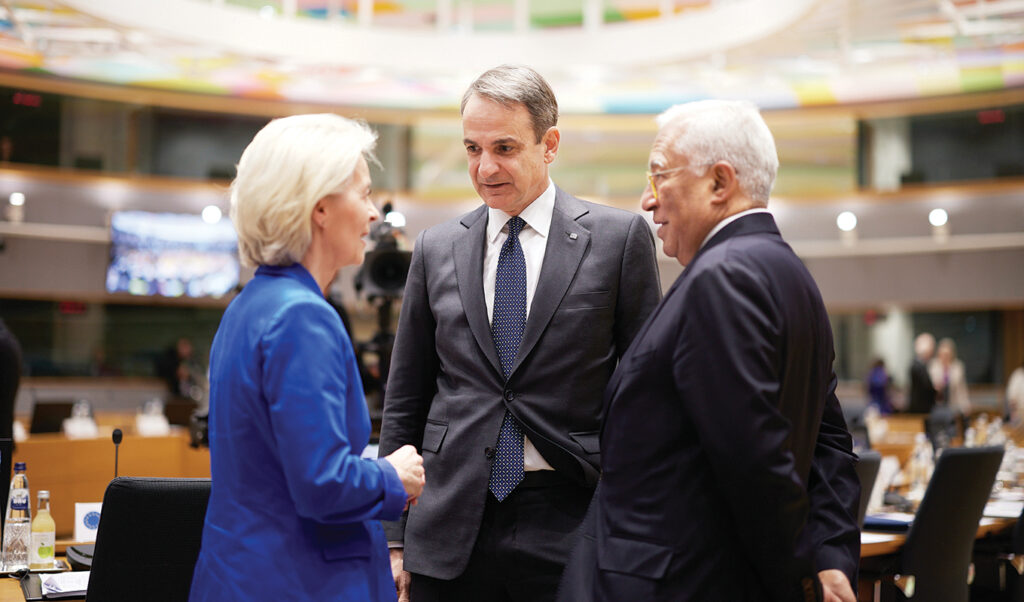
Regarding the latter aspect, the presence of Greek armed forces in the Eastern Mediterranean for Cyprus’s defense is already being positively assessed, with two frigates and two pairs of F-16 fighter aircraft. After the conclusion of the European Summit in Brussels, late Thursday evening, Kyriakos Mitsotakis characterized as “extremely positive the fact that in the case of the attack Cyprus suffered, many European countries, led by Greece, rushed to assist Cyprus, offering air and naval support, so that Cyprus feels absolutely secure.” He set the goal for the EU to chart a roadmap with a horizon of months, so that “we can have a clear operational plan, in case this clause (mutual assistance) needs to be activated – what would be the steps we would take depending on the type of threat.”
At the same time, in her own press conference, European Commission President Ursula von der Leyen emphasized among other things that “Cyprus’s security is the European Union’s security.” It’s worth noting that in the Summit’s conclusions text, in an indirect reference to Turkey as well, the phrase was included again that “the European Council recalls the importance of cooperation with like-minded partners who share the EU’s objectives in the field of foreign policy and security policy.”
Increasing Greece’s geopolitical footprint
The increase in geopolitical footprint is also related to the practical assistance our country offered to Riyadh and defense against foreign invasion through the Patriot artillery, part of the Greek Force in Saudi Arabia. On Thursday, for the first time, Patriot missiles of the Greek Armed Forces were activated and shot down Iranian ballistic missiles, contributing to the security of the country’s oil installations.
Defense Minister Nikos Dendias emphasized that “the effectiveness of the Armed Forces is proven,” while noting that in this way “we protect every EU citizen and the entire world, as oil prices are very important for our livelihood.” Meanwhile, Mitsotakis and Macron took the initiative for the “27” to agree on a formulation calling for a moratorium that would exclude any strikes against energy installations, whether located in Iran or in Persian Gulf countries.
Alert for new migration wave
Regarding migration, Mitsotakis is coordinating with Giorgia Meloni and other European state leaders to ensure timely and effective coordination so that Europe is not caught off guard as in 2015 and the refugee crisis that followed the Syrian crisis. Strengthening protection of EU external borders is at the center of this effort. It’s no coincidence that as a result of this discussion that had preceded it, the Summit conclusions included the provision that “based on lessons learned from the 2015 migration crisis and to avoid a similar situation, the EU is ready to fully mobilize its diplomatic, legal, operational and financial tools to prevent uncontrolled migration movements towards the EU and to maintain security in Europe.”
Interventions for economic impacts
The first and most important front, that of the economy, is increasingly occupying the government’s attention, as naval and air military operations intensify, the crisis expands, and impacts on energy prices are already visible. In the conclusions text, “the European Council calls on the Commission to continue reporting to the Council on the potential impact of recent developments for the EU regarding energy security and energy prices, supply chains and migration, and to propose measures, as appropriate.” Specifically regarding fuels, it calls on the Commission “to present without delay a toolkit of targeted temporary measures to address recent sharp increases in imported fossil fuel prices due to the Middle East crisis.”
As Mitsotakis subsequently noted, this reference “opens the door for more flexibility in taking measures, national but also European, to address this emergency crisis.” Since the Commission’s toolkit includes the notorious escape clause, this will allow Greece to exceed the agreed spending limit and either reduce fuel excise tax or activate the so-called fuel pass. In any case, the government maintains a wait-and-see stance pending developments and will not immediately proceed with any of these measures.
Published in Parapolitika