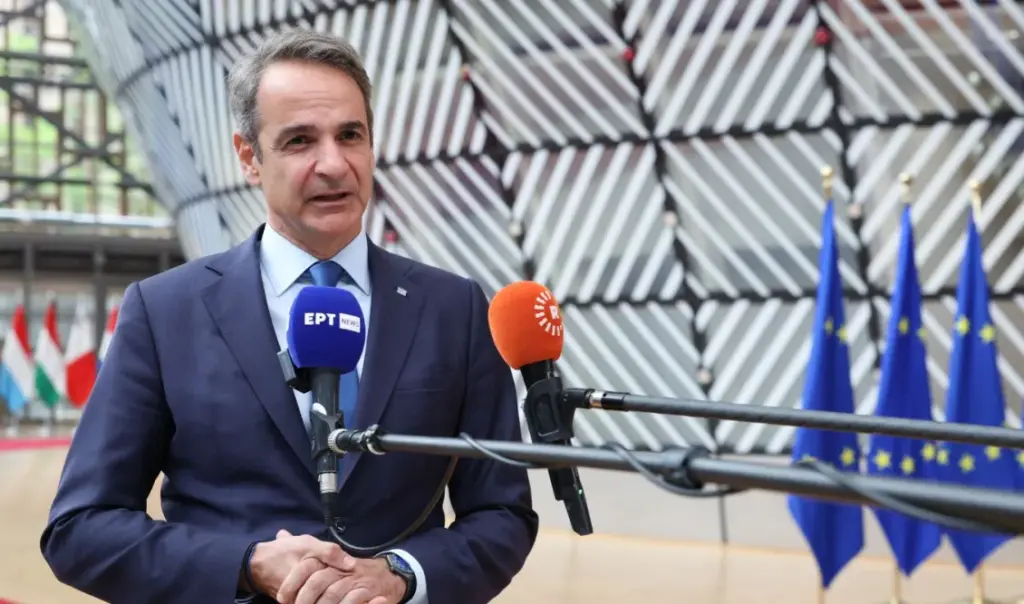
The European Council summit, amid a period of great geopolitical fluidity, will take place in Brussels on Thursday. Competitiveness and the Multiannual Financial Framework, the situation in Ukraine, the latest developments in the Middle East, their consequences and the European response, European security and defense, and migration are the main issues to be discussed.
Regarding the consequences and economic impact of the war, Kyriakos Mitsotakis is expected to emphasize that Europe must rely on the lessons learned from the energy crisis of 2022, following the Russian invasion of Ukraine. The compass for all decisions, as the Prime Minister highlighted in his Tuesday discussion with Bloomberg in Athens, should be the purchasing power of citizens, which is the other side of competitiveness. If necessary, the EU must have ready a plan that will provide temporary and targeted support to businesses and households.
Kyriakos Mitsotakis: Greece’s stance on the Middle East war
Regarding the war in Iran and the Middle East, Kyriakos Mitsotakis will emphasize that the defensive support provided by Greece – and subsequently other member states – to the Republic of Cyprus, was a demonstration of European solidarity in practice, without even activating Article 42.7 (TEU), which sets a precedent. At the same time, it emphasizes in the most emphatic way the geopolitical significance of the Eastern Mediterranean.
Today’s developments in the broader region vindicate the Prime Minister, who insisted in his positions at the European Council that the EU’s defense strategy (and the EU defense preparedness map) must have a 360-degree approach. That is, Europe must be ready to face threats not only on the eastern, but also on the southern borders of the EU. European security is directly linked to developments in the Middle East, as demonstrated by the example of Cyprus, an EU member state facing security threats.
Greece’s position is that the EU’s goal must be to achieve a diplomatic solution with Iran that addresses all aspects – with the nuclear and ballistic program of Tehran being fundamental.
Greece is not involved in military operations and does not intend to get involved in a possible operation in the Strait of Hormuz, as Kyriakos Mitsotakis has already made clear, recalling, in connection with the discussion about the possible extension of the mandate of Operation “ASPIDES,” that only Greece and Italy ended up contributing forces to the European operation in the Red Sea – a disappointing precedent that should not set high expectations.