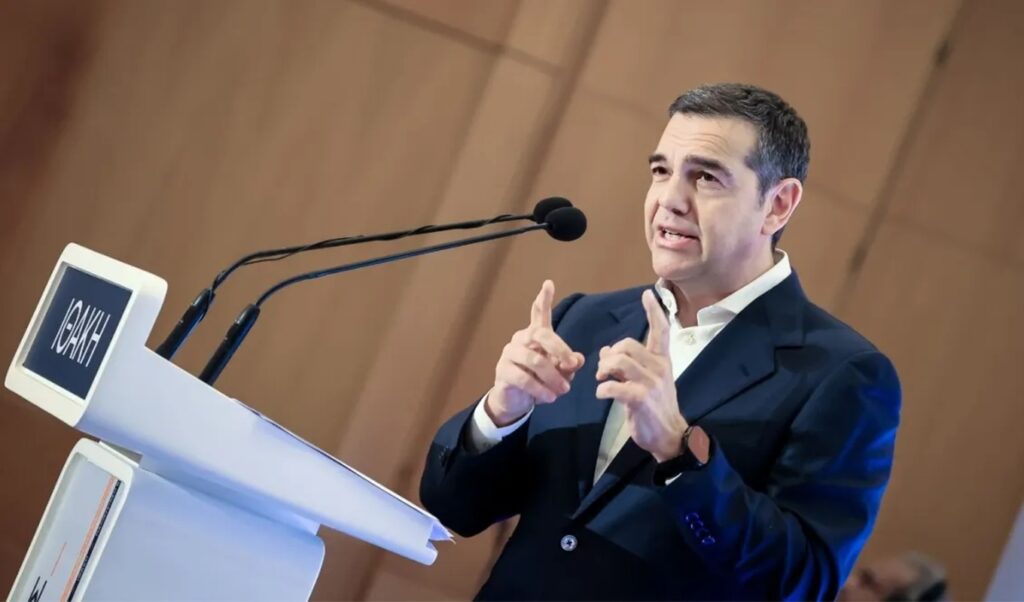
One day after the government’s announcements on tackling the energy crisis due to the war in the Middle East, Alexis Tsipras‘ Institute is expected to present its proposals for the country’s energy shield today. It should be recalled that the former prime minister, speaking in Kozani and analyzing the data of the new military conflict in the Middle East, had emphasized that the war in Iran is not simply a regional conflict, but the beginning of a new era of generalized geopolitical instability, clarifying that the red line for Greece is that our military installations should not be used for operations that could put the country in immediate danger.
At the same time, Alexis Tsipras had underlined that defending the homeland and Hellenism requires not only the necessary defense shield. “It also requires creating an energy shield. Which is a shield for the economy, production, households, businesses. And a shield against high prices. With a radical change in the role of PPC, from participant and accomplice in profiteering, to ally of society and households. As during our governance, when electricity prices did not increase by even one euro for four and a half whole years. But also with the immediate operation of the Ptolemaida 5 unit, which meets all modern specifications, not with imported natural gas, but with the lignite reserves of the region.”
Alexis Tsipras had also pointed out that “war is tragedy for the many, but for a few, very few, it is opportunity.” As he noted, the experience of recent years shows that the Mitsotakis government has surrendered the country to cartels and particularly to those in energy. “The Ukraine war gave them the opportunity for an unprecedented profiteering assault, based on bleeding millions of households dry,” he stated.
According to him, the data is revealing: “Electricity in Greece is 11% more expensive than the European average. Even this, however, is a misleading picture if we factor in Greeks’ purchasing power. Then, based on Eurostat data, we will see that the real cost of electricity for consumers in Greece is 40% more expensive than the European average. We are the 4th most expensive country among the 27 EU member states. And this is not an ‘achievement’ only of Putin or Zelensky. It is mainly an accomplishment of Mr. Mitsotakis. Who bears grave responsibilities for surrendering PPC to the alliance of cartels and profiteering. For violent delignification, destructive both for the country’s energy independence and for Western Macedonia. And of course for surrendering your region to indifference, economic decline, social dead end.”
The intervention package that Alexis Tsipras’ Institute will present on energy
Based on the proposals submitted by Alexis Tsipras, his Institute is expected to present today a package of interventions to strengthen energy security and tackle energy poverty.
– The first proposal concerns Western Macedonia and provides for creating a guaranteed free energy package for 20 years for every household in delignification areas. The plan is based on developing community-owned photovoltaic parks and implementing virtual energy offsetting. In parallel, installing energy storage systems at community level is proposed, so that free energy provision is stable and reliable. The same framework includes participation of all households experiencing energy poverty in delignification areas in collective self-production schemes, with full coverage of participation costs from public resources. Additionally, allocating land freed from lignite activity to new farmers for cultivation is proposed.
– The second proposal concerns shaping a National Strategic Plan for upgrading energy communities. As noted, today almost 20% of Greeks cannot adequately heat their homes, while 40% to 45% of households face overdue energy bills. In this context, a national plan is proposed, modeled on countries like the Netherlands, that would bring energy communities to 15% of electricity consumption within the next five years. The goal is for 200,000 citizens to actively participate in such schemes and at least 50,000 vulnerable households to join collective self-production programs. It also provides for dedicating at least 10% of new electrical capacity in each Region to broad-based energy communities, which is estimated to lead to 40% to 70% annual reduction in electricity bills for participating households. Additionally, simplifying licensing procedures through creating a unified service for energy communities is proposed, aiming to reduce bureaucracy.
– The third proposal focuses on reducing energy costs for municipalities. Specifically, mandatory establishment of an energy community in every municipality with over 10,000 inhabitants is proposed, within the framework and possibilities provided by the European REPowerEU program. The goal is that within the next five years, at least 15% of municipal infrastructure energy needs are covered through these schemes, as well as lower water supply and irrigation costs. Additionally, creating a special structure in each municipality to address energy poverty is proposed, which would support vulnerable households for their participation in energy communities, contribute to residential energy upgrades, and ensure no one is left without adequate heating.
– The fourth proposal concerns establishing a reciprocity clause for large energy investments. Prompted by plans to create a Giga Data Center in Western Macedonia, a large computing center worth 2.3 billion euros in the Agios Dimitrios area, it is proposed that the energy required for its operation be produced entirely by the investors themselves and not burden the region’s existing energy system. Additionally, based on the reciprocity principle, providing free basic energy to households in areas hosting such infrastructure is proposed. Furthermore, utilizing heat generated by facility cooling systems to feed the region’s district heating networks is proposed.