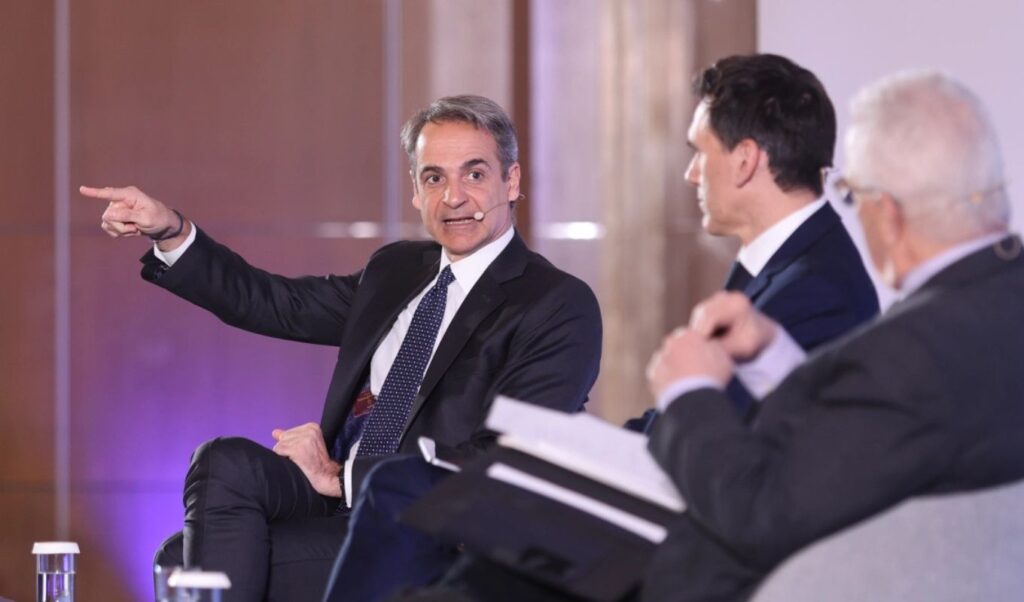
The “green light” was given on Wednesday by Kyriakos Mitsotakis for the much-discussed legislative regulation in recent months regarding the ban on social media use for children under 15 years old. A few days ago, responding to questions about social media use by minors, the Minister of Digital Governance, Dimitris Papastergiou, noted that Greece was among the first countries to raise the issue of restrictions on social media use by minors, emphasizing that the discussion is evolving at the European level, while announcing forthcoming announcements about the framework to be adopted.
On Wednesday, speaking at the “Athens Alitheia Forum,” the Prime Minister revealed that the government will very soon announce its final decisions on restricting access to specific social media platforms for children under 15 years old. As he emphasized, “we want to be absolutely sure that what we will announce will be implementable and will not ‘stumble’ over the European regulatory framework, specifically the Digital Services Act, the DSA. So stay tuned, very soon, I believe within the month, there will be significant announcements on this issue.”
The issue is complex and multifaceted and has been the subject of extensive consultation in recent months between the relevant Ministers of Digital Governance, Dimitris Papastergiou, Health, Adonis Georgiadis (with active involvement of the Deputy Minister responsible for Mental Health, Dimitris Vartzopoulos), and Justice, Giorgos Floridis, in cooperation with State Minister Akis Skertsos. The legislative initiative will come from the Ministry of Health, as the issue will be legally framed around protecting children’s and adolescents’ mental health from social media addiction.
The related preparatory work has been completed and what remains is the finalization of difficult and sensitive issues, such as the precise definition of digital addiction and determining fines for online platforms in case of non-compliance, as well as whether a provision will be included in the Penal Code for parental responsibility, similar to what exists for alcohol consumption or drug use by minors, with such a measure being studied very seriously.
It’s worth noting that in a poll conducted by Alco company in February, the overwhelming majority of respondents (80%) agree with imposing restrictions on social media and banning access for children under 15 years old.
The factors that must be considered for the social media reform
The cooperation required to implement this reform, based on government planning, is four-fold. The first factor is the state, which will legislate the obligation for companies controlling social media to establish a specific framework for protecting minors, with digital age identity verification control. Anyone wanting access to social media will need to prove they are over 15 years old (after completing mandatory education in middle school), while some restrictions will also exist for those aged 16 to 18.
The second factor is the Commission: Australia was the first country to establish a strict framework for social media access, however it doesn’t have the restrictions imposed by the European common market, which Greece is naturally subject to as a European Union member state. Consequently, pressure on the European Commission to take immediate initiatives in this direction will increase. Indeed, the government will present the example of KidsWallet -the first state-supported age verification application- as a suitable technical solution model for age verification on platforms.
The third factor is the companies: Chinese ByteDance (TikTok), American Meta (Facebook, Instagram and WhatsApp, which is not expected to be included in the social media list) and also American Alphabet (YouTube) will be called upon to adapt to the new requirements of Greek legislation, otherwise fines and sanctions will apply.
The fourth and final factor is the parents of minors themselves, whom the government will attempt to sensitize more regarding their children’s exposure time to platforms and the consequences for their mental health, in order to have them as allies in this effort.