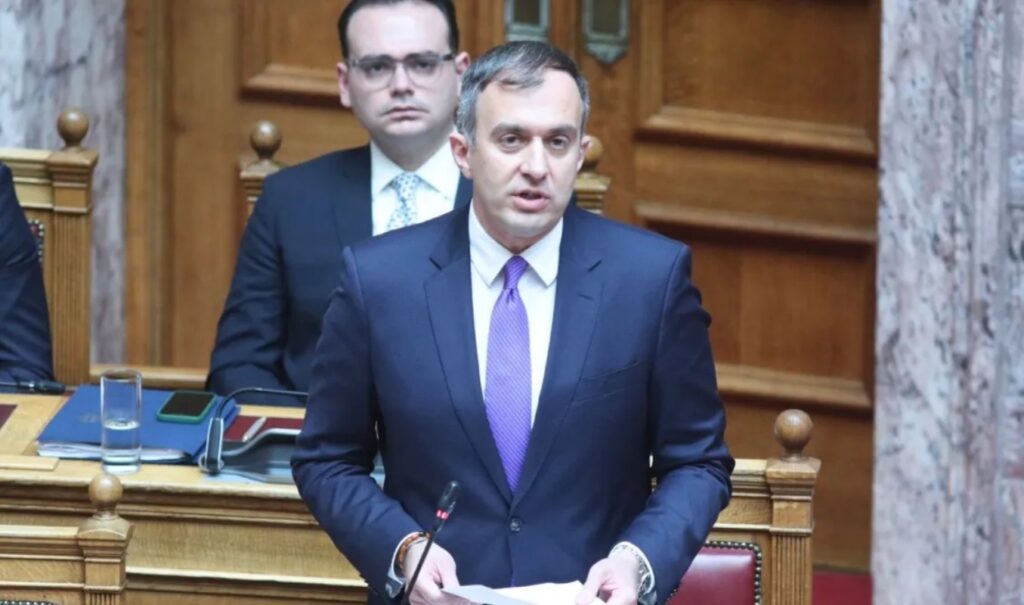
The government is attempting to highlight the joint presence of Kyriakos Mitsotakis and Emmanuel Macron in Cyprus as something far greater than a symbolic summit visit, and Tasos Chatzivasileou delivered precisely this political message in his statements to SKAI TV. The Serres MP and secretary for International Relations and EU of New Democracy characterized the visit to Paphos as “historic,” arguing that what transpired proves that support for the Republic of Cyprus is not limited to announcements and wishful thinking, but can acquire real operational and geopolitical substance. According to SKAI’s report, Chatzivasileou insisted that Mitsotakis’s initiative activated European forces to stand alongside Cyprus during an extremely difficult period, which the government now presents as a foundation for a new framework of European security in the Eastern Mediterranean.
The core message of his statement was that Cyprus can function as a testing ground for transitioning common European defense from theory to practice. This is precisely where the political weight of his declarations lies. He didn’t simply speak about a trilateral meeting with high symbolism, but about a moment that, according to his assessment, establishes “new foundations” for a new European security environment in the Eastern Mediterranean. In this way, the government attempts to present the Paphos visit not only as a supportive move toward Nicosia, but also as a model for future European defense cooperation, where member states will not settle for declarations but will coordinate in the field as well.
Chatzivasileou: The narrative for common European defense
Chatzivasileou directly connected the developments in Cyprus with Article 42 of the Lisbon Treaty, arguing that the partnership of European forces reflected in the current crisis mirrors the spirit of European defense assistance. This point has particular significance because the EU’s mutual defense clause is indeed provided for in Article 42, paragraph 7 of the Treaty on European Union, as recorded in EUR-Lex. The clause stipulates that if a member state suffers armed aggression on its territory, the other member states are obliged to provide it with aid and assistance by all means at their disposal, in accordance with Article 51 of the UN Charter. This doesn’t automatically mean the clause was officially activated in the current phase, but explains why government officials use this institutional background to politically frame the visit’s message.
This reference also gives a broader European dimension to a crisis that Athens doesn’t want to appear as solely a Greek-Cypriot matter. The government narrative essentially states that Cyprus is European territory and therefore its security concerns not only Nicosia and Athens, but the entire European Union. Within this framework, Mitsotakis attempts to appear as a leader who is not limited to national rhetoric but claims a role as architect of a new European strategy for Eastern Mediterranean security. This is precisely the logic behind Chatzivasileou’s phrase that the prime minister confirms his role as a “European statesman,” a formulation with clear political targeting and obvious domestic consumption.
Chatzivasileou: The message to Turkey
His statements also placed particular weight on the reference to Turkey. Chatzivasileou said that Ankara received a dual message of European solidarity and regional stability, and that the Republic of Cyprus is European Union territory that Europeans defend collectively. This phrase fits into Athens’s effort to show that Cyprus is no longer an issue that can be addressed only within the narrow framework of Greek-Turkish or Turkish-Cypriot balances, but is part of European security. Simultaneously, Chatzivasileou insisted that Turkey, regardless of any military or communicative maneuvers it attempts, cannot change the basic fact that it continues to illegally occupy the northern part of Cyprus.