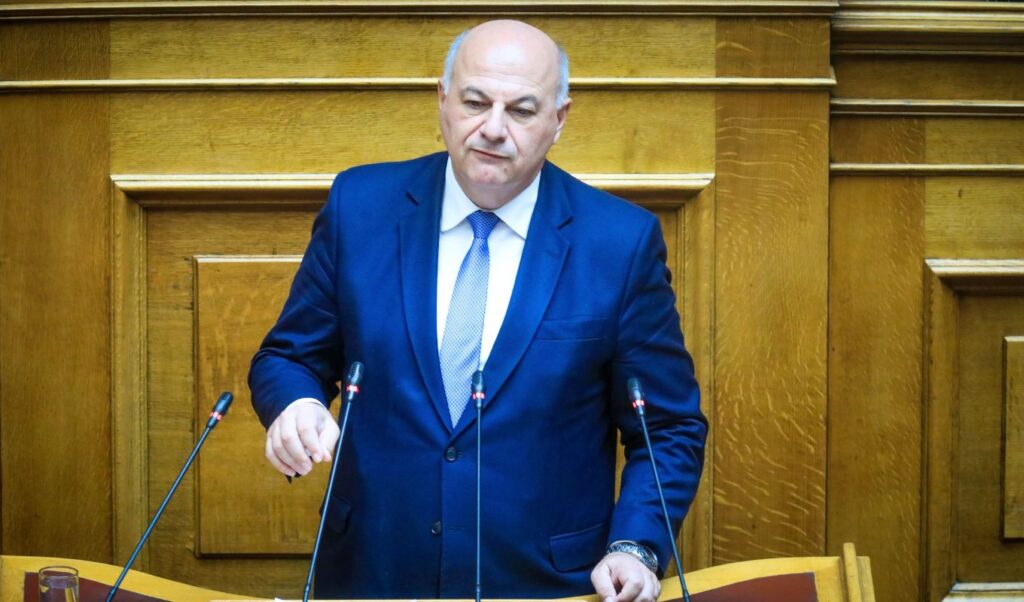
“Today’s discussion in the Plenary completes a long parliamentary process that lasted five months and focused on the operation of OPEKEPE and the management of EU subsidies in the agricultural sector. This is a particularly important issue, as it concerns not only the operation of a public organization, but also the credibility of the agricultural payment system, the trust of producers and the proper management of European resources. This trust is the most important capital that we must protect,” emphasized Minister of Agricultural Development Kostas Tsiaras speaking in Parliament during the discussion on the OPEKEPE report.
Tsiaras: Government treated OPEKEPE as an institutional problem requiring solutions
“That’s why the investigation conducted in Parliament was extensive and in-depth. The Investigative Committee operated for five months. Dozens of sessions were held. More than 350 hours of work were recorded. 76 witnesses were examined. Thousands of pages of documents were submitted. This was one of the most extensive parliamentary procedures ever conducted for the operation of a public organization,” he further noted.
“Therefore, when I hear the word ‘cover-up’ being repeated, I must say that it does not correspond to the actual facts. Cover-up has specific characteristics: limiting the investigation, limiting witnesses, limiting evidence. In the case of the Investigative Committee, exactly the opposite happened. Dozens of people were examined, a large volume of evidence was collected and all views were recorded. And it’s worth noting that the majority of witnesses concerned the period of New Democracy governance. So if there was an intention to cover up, we would not have opened such an extensive investigation process ourselves,” continued the Minister of Agricultural Development.
“OPEKEPE’s problems are not circumstantial”
“The Investigative Committee process revealed something very substantial. That OPEKEPE’s problems are not circumstantial. They did not suddenly appear in recent years. On the contrary, these are pathologies that have been formed over time. Weaknesses in control mechanisms. Deficiencies in technological infrastructure. Administrative distortions. Delays in critical reforms, such as grazing management plans,” added Kostas Tsiaras.
“This is a complex institutional problem. And precisely because it is complex, it cannot be addressed with simplistic political interpretations. Yet this is exactly the choice the opposition made. Mr. Androulakis tried to present the issue as a case limited to specific political figures. But reality is much more complex than this image. And the responsibility of all of us is to address problems with seriousness and documentation. During the Investigative Committee we heard dozens of witnesses and examined a huge volume of evidence. And what emerged ultimately? That there is no objective evidence of illegal ministerial intervention. The Committee’s own report records that the objective or subjective substance of the allegations made is not substantiated,” he then emphasized.
“On the contrary, we heard testimonies that confirmed that the so-called ‘technical solution’ was a practice known in the agricultural subsidies system. The former Minister of Agricultural Development of SYRIZA, Mr. Arachovitis, testified that it was implemented in consultation with European authorities and controlled by the European Commission. Other witnesses recognized that it was necessary to pay livestock farmers within the framework of the Common Agricultural Policy. And yet today there is an attempt to present this long-standing practice as alleged criminal responsibility of specific ministers,” he added at another point.
“Institutional problem requiring solutions”
“Let me now focus on the most substantial issue. What we do from now on. The government did not treat the OPEKEPE issue as a circumstantial political crisis. It treated it as an institutional problem requiring solutions. Upon assuming my duties in June 2024, I received a clear mandate from Prime Minister Kyriakos Mitsotakis: to examine the Organization’s operation in depth and proceed with the necessary corrective interventions. We did not choose the easy path of silence. We chose the difficult path of reform. That’s why we proceeded with drafting a comprehensive action plan for OPEKEPE’s reorganization. A plan that includes: improvement of control procedures, strengthening of cross-checks, corrective interventions in payment procedures, and full compliance with observations from European authorities,” argued Mr. Tsiaras.
According to the Minister of Agricultural Development, “control procedures were strengthened to identify cases that do not meet legal requirements. Cases showing signs of irregularities were referred to the Justice system. Initiatives were also promoted for upgrading information systems and strengthening internal control mechanisms. And we proceeded with institutional interventions aimed at restoring the credibility of the payment system, by transferring the Organization to AADE.”
“And this is because the real stake is to ensure that every euro of European support reaches real producers. In closing, I want to make a brief reference to a broader institutional issue. The experience of recent years shows that criminal investigation of political figures often becomes a field of intense party confrontation within Parliament. This helps neither Justice nor citizens’ trust in institutions. That’s why, with Prime Minister Kyriakos Mitsotakis’ proposal in the context of the next constitutional revision, modification of Article 86 of the Constitution is being considered, so that such cases are handled with an enhanced role of Justice. Because ultimately what is sought is not to multiply investigative committees, but to have results. And mainly to protect the public interest and the people of rural Greece who expect a reliable and fair support system,” concluded Kostas Tsiaras.