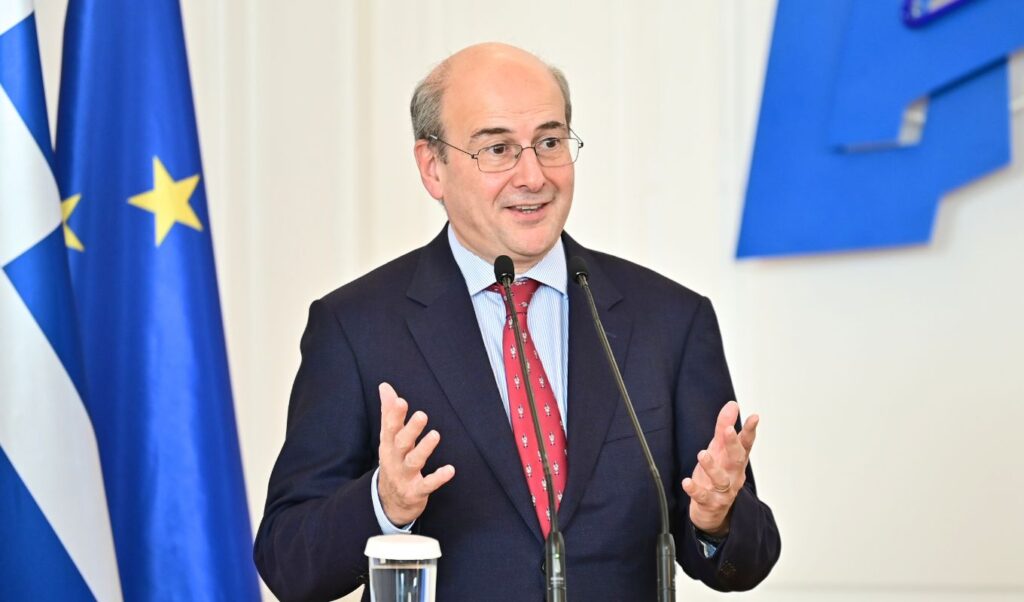
Deputy Prime Minister Kostis Hatzidakis speaking at the “Beyond Risk: Insurance as a lever for stability and development” event organized by the Hellenic Association of Insurance Companies stated: “After many efforts and several months, Greece is finally reaching the point, for the first time, of having no uninsured vehicles at all. This is a success for all of us. A success in terms of road safety. A success in terms of equality of citizens before the law. Because citizens are not the ‘smart alecks’ who avoid being insured while the rest become victims twice – in road accidents and in how the state treated them until now.”
Hatzidakis: €55 million in fines for 125,051 uninsured vehicles
Mr. Hatzidakis emphasized that he personally dealt not only with the legislation but also with the implementation of the uninsured vehicle detection mechanism, in cooperation with the competent Ministries of National Economy and Finance, Infrastructure and Transport, and Digital Governance.
As the Deputy Prime Minister noted, “just from the first of three notification cycles, 28,627 vehicles were insured and we estimate that today this number will be even higher as we proceed with the other two cycles. At the same time, yesterday the first fines totaling €55 million were issued for 125,051 vehicles that remained uninsured”. The Deputy Prime Minister stressed that strict enforcement of related measures will continue for businesses that have insurance obligations.
He added: “The first fine has already been imposed on a business. And I want to assure you that we are determined to conduct the necessary cross-checks – as in the case of cars – to ensure that businesses comply with their obligations”. Mr. Hatzidakis also noted that 2025 was a very good year for the insurance sector, as total premium production exceeded €6 billion, recording a new historic record. “For comparison, in 2019 total premium production was €4.4 billion”, he added. Mr. Hatzidakis also referred to a series of interventions implemented in 2025 to encourage private insurance and reduce costs for citizens. “We abolished stamp duty on a series of insurance acts, we abolished the 15% tax on health insurance for children up to 18 years old, and we increased to 20% the property tax discount for owners who insure homes valued up to €500,000 against natural disasters”, he noted.
Meanwhile, the Deputy Prime Minister referred to the establishment of mandatory insurance against natural disasters for properties valued over €500,000, for large businesses with turnover over €500,000, as well as for all cars, and to earlier initiatives such as the establishment of TEKA with savings accounts and the passing of the law for the reform of professional funds.
Possibilities for further tax incentives being examined
Referring to the sector’s requests for further tax incentives, the Deputy Prime Minister noted: “We are carefully examining the proposals you have submitted. You know we have made steps in previous years. At the same time, you understand that as a government we have an obligation to maintain fiscal balance and simultaneously with recent developments to keep our eyes on the Middle East and any consequences of this crisis. However, I cannot say your requests were unfounded, otherwise we would not have proceeded in the direction we did in previous years. Therefore, every tax relief must be evaluated under this lens as well”. Regarding health insurance premiums, Mr. Hatzidakis stressed that the government’s goal is to have a strong insurance market that simultaneously protects consumers. “We want a strong market that ensures capital adequacy of sector companies. But we also want a market that operates with transparency rules and ultimately for consumers. This is why last year we decided – the insurance companies, the Bank of Greece and the government – to intervene, as increases had reached levels particularly burdensome for citizens, especially regarding lifelong contracts”.
Mr. Hatzidakis stressed that “The preparation of the new index by ELSTAT, which is expected to be completed within the year, does not aim to restrict market operation. It aimed to restore reasonable balance”, while acknowledging that other interventions are needed to rationalize the increasing cost of hospitalization in private hospitals. “We are ready to examine all proposals and solutions based on a spirit of justice and international best practices”, he stated. Mr. Hatzidakis also noted that despite positive progress, significant room for insurance market development remains: “It is undoubtedly positive that insurance contracts gradually increased from 2023, but only 2 out of 10 homes are insured. While 6 out of 10 Greeks still do not contribute to supplementary pension programs. This means there are great opportunities for further sector development benefiting both the economy and society”. In this context, he emphasized that the government will continue strengthening the institutional framework for the insurance market. As he pointed out, “we are proceeding with the preparation of the National Strategy for Private Insurance against Natural Disasters, while simultaneously proceeding with the incorporation of the European Directive on the recovery and resolution framework for insurance and reinsurance undertakings”.