Widespread anxiety and uncertainty prevails in Cyprus. The Cypriot government is taking all necessary defense measures against the possibility of an attack by Iran and Hezbollah based in Lebanon. The climate of insecurity intensified significantly after the announcement by the US embassy in Nicosia, which authorized the departure of non-essential personnel and their families for security reasons.
The President of the Republic of Cyprus, Nikos Christodoulides, addressing the citizens of Cyprus on Wednesday with his announcement made clear once again that Cyprus does not intend to become part of any military operation. Diplomatic sources told parapolitika.gr that Nicosia’s strategy throughout the previous period was for Cyprus to serve as a bridge for providing humanitarian aid to all civilians – victims of war, a practice that was successfully applied during the 12-day War last summer.
In the diplomatic field, Nikos Christodoulides is in constant communication with European leaders, such as German Chancellor Friedrich Merz, as Berlin is in regular consultation with the Cypriot government. At the same time, the military presence of allies in the region is being strengthened, with the British warship HMS Dragon expected on the island next week, while France and Italy are considering sending additional naval and air forces, including the aircraft carrier Charles de Gaulle.
Avramopoulos to parapolitika.gr: Any threat against Cyprus concerns international legitimacy and the European Union itself, Greece must constantly highlight this dimension
The situation is also being closely monitored from Athens, where the National Council of Foreign Policy met for more than four hours. Foreign Minister Giorgos Gerapetritis briefed party representatives and, according to information, a climate of consensus prevailed.
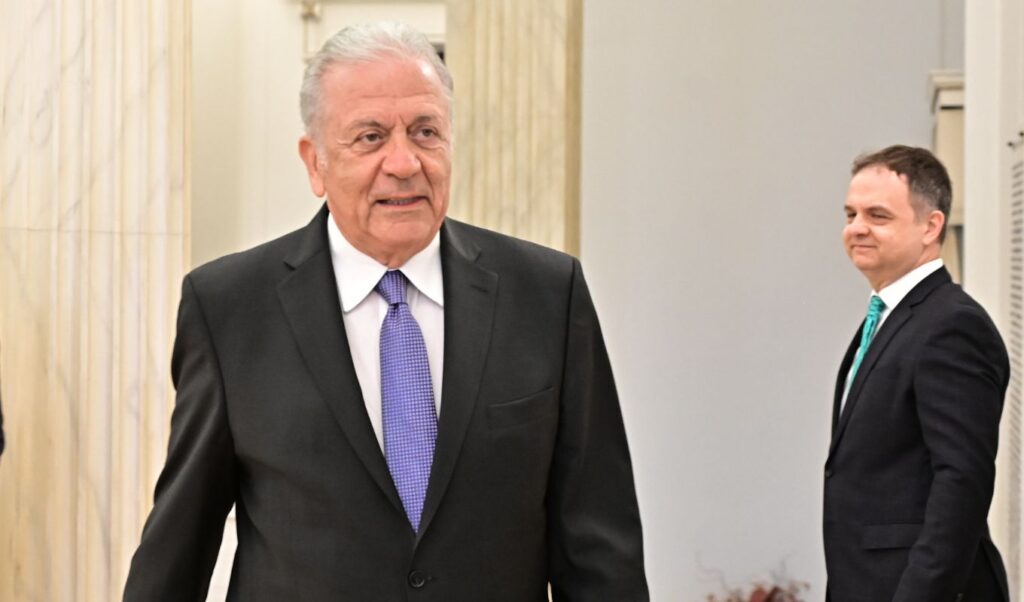
Former Foreign Minister Dimitris Avramopoulos, speaking to parapolitika.gr, argued that the current situation as it unfolds in the Eastern Mediterranean and mainly in Cyprus is particularly difficult and it is the duty of Greece, as well as the European Union, to provide it with strong political and diplomatic support. As he characteristically emphasized: “Cyprus security is not a bilateral issue. It is a European issue. Any threat against the Republic of Cyprus concerns international legitimacy and the European Union itself. Greece must constantly highlight this dimension and mobilize European and international institutions in this direction. The second level concerns deterrence. The presence of naval and air assets in the region functions as a message of stability and protection. This is not a show of force, but a defensive presence that contributes to security and deterrence of any further escalation.”
According to Mr. Avramopoulos, we are in a transition period and an environment of uncertainty is being created that requires composure, strategic thinking and diplomacy to prevent any unwanted escalation. In this context, Greece should move with strategic discipline, strengthen its credibility and its European role. “We are fortifying the Republic of Cyprus as a pillar of stability and sending the message that the Eastern Mediterranean is not a space for fait accompli,” he emphasizes, while simultaneously highlighting the defensive character of Greece’s military presence in the Eastern Mediterranean. “The Greek presence in the region must be clear as to its defensive character and must be part of a broader plan that serves stability. Responsibility requires that we always assess developments with sobriety, ensuring that our moves contribute to deterrence and maintaining balance. At the same time, the broader instability in the region can have indirect effects on sectors such as shipping, economy and tourism. That is why it is important to strengthen national resilience and have continuous preparation for every eventuality.”