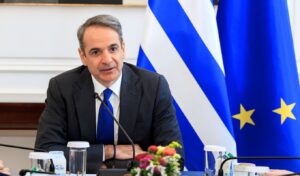
Left-wing party officials are calling it unacceptable that Prime Minister Kyriakos Mitsotakis will brief political parties on regional developments and Greece’s involvement in the conflict during a parliamentary discussion on postal voting.
As officials from SYRIZA and New Left emphasize, the issue is too serious to be discussed among other topics, particularly during a debate triggered by an Interior Ministry bill on diaspora voting. They add that “bilateral meetings” for party briefings “are not enough” and stress that “a specific national policy needs to be established.”
The same sources insist that a Council of Political Leaders should convene so Kyriakos Mitsotakis can explain how the country is operationally involved in this military conflict, how the safe repatriation of Greeks trapped in the Gulf region will be conducted, and what measures have been taken at Souda Bay. They emphasize that the Greek government should make it clear that Souda should under no circumstances be included in the operational framework, noting that Greece should manage the crisis like Spain did.
Political Leaders Council convening requested
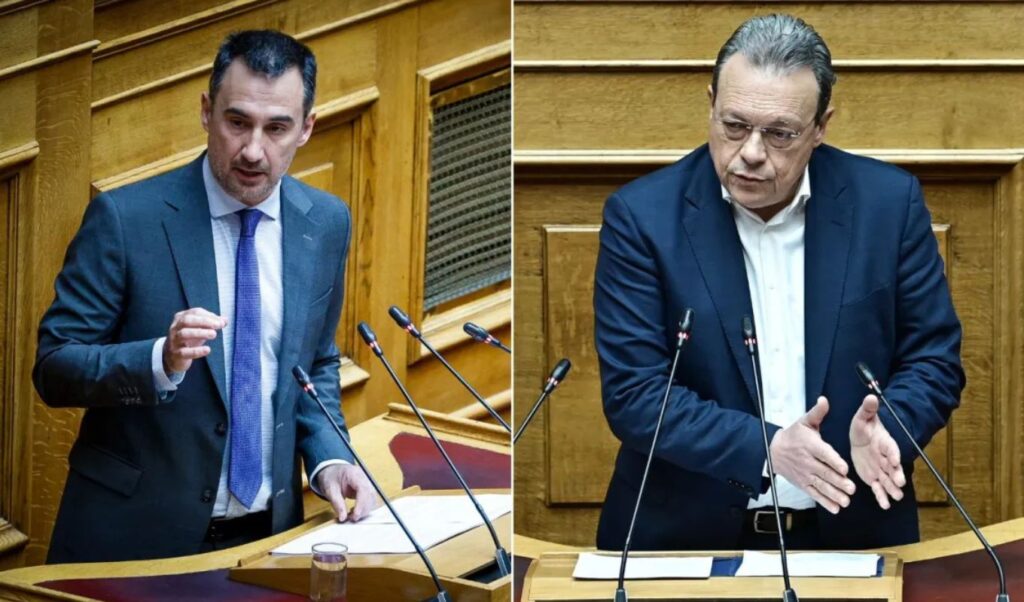
On Tuesday, Sokratis Famellos together with Alexis Charitsis sent a letter to the President of the Republic and the Prime Minister requesting the immediate convening of the Council of Political Leaders. In their letter, the two leaders emphasize that “Greece must function as a factor of peace and security with adherence to International Law” and note that “the escalation of war in the Middle East creates serious implications for international stability and directly affects Greek interests.”
Sokratis Famellos, speaking Tuesday in Parliament, stressed that he expressed the view that Greece “could and should have acted toward de-escalation and stability” as an EU member and non-permanent member of the UN Security Council. Instead, he said, “we witness continuous concessions within the framework of the given ally policy” and accused the Prime Minister of “acting as a tail to Trump and Netanyahu.” In this context, he recalled that SYRIZA-PS has requested the convening of an international conference for the Eastern Mediterranean and Middle East with our country’s initiative and EU participation, which, if it had happened, would have “strengthened the country’s diplomatic power.”
Tsipras intervention
However, former Prime Minister Alexis Tsipras’ intervention created particular sensation, as he stated that “Greece, like Cyprus, has no reason to become part of this war being conducted openly, with flagrant violation of International Law, with the basic objective of controlling Iran’s energy sources and obviously not democracy in the long-suffering country,” showing his disagreement with the involvement of Greece and Cyprus in this military conflict.
He also pointed out that the first priority in these difficult moments is for Greece to respond to Cyprus’ request for support of its defense and citizen security against Iranian attacks. “Those who speak big words about Hellenism today should consider whether its security, interests and values are served by leading in war fronts seeking protectors or in peace formations building alliances.” He added that “the United Kingdom owes explanations for the involvement—and moreover without warning—of the British base in Cyprus in American operations, endangering the island’s security.” He concluded by criticizing once again the responsibilities of EU leadership.