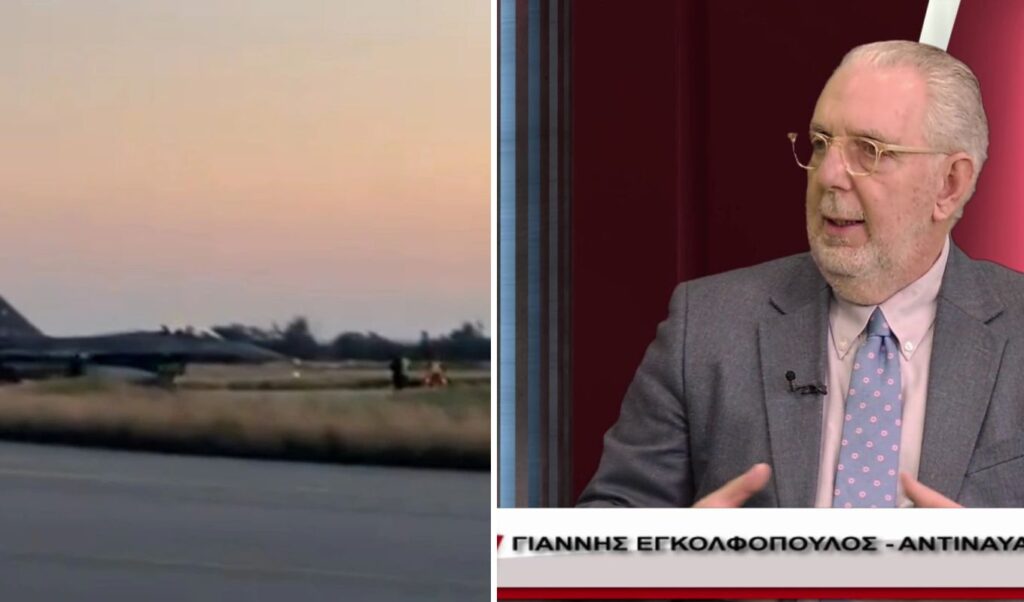
In a move of high symbolism, Greece proceeded to send advanced military systems to Cyprus, the first European country where the volatile Middle East scenario was transferred, with drone launches against British bases. With Greek assistance to Nicosia, a message of high diplomacy, peace, and response to Turkish claims is automatically sent. The fact that Greece sent two frigates and a pair of F-16s to Cyprus is commented on at parapolitika.gr by retired rear admiral Yiannis Engelfopoulos, highlighting the historical and geopolitical significance of the move.
Retired rear admiral Yiannis Engelfopoulos: “Greece protects all of Cyprus”
“Greece offers protection to any point where drones are directed. It protects all of Cyprus in contrast to Turkey, which instead of protecting Cyprus, cries for Khamenei,” emphasizes Mr. Engelfopoulos, who underlines the difference in perception between the two countries, with Athens siding with the peaceful side of history, while Ankara finds itself close to the theocratic Iranian regime.
“Turkey pretends to care about peace, talks about northern Cyprus, but didn’t protect a single point of it. On the contrary, Greece provided protection to a divided region,” adds the retired rear admiral with a statement that implies Greece cares comprehensively for Cyprus and does not focus on specific areas, de facto rejecting two-state solutions that are part of Turkish demands.
At the same time, Mr. Engelfopoulos acknowledges that the weapons systems Greece sent constitute “our best material. They are Vipers.” When the discussion reaches the Souda area and the contentious question of whether it will be affected by Iran’s missile attacks, the retired rear admiral estimates it is “the best protected place in the world. Who would dare to touch it? Even if Iran sends long-range missiles, they will be intercepted due to distance.”
The prime minister’s briefing on Middle East developments
It is recalled that as government sources announced earlier, Prime Minister Kyriakos Mitsotakis intends to proceed with private briefings to political leaders regarding developments in Iran and the Middle East region.
According to government sources, “the prime minister is open to private briefings with any political leader, provided a relevant request is submitted. In this context, Kyriakos Mitsotakis will meet tomorrow at 12:00 with PASOK President Nikos Androulakis at the Prime Minister’s Office in Parliament.”
The prime minister will speak on Wednesday in Parliament during the discussion of the bill on postal voting for expatriates, where he is expected to address current international developments.
Additionally, Foreign Minister Giorgos Gerapetritis is urgently convening the National Foreign Policy Council on Wednesday to discuss the latest developments in the Middle East.