
According to the Alexis Tsipras Institute, Greece is the 4th most expensive country in the EU for energy and supply costs. The Institute’s Energy, Environment and Climate Crisis Group writes about the narrative of “cheap energy in Greece” which “proves to be inaccurate and misleading.”
Tsipras Institute: “The narrative of cheap energy in Greece”
“The Alexis Tsipras Institute conducted a comparative analysis of electricity costs among the 27 European Union countries, which reveals, as it states, that ‘Greece is the 4th most expensive in the EU for energy and supply costs’.”
The former Prime Minister specifically states in his post:
“A few days ago in Parliament, the Prime Minister declared that Greek household energy tariffs are 21% cheaper than the European average.
How accurate is this statement?
Does this picture change if we factor in the purchasing power of Greek households?
What happens with the gap between wholesale and retail energy prices?
The Alexis Tsipras Institute and the Energy, Environment and Climate Crisis Group publicly present their analysis of electricity costs and comparison with the remaining EU-27 countries
The analysis proves that the narrative of ‘cheap energy’ in Greece is completely inaccurate and misleading.”
In detail:
“Comparison of Electricity Costs Among the 27 European Union Countries
1.1 Retail Price of Electricity
“Greek household tariffs in the first half of 2025 were 21% cheaper than the European average” – Kyriakos Mitsotakis, February 27, 2026.
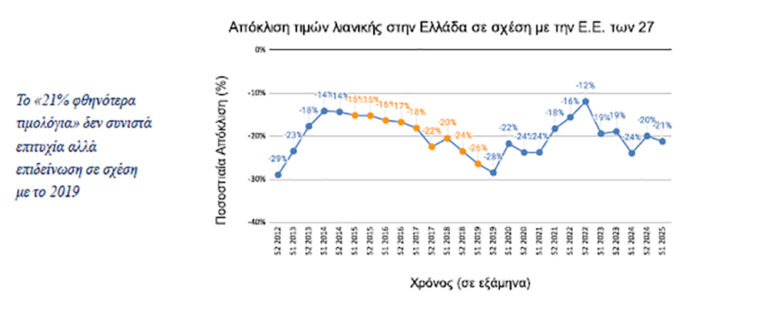
Chart 1 presents data on the evolution of retail electricity prices in Greece compared to the average of the 27 European Union countries, from 2012 to the first half of 2025. The prices shown in this chart are drawn from Eurostat’s nrg_pc_204 dataset and concern nominal retail prices, including taxes, for households with annual consumption from 2,500 kWh to 5,000 kWh. These are the data from which the prime minister’s “21% cheaper” figure emerged.
We observe that historically, retail prices in Greece consistently move below the European average, making the -21% of 2025 not some groundbreaking achievement, but rather a deterioration compared to the past. Specifically, analysis of the 2015-2019 period shows gradual increase in deviation (i.e., cost reduction for Greece relative to Europe-27), reaching -26% and -28% at the end of 2019, meaning the current distance from the European average has actually shrunk. After 2019, Greece approaches the European average in retail price levels, and only from 2023 onwards was there a return to -20% on average, which is still clearly worse than prices in the final years of the 2015-2019 period.
Chart 1: Deviation of Greek and Europe-27 retail prices. The 2015-2019 period is shown in orange.
Beyond tables and percentages, however, there’s the harsh reality each of us faces when opening their electricity bill. Is electricity in Greece cheap? The answer is, of course, no. Citizens don’t live in an illusion. They live in a daily reality where electricity has transformed from a basic good to a luxury item. If someone compares a 2018 bill with today’s, the difference is shocking. Based on Eurostat data, the retail price of electricity for households in the first half of 2025 is 46% higher compared to 2019 (226.3 €/MWh in the first half of 2025 versus 155.1 €/MWh in 2019). The trend of consolidating increases above 40% compared to 2019 is the new reality.
It’s important to note that the final retail price in Greece is determined following government interventions and subsidies, which mask the constant deviation of the Greek wholesale market from the European average, a deviation that drags electricity and supply costs to levels significantly higher than the European average.
The main methodological error, however, lies in the very use of nominal retail prices in euros without considering Greeks’ disposable income compared to other European citizens’ incomes. Eurostat uses the Purchasing Power Standard (PPS) index for this purpose to show how much a service burdens citizens’ pockets.
The nominal price of electricity, if not correlated with wage levels, conceals the real burden each household must bear.
In other words, claiming that electricity is cheap in Greece because the retail price in euros is low compared to other countries, without considering the purchasing power of each country’s citizens, is like saying that an €800 rent in Athens is a good price because it costs €1,500 in London, ignoring that an average salary in Athens is €1,000 and in London €3,500.
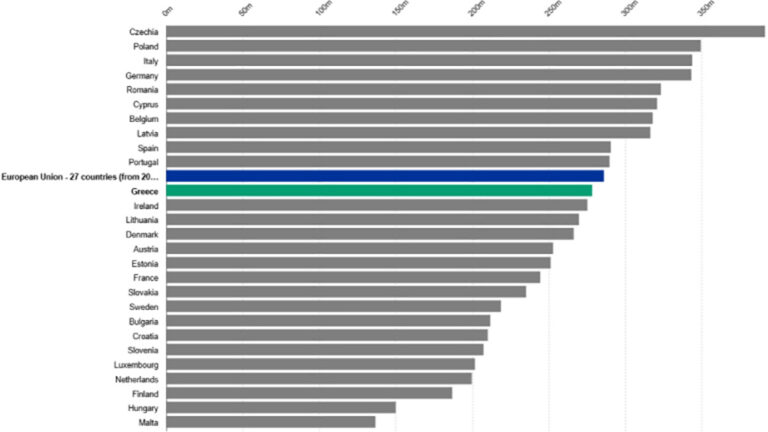
Chart 2 shows the comparison of retail prices for the 27 European Union countries for the first half of 2025, taking into account the purchasing power of each country’s citizens. The situation here has changed significantly. Greece, when purchasing power is considered, absolutely approaches the European average level, meaning higher retail prices. Even this chart, however, doesn’t fully capture Greece’s relative position regarding the real cost of electricity, as it merges energy costs with taxes and subsidies, which differ significantly from country to country.
1.2 Wholesale Price of Electricity
To clearly see how Greece moves relative to the European average in electricity prices, we must examine the wholesale market, where electricity is traded as a product before reaching households. It’s no coincidence that all official bodies, such as the European Commission and Regulatory Authorities, focus on the wholesale market rather than retail, as wholesale constitutes the only clean indicator for comparing a country’s energy performance before taxes, network fees and social policies are added.
“We were in 2019 by far the most expensive country in wholesale energy price in Europe.” – Kyriakos Mitsotakis, February 27, 2026
Greece during 2021-2023 had record deviations in wholesale price compared to the European average.
In Chart 3 we see the difference of wholesale price in Greece compared to the European average, for each month from 2015 to today. In 2019 we indeed had proportionally the most expensive wholesale price per MWh, with deviation around 20 euros/MWh from the European average. However, significantly greater deviation from the European average appears during 2021-2023, as clearly shown in Chart 3, reaching up to 90 euros/MWh in some months (data refers to monthly averages of hourly prices). This huge Greece-EU deviation during 2021-2023 cannot be attributed to the Russia-Ukraine war, as the war’s impacts affected all European countries.
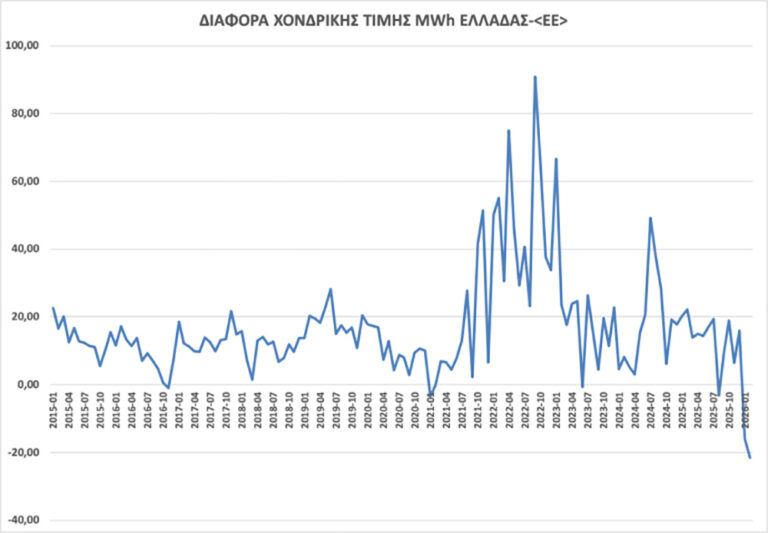
Chart 3: Chronological deviation of Greek wholesale price from European average (€/MWh). EMBER’s European Wholesale Electricity Price database was utilized
1.3 Net Cost of Electricity and Supply
Greece is the 4th most expensive country in the EU for energy and supply costs.
By isolating the net cost of electricity and supply (“Energy and Supply” indicator from Eurostat’s nrg_pc_204_c dataset), we find that electricity as a product is 11% more expensive in Greece compared to the European average. When purchasing power is factored in, the real burden skyrockets to +40% versus the European average, with Greece occupying the 4th most expensive position in the EU.
(Chart 4). The data refers to 2024, as Eurostat has not yet published 2025 data for this indicator.
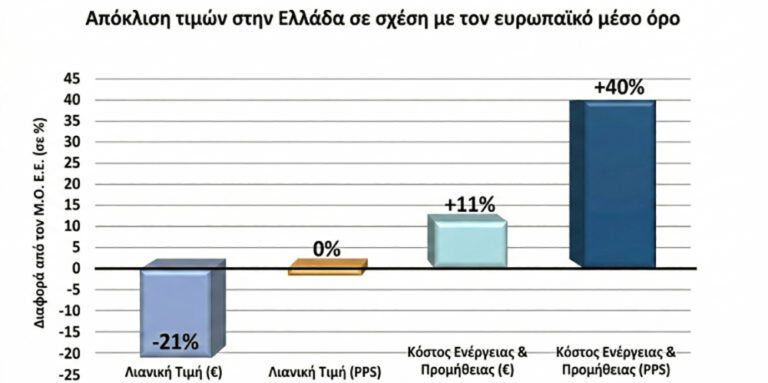
The deterioration is clearly visible in Chart 5: the seemingly lower retail price (-21%) is not due to genuinely cheaper electricity, which as we found is among the most expensive in Europe, but to existing subsidy and tax policy and the fact that Greek citizens’ purchasing power is not factored in. In purchasing power terms, the final retail price paid by citizens is not cheap at all and approaches the European average. Additionally, the high cost of electricity as a product continues to burden the economy and actually rolls over indirectly to citizens themselves, as subsidies are financed by public resources from their taxation. Thus, the narrative of “cheap energy in Greece” proves completely inaccurate.