The conflict in Iran finds Greece at a critical geopolitical juncture, as it attempts to maintain a delicate balance between the US, Israel, and Arab countries, at a time when Greece was seeking to upgrade its geopolitical role in the region. Beyond this, although the effects are not currently apparent, an extension of the conflicts for several days, as announced by American President Donald Trump, could drastically change the situation. The widespread escalation in Middle Eastern countries portends significant consequences for the Greek economy, mainly after the closure of the Strait of Hormuz with major impact on shipping, trade and supply chain, energy, and tourism.
Professor of International Relations at the University of Peloponnese, Sotiris Roussos, argues to parapolitika.gr that, although our country does not import large quantities of oil from the Persian Gulf, fuel prices are expected to be affected due to speculative pressures on oil prices. However, everything will depend on the duration of the war.
Sotiris Roussos’ assessment of Souda and the British base in Cyprus
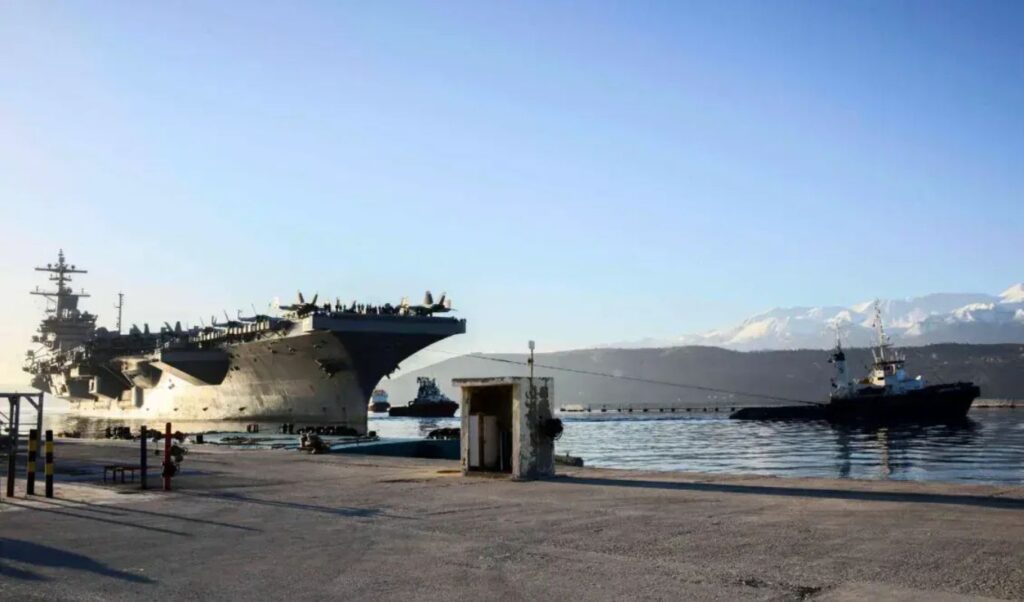
According to Mr. Roussos’ assessment, at a general level, Greece, if it does not participate in some way in this operation, will not suffer significant consequences. As he points out, even the concession of the Souda base will not cause any kind of strike, as speculated, because as he explains “Iran’s ballistic missiles cannot reach Souda. It would not be rational on Iran’s part to waste missiles even if it were to hit such a target, when it could use them to strike Israel or the Gulf countries.”
He appears equally reassuring about a possible strike on Cyprus, given that the British base, according to British statements, is not taking part in the operation. “I don’t think an attack against Greece and Cyprus is likely, if they don’t openly take part in this conflict. I believe they will be rational enough not to do so,” he maintains. However, the conflict in Iran is expected to bring about yet another upgrade of Turkey’s position in the region, which according to Mr. Roussos is “the only country that seems able to play a role in Iran, despite the fact that it doesn’t have a good relationship with Israel. As it had done with Syria despite Israel’s objections. Greece cannot play any role in this region,” he notes.
Why there is a risk of prolonged war – Ambassador emeritus Giorgos Poukamassis’ assessment
Ambassador emeritus Giorgos Poukamassis, speaking to parapolitika.gr, estimates that the economic impact on our country will be significant in case of conflict escalation. However, he raises another parameter. As he argues, there is a risk of prolonged war as, he estimates, changing the regime in Iran is difficult if not impossible. Something that, when proven, will damage the prestige of the US and Israel, which are strategic partners for Greece. As he notes “Khamenei’s execution should have given both Israel and America an opportunity to step back and say that the root of evil has been uprooted. Otherwise, the prolongation of the war, I fear, will cause many broader problems.” According to Mr. Poukamassis, “Greece should coordinate, on this issue too (as with Ukraine) with our partners in the European Union, who are more restrained, as their statements show, despite the fact that for the sake of balance they condemned Iran’s attacks on the Arab states of the Persian Gulf.”
Nevertheless, Foreign Minister Giorgos Gerapetritis has been in constant communication with the Foreign Ministers of European Union countries from the first moment of the war’s outbreak, with whom he participated yesterday afternoon in an emergency teleconference, which was convened by the High Representative of the European Union for Foreign Affairs Kaja Kallas, to examine developments in Iran.