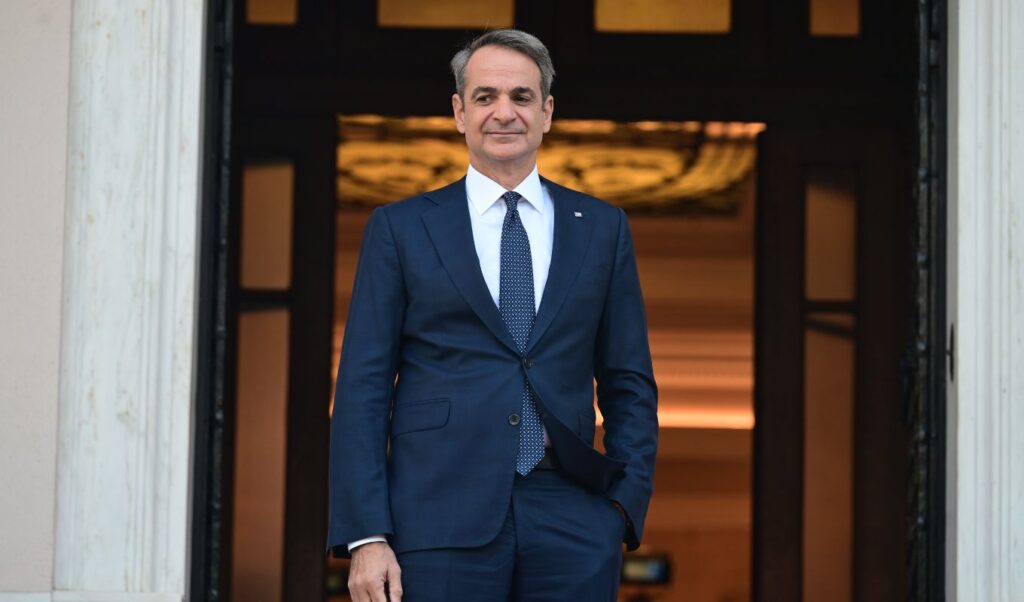
Prime Minister Kyriakos Mitsotakis described “two major milestones in natural gas exploration after 40 years” in his regular weekly review, referring to the signing of agreements between the Greek state and the Chevron-Helleniq Energy consortium.
Kyriakos Mitsotakis’s post:
“Good morning. Since tomorrow is Clean Monday, some might have expected us to… fly kites from today. But, as every Sunday, we’re here to see what happened this past week. After all, consistency is also a good tradition.
I’ll start with the signing of agreements between the Greek state and the Chevron-Helleniq Energy consortium for granting exclusive rights to explore and exploit hydrocarbons in marine areas south of the Peloponnese and Crete. This development, combined with the planned first exploratory drilling in the ‘Block 2’ marine plot in the Ionian Sea expected in early 2027, constitutes the two major milestones in natural gas exploration after 40 years. It’s a substantial restart. After ratification of the agreements by Parliament, research programs will begin, and by the end of the year, the first seismographic surveys in the new areas are expected. With the four new concession contracts, the Greek state secures approximately 40% of profits in case of discovery and production of potential deposits, without requiring the expenditure of state capital for these high-risk investments. Through these agreements, Greece strengthens its energy autonomy and security, creates fertile ground for new investments and new, competitive jobs, as well as significantly increased public revenues. Our energy policy invests in diversifying energy sources and utilizing our national advantages, so we don’t depend on expensive energy imports. Over the past 6.5 years, we have literally leaped in renewable energy sources – with 50% of generated energy coming from renewables – we are already an energy-exporting country, and simultaneously we are finally actively utilizing potential natural gas deposits within strategically significant alliances that highlight our geopolitical position in the broader region, while simultaneously guaranteeing our security against those who challenge our sovereign rights.
Another sector that also shapes the future is Artificial Intelligence. At the recent India AI Impact Summit 2026 in New Delhi, I had the opportunity to present to heads of state, leaders of international organizations, and top technology leaders the digital leap our country has made in recent years and our position that technology needs rules, transparency, and social purpose. Technology governance is the field that will determine the geo-economic power of the coming decades, and our homeland cannot be absent from shaping the framework of the next day. Soon we will speak more specifically about the measures we will take to address digital addiction among minors.
In New Delhi, I also met with Prime Minister Narendra Modi – for the third time in two and a half years – confirming the strategic relationship between our countries. A relationship that gains even greater momentum through the EU-India trade agreement under development, which creates new access opportunities for European products and businesses in a huge market. In 2026, we’re opening two new consulates in Mumbai and Bangalore, while the direct Athens-New Delhi connection has already begun. Greece can serve as a gateway from the Indo-Pacific to Europe and a critical hub of the Middle East-India-Europe Corridor (IMEC), a position that Prime Minister Modi also shares.
I now come to other important government actions of the week. A breakthrough bill was submitted to Parliament for extending postal voting rights to Greeks abroad for the next national elections in 2027, as was done in the European elections. I characterize it as an institutional breakthrough because our proposal provides that our compatriots who permanently reside outside Greece will be able not only to choose their preferred party but also a specific MP as their representative in the National Parliament, through the creation of a special three-member Diaspora Constituency. We thus strengthen ties with the Greek diaspora and practically support the brain regain policy. To implement the regulation from 2027 requires an enhanced majority of 200 MPs. Dialogue with the parties has already begun, and I expect they will approach this important reform with a spirit of responsibility and consensus.
Another modernization step was taken this week with the operation of ‘ERGANI II’, with less bureaucracy for businesses, better labor market oversight, transparency, and greater protection for workers. When I say less bureaucracy, I mean for example that 3 out of 4 printed declarations for hiring and staff lists are abolished, and this data is now recorded digitally, without the time-consuming obligation of posting. At the same time, workers, through the upgraded myErgani app from their mobile and through the myErgani.gov.gr platform, can access all information about their employment relationship in real time. I recommend downloading it!
The ‘Neighborhood Nannies’ are now expanding throughout the country, after the positive results of the pilot action in 62 municipalities. Specifically, 1,209 certified caregivers participated, 2,243 families were served, and care needs were covered for 2,370 children aged up to 2.5 years. Family support is a central pillar of our social policy, with interventions that are tested, evaluated, and expanded.
Public property utilization concerns the next topic, specifically 2 inactive areas of the Technical University of Crete, where infrastructure for the student and research community will be built. Relevant contracts were signed for the development, near the Polytechnic campus, of student housing complexes with low rent and flexible rental terms, as well as modern, environmentally sustainable conference infrastructure. The project will be implemented through Public-Private Partnership, with the support of the Superfund. The second intervention concerns the utilization of a plot in the ‘Kokkini Chalepa’ area. For the first time in the country, starting with the Technical University of Crete, an organized plan for utilizing public university property begins, with immediate benefit for the academic community and local society.
What else happened this week?
On Thursday, the platform for regulating Swiss franc loans opened, closing a many-year pending issue that torments 50,000 borrowers. The regulation provides for conversion of obligations to euros with fixed, low interest rates, as well as haircuts from 15% to 50%, depending on financial and property data, along with the possibility of extension up to five years. There is special provision for the economically most vulnerable, without burden on the state budget. The platform will remain open for six months, until August. Participation is optional, but the deadline is final.
Also, the bill for establishing the Higher School of Performing Arts was put to public consultation, implementing our political commitment to this emblematic reform in Education and Culture. It provides for establishing university-level studies in performing arts and simultaneously we proceed with institutional regulation of the artistic education field with rules, transparency, and prospects. A long-standing and fair demand is satisfied for performing arts to acquire a university home in our country, with an institution worthy of the history, talent, and international presence of Greek creators. For current students, a transitional path is provided for safe transition without surprises, while the professional profile of degrees is also regulated in the direction indicated by the Council of State. The same bill introduces the International Baccalaureate framework in public school units and upgrades school libraries.
Also significant is the detection of serious irregularities in social solidarity benefit approvals during 2020-2022, after controls ordered by OPEKA management when reports were made about practices incompatible with protocol and serious deviations from prescribed procedures. Benefits are alleged to have been granted to non-beneficiaries. The National Transparency Authority assists in investigating the case so that a complete file can be forwarded to Justice. The government demonstrates practically, for any case that comes to light, absolute respect for legality and zero tolerance for any illegal behavior. While new institutional tools for more effective anti-corruption fight, such as NTA, now bring visible results benefiting the public interest.
Let’s go north, to Thessaloniki. The first 100 new electric buses that will join the OSETH fleet through the KTEL consortium have arrived and will hit the roads next month, after necessary tests. These are modern, comfortable, and safe vehicles with innovative functions: from automatic interior lighting adjustment to an alcohol test system that doesn’t allow bus ignition if the test is positive. By September, another 130 new buses are expected, completing the largest fleet renewal in recent decades in the city. Thessalonians remember that in 2019 only 240 old vehicles were circulating. Today the fleet exceeds 500 and continues to be renewed. Together with Metro extension and the Western Thessaloniki Suburban Railway, the city’s transportation map is substantially changing.
And something else concerning transportation: a years-old pending issue was closed in Piraeus with the operation of the new ‘Akti Poseidonos’ terminal tram station, thus fully activating Line 7’s connection with the port. The tram now terminates at the port and will serve thousands of passengers, who will no longer be troubled carrying their luggage on Piraeus streets.
Finally, the State, through the Ministry of Culture, immediately mobilized for photographs that appeared on an online auction site depicting Greek patriots before their execution in Kaisariani on May Day 1944. They were examined by the competent Council and declared monuments, as exceptionally important documents of modern Greek history, allowing the Ministry of Culture to claim the collection and acquire it on behalf of the Greek state. Experts have already traveled to Belgium, contacted the photograph holder, and confirmed the authenticity of 262 photographs total. Specifically, a preliminary agreement was signed between the Ministry of Culture and the collector, the collection was withdrawn from the online auction site and passes to Greek state ownership. This is material directly connected to our national memory that we must preserve.
This week we bid farewell to three great personalities: Anna Psarouda-Benaki, Eleni Glykatzi-Ahrweiler, and Antonis Manitakis. All three distinguished themselves individually in their fields. They opened paths, honored the country, and left a strong imprint. Many words have already been said. Let us be inspired by their example.
We close for this Sunday. I wish you to have a good time, whatever you do. Good Lent!”