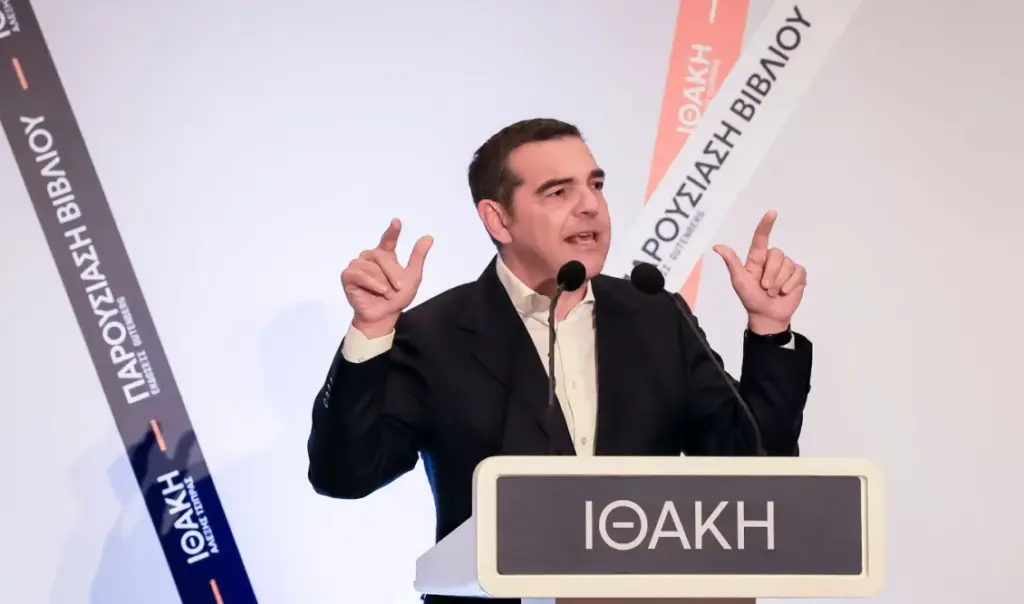
Alexis Tsipras appears ready to take the next step, as his associates point out that when he resigned as MP, he had declared his goal to “go down” to society and engage with citizens, and through the presentations of his book “ITHACA” he has achieved this.
“I abandon the security of the parliamentary benches. And I aspire to return to the hopeful insecurity of social action. Not to lead from above, but to better listen to society and its needs,” the former prime minister had characteristically declared, and through the contacts and meetings he makes for “Ithaca” this is exactly what he is doing.
Alexis Tsipras: New stops for book presentations across Greece and islands
The next stops for Alexis Tsipras to present his book “Ithaca” are, according to information, Alexandroupoli, Kozani, Lamia, Kalamata, Crete, Lesvos, Rhodes, and Corfu.
The goal of the new presentations is to open up dialogue with citizens even more in the coming period, not only about what happened from 2015 until today, but also about the next day. Politically, with arguments for the reconstruction of the progressive coalition, but also programmatically, with proposals that Alexis Tsipras’ Institute has developed for the future.
Which citizens are attending Alexis Tsipras’ “Ithaca” presentations
Meanwhile, the Amalia staff evaluates the first cycle of Alexis Tsipras’ book presentations with an extremely positive sign. This assessment refers both to the mass nature of the events and to the contacts that Alexis Tsipras has the opportunity to make on the sidelines of these presentations with ordinary citizens, collectives, institutional bodies, mayors, regional governors, young people, professionals and others.
What his associates note is that interest grows with each event. Tsipras is “reintroducing himself” with “Ithaca” and his interventions to an ever-expanding audience. In Athens, Patras and Thessaloniki, and even more so in Ioannina and Larissa, the turnout is impressive. As they say, in Ioannina it was necessary at the last minute to move the dividers so that two halls could be joined to accommodate the crowd.
Similar was the turnout in Larissa, where people had covered, beyond the main hall, both the foyer and the hotel’s outdoor space.
Equally encouraging is the demographics of those attending the events. These are not only traditional voters and SYRIZA members, but citizens from the broader progressive space, voters from across the progressive spectrum and unaffiliated people seeking a way out from the Mitsotakis regime and concerned about the fragmentation of the democratic opposition. Citizens who participate in the discussion about “Ithaca” are interested in A. Tsipras’ truth about the difficult 2015, but also look forward to a better future.
The demographics of panels at book presentations
The expanding interest is also reflected in the composition of the panels presenting the book in each city. People from various sides of the progressive coalition, with social references, political action and scientific identity, reflect the broad response to the project with A. Tsipras as protagonist. And it was natural for the publicity spotlight to fall on the participation of Giorgos Pappas and Giorgos Siakantaris in Patras, A. Saoulidis and Katerina Spyropoulou in Thessaloniki, G. Boulbasakos in Ioannina and many others from various fields who participated in the presentation of “Ithaca”.
The speaker panels also included many new faces, such as Dimitris Kitsikopoulos, who represented energy communities and the KOINSEP space. People from the cultural field, such as Maria Katsoulidou, Marianna Toumasatou, Aimillios Cheilakis and Fai Kokkinopoulou. Academics such as Th. Lazaridis, I. Laliotou, A. Liakos, A. Stylianou. From local government, such as V. Aivalis and A. Kalogiannis. And of course active members of local society representing collectives and independent bodies, such as Ioanna Karavana, president of the Cancer Patients Association, and Children’s Ombudsman Theoni Koufonikoulakou. And finally close associates of the former prime minister, such as M. Kalogirou, K. Toumbouros and G. Chouliarakis. And politicians who accompanied him, such as P. Kokkalis and D. Teboneras.
What also does not go unnoticed are Alexis Tsipras’ contacts with local society in the cities he visits. In all cities he goes from the previous day and his contact schedule is intense and dense. Contacts with young people, professionals, organizations, farmers, cooperative representatives, members from local initiatives and collectives, but also representatives of local government, political figures from the region, metropolitans and others.
A characteristic example is Larissa, where Alexis Tsipras had successive meetings with a group of workers and professionals from the construction sector. Extensive discussion with young people in the city center. Working lunch with local figures. Meeting with the Regional Governor of Thessaly, visit and discussion with students and teachers from the Averoff Agricultural School of Larissa, meetings with representatives from the local press. Meeting with agricultural associations that participated in the blockades. With representatives from the Agricultural Cooperative of Melivoea, which besides production also invests in processing its products.