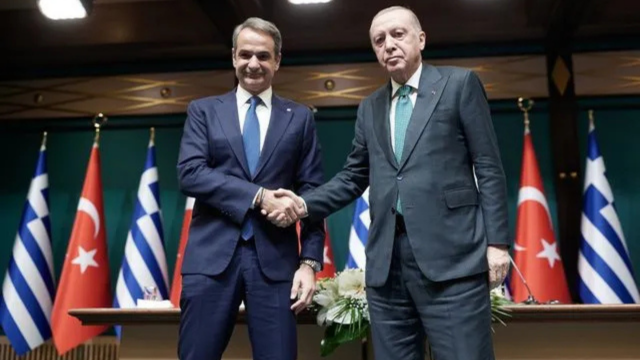
From “Mitsotakis yok” (no Mitsotakis), which Tayyip Erdogan had said a few years ago, we reached “friend Kyriakos.” The meeting between Prime Minister Kyriakos Mitsotakis and the Turkish president, as well as the joint session with nine ministers from each side, within the framework of the 6th High-Level Strategic Cooperation Council (HSC) Greece-Turkey, took place in Ankara in an exceptionally good climate and lasted an hour and a half.
One could say that the atmosphere was so calm and Erdogan’s demeanor so… conciliatory, that it didn’t match the climate prevailing just hours before the HSC, with a series of illegal NAVTEX, NOTAM and provocative statements. The two leaders agreed to maintain open communication channels, appeared optimistic and reached seven agreements, based on the so-called “positive agenda.” In their statements, however, the great distance between Greece and Turkey regarding the Aegean was highlighted.
Mitsotakis: why he raised the lifting of casus belli – Erdogan’s response
The two leaders met for the first time after 18 months and a postponement in New York. It’s worth noting that Turkish Minister of Culture and Tourism, Mehmet Nuri Ersoy, was the one who welcomed the Greek prime minister at Ankara airport. From their admittedly “mild” joint statements to the press, as well as from “Sunday Afternoon” information about what was said behind closed doors, the fact remains that K. Mitsotakis raised the issue of casus belli, requested its lifting and spoke of one difference in the Aegean, in contrast to T. Erdogan.
“It’s time now to lift every threat, formal and substantial, in our relations. If not now, when?” wondered Mr. Mitsotakis and added: “The delimitation of maritime zones, continental shelf and EEZ, in the Aegean and Eastern Mediterranean, constitutes the only difference that can be brought to an international jurisdiction, based on International Law.” Mr. Erdogan, on the other hand, spoke of interconnected issues. Nevertheless, he said that “although the existing issues are thorny, they are not unsolvable on the basis of International Law.”
The fact that Erdogan publicly referred to International Law, something he doesn’t usually do, was characterized by Giorgos Gerapetritis, speaking on ERT, as “enormous added value for the relations of the two countries.”
Of course, as expected, Mr. Erdogan indirectly asked Greece to unblock Turkey’s participation in European defense programs, while “baptizing” the minority in Thrace as “Turkish” again, with Mr. Mitsotakis responding: “You know well that the regime is determined with absolute clarity by the Treaty of Lausanne. Which explicitly provides that the minority in Thrace is religious, excluding any other misinterpretation.” Up to there. There was no counter-response from the Turkish president.
Generally, it was a very carefully “choreographed” meeting, for which – according to reliable information from “Sunday Afternoon” – the Foreign Ministries of the two countries worked intensively for months, preparing even a plan B for the two delegations. It’s no coincidence that no questions were allowed at the press conference.
Both leaders wanted to send the message that we can talk even if we disagree, so that tensions don’t lead to crises.
Greece-Turkey agreements
While the leaders’ meeting was in progress at the White Palace, on the sidelines the ministers had meetings where they “locked in” the agreements that were signed later, while also scheduling exchange of visits. Specifically, they agreed to encourage a ferry line between Thessaloniki and Izmir, to cooperate in the Black Sea Economic Cooperation Organization, as well as in the sectors of civil protection, investments, science and technology, and culture. The ministers mingled and conversed, while, according to information, Mr. Erdogan congratulated – within the HSC – Kyriakos Pierrakakis for assuming the leadership of the Eurogroup. This spirit of cooperation is also reflected in the joint communiqué signed by Mitsotakis and Erdogan, which refers to the need for communication channels, while prioritizing all issues of the positive agenda, with the primary goal of reaching bilateral trade of 10 billion.
The ministers, meanwhile, agreed to encourage a ferry line between Thessaloniki and Izmir and to cooperate in the Black Sea Economic Cooperation Organization and in the sectors of civil protection, investments, science and technology, as well as culture
The dinner and the red worry beads
The first image that greeted the Greek delegation in Ankara was the large illuminated sign that read “Honorable Prime Minister of Greece, Kyriakos Mitsotakis, welcome to Turkey.” While, the last “taste” that the Greek officials got from the White Palace was the notes from the song “Teli teli teli” by Manos Loizos, played by the orchestra at the leaders’ dinner. Even the menu was “shared.” It included stuffed cabbage with chestnuts and Aegean greens, lamb chops and beef kebab. The Greek prime minister sat with the Turkish president at the same rotunda and, according to information, they talked about Turkish and Greek cuisine, as well as their families. Also invited to dinner was Patriarch Bartholomew, to whom K. Mitsotakis showed the red worry beads that T. Erdogan gave him as a gift.
Tomorrow
According to analysts, tensions in Greek-Turkish relations are not expected in the near future, for two reasons: First, Turkey usually provokes when it is “weak.” In the current phase it is not. Second, because the neighbor has many open fronts and focuses elsewhere (Syria, Israel, etc.). Therefore, analysts estimate that the calm will be maintained at least until the next elections, which barring unforeseen circumstances will be held in Greece in 2027 and in Turkey theoretically in 2028. Although it’s not ruled out that ballot boxes might be set up earlier. In case the Turkish leadership needs a “victory” for its domestic audience before elections, it’s not ruled out that it might provoke Greece according to its usual practice.
Published in Sunday Afternoon