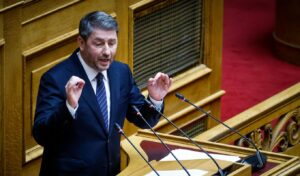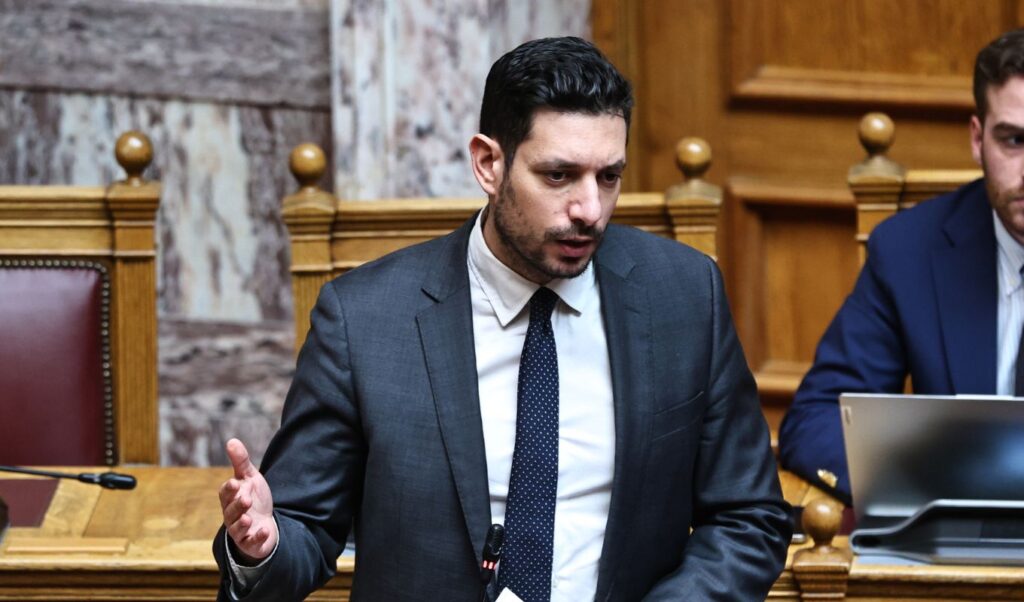
Deputy Minister of Transport Konstantinos Kyranakis announced that in 17 months from today, the gradual arrival of the first brand-new Hellenic Train units will begin, and by the end of 2027, the delivery and integration into service of all 23 trains will be completed. This represents, as he explains, an absolutely binding schedule for the Italian group, with clear clauses and consequences. For the first time, if the timeline is not met, the state has explicit contractual termination rights. We’re not talking about general promises; we’re talking about investments with terms, control, and accountability.
Of the 23 new trains provided by the agreement, 11 are suburban-type and 12 are intercity. This means approximately a 50-50 ratio. Nearly half of the new trains are directed straight to the suburban network, a system that has fallen behind in recent years, despite serving thousands of workers, students, and families daily. Because the railway, as Mr. Kyranakis emphasizes, is not judged only on long-distance routes. It’s judged every morning, at the platform, by whether the train arrives on time and whether it’s clean and reliable. That’s where citizens’ trust is built or lost.
He also references all the new safety systems being implemented on the railway, emphasizing that it’s important to remember that ETCS constitutes an additional, critical safety valve that wasn’t even included in contract 717.
Konstantinos Kyranakis: Full interview with the Deputy Minister of Transport
Minister, when will the first of the new trains included in your agreement with Hellenic Train arrive, and when will all of them be delivered?
In 17 months from today, the gradual arrival of the first brand-new trains begins, and by the end of 2027, the delivery and integration into service of all 23 will be completed. This is an absolutely binding schedule for the Italian group, with clear clauses and consequences. For the first time, if not adhered to, the state has explicit contract termination rights. We’re not talking about general promises; we’re talking about investments with terms, control, and accountability.
The difference from the past is substantial. The previous contract didn’t obligate the company to bring brand-new trains. This changed through tough, months-long negotiations that resulted in an investment package of 420 million euros, of which 308 million euros concerns the procurement of 23 new electric trains. This is the first purchase of new trains since 2004.
And something else critical: this money comes from the Italian state budget, not from Greek taxpayers. We first secured the order for new trains and then ratified the agreement in Parliament. This is the new model: from tolerance and vagueness to specific obligations with timelines, clauses, and accountability.
When will the new safety systems like GPS tracking and ETCS be ready to operate?
“Visibility” isn’t a communications slogan. It’s a clear break with yesterday, with blank checks, handwritten notes, and “approximate” operations. The precise GPS tracking system is already operating in pilot mode and will be available to citizens within the coming days. For the first time, passengers will be able to see that trains don’t move “blindly,” but with complete real-time monitoring and accuracy to within centimeters. With digital recording of every movement, we’re moving from uncertainty to transparency. This is the essence of reform, and perhaps that’s why, from day one, it faced fierce opposition from parts of the opposition.
Regarding ETCS, onboard equipment has already been installed on all trains operating on the Athens-Thessaloniki axis. With completion of restoration works after Daniel, by summer 2026 the central axis will operate with 100% signaling, 100% remote control, and 100% ETCS in full operational function. We’re not talking about partial, fragmentary improvements, but about an effort aimed at a fully armored system.
Simultaneously, train driver education enters a new era, with modern ETCS simulators and practical tests, so that technology is accompanied by real operational readiness. And it’s important to remember that ETCS constitutes an additional, critical safety valve that wasn’t even included in contract 717.
When the line restoration destroyed by Daniel is completed this summer, combined with the arrival of new trains and operation of all systems, how much will the Athens-Thessaloniki journey time be reduced?
The first major milestone is complete restoration of the railway line in Thessaly after Daniel. The next is the arrival of new trains and operation of all modern safety systems. When these are achieved and combined, the goal is clear and measurable: Athens-Thessaloniki in under 3.5 hours.
This isn’t a spur-of-the-moment promise, nor something that happens overnight. We’re talking about a new network, with complete signaling and safety systems, and brand-new trains with better acceleration, stability, and energy efficiency. Simultaneously, we’re intervening at points where slowdowns currently exist, so permanent speed restrictions are removed and the overall capacity of the axis is increased.
Simply put: we’re not chasing a few minutes on the clock. We’re making the country’s main railway axis truly competitive against cars and planes – in speed, safety, and reliability. This is the challenge, and this is what will rebuild public trust.
How many of the new trains will enter the suburban network that has been left behind for many years despite being used by thousands of people daily?
Of the 23 new trains provided by the agreement, 11 are suburban-type and 12 are intercity. This means approximately a 50-50 ratio. Nearly half of the new trains are directed straight to the suburban network, a system that has fallen behind in recent years, despite serving thousands of workers, students, and families daily.
Because the railway is not judged only on long-distance routes. It’s judged every morning, at the platform, by whether the train arrives on time and whether it’s clean and reliable. That’s where citizens’ trust is built or lost.
With this agreement, we’re not only upgrading the Athens-Thessaloniki axis. We’re strengthening daily-use lines, where citizens experience the railway in practice. These new trains can be utilized both on Athens suburban railways and Western Thessaloniki suburban railways when that project advances, so renewal reaches where there’s real need.
Where do we stand with electrification of the Kiato-Aigio line and when do you estimate the line to Psathopyrgos will be delivered?
On the Kiato-Rododafni (Aigio) section, a complete modernization package is being implemented: electrification, modern signaling, remote control, and ETCS Level 1 installation. The goal is for the line to Patras to operate with unified safety and interoperability specifications, like the rest of the country’s electrified axis.
The timeline is clear: the Kiato-Rododafni section is completed by the end of 2026 and will then be fully integrated into the electrified axis, without operational restrictions. In other words, a years-long pending issue is resolved and the line moves to normal, modern operation.
Extension to Psathopyrgos is the next critical step to substantially bring the railway to Patras. The goal is delivery by the end of 2026, so the largest part of the pending corridor is completed and Western Greece acquires a unified, fast, and safe railway front. We’re not talking about fragmentary projects, but a comprehensive connection that finally takes shape.
Greece is perhaps the only European country not connected by rail to neighboring countries despite having the network… What’s the reason? Is operating such a line so unprofitable?
For years, international passenger connections had stopped due to low demand, technical restrictions, different signaling systems, and because the network in Northern Greece didn’t have the speed and reliability that a competitive cross-border service requires. Let’s be realistic: when trains are slow and unreliable, passengers choose buses or planes.
Regarding whether connection to abroad is unprofitable, my answer is clear: no. Particularly from a geostrategic perspective, such a connection is critical. There may not be huge passenger interest, but at the freight transport and logistics level, its role is strategic.
That’s why we’re working on the Thessaloniki-Alexandroupoli-Bucharest axis. A few weeks ago I met with my counterparts to advance the project under coordination of European Transport Commissioner Apostolos Tzitzikostas. The goal is to connect the Balkans and Eastern Europe, bypassing saturated or geopolitically sensitive corridors like the Bosphorus.
The problem until now wasn’t that we “didn’t want” international connection. The problem was we didn’t have a network fast, electrified, and fully interoperable enough to support it. As infrastructure improves, European systems (ERTMS/ETCS) are installed, and the Northern Greece axis is strengthened, cross-border operation stops being theoretical and becomes implementable.
Do you have a plan for upgrading the Thessaloniki-Alexandroupoli-Orestiada line? Where do we stand? There have been announcements over time about railway connection of Kavala port to Sofia…
Yes, there’s a plan and it’s progressing. The Thessaloniki-Alexandroupoli-Orestiada axis is part of the vertical corridor connecting the Aegean with the Black Sea and Eastern European markets. We’re not talking about a simple regional line, but a strategic corridor with economic and geopolitical significance.
Planning provides for upgrading the existing line, complete electrification, modern signaling, and European ERTMS/ETCS system installation, so there’s interoperability with Bulgarian and Romanian networks. Currently we’re at the stage of study maturation, securing European funding, and interstate coordination. The difference from the past is that now the project is integrated into unified Balkan planning rather than fragmentary announcements.
Regarding railway connection of Kavala port to Sofia, this has indeed been discussed for years. Today, it’s being examined as part of the same strategic framework: interconnection of Greek ports with Balkan networks and European TEN-T networks. The viability of such a project isn’t judged by passenger traffic, but mainly by freight flows and the country’s role as a transport hub.
Simply put, plans exist and are advancing with European cooperation and financial support. Our goal is for Northern Greece to stop being a terminal station and become a transit hub.
You recently said you would hire new Greeks who had left abroad during the memorandum period and specialized in major foreign railway companies? How is this developing?
To truly change the railway, new trains and systems aren’t enough. We need people with experience, knowledge, and appetite for work.
Through the braingain.ose.gr platform we reached out to Greeks working in major foreign railway companies – people who have worked with modern safety systems and large infrastructure projects. Interest was substantial and we’re already moving to the utilization phase of this pool.
We announced 33 key executive positions at the new OSE – 6 general directors and 27 directors – with open, public procedure, modern evaluation criteria, and transparent selection stages. These positions concern the core of reform: safety, interoperability, ERTMS, traffic, digital systems, infrastructure management.
Contracts are three-year, with specific targets and performance indicators. We’re moving away from the logic of perpetual administration toward a model of responsibility, results, and accountability.
The message is clear: the new OSE isn’t being built in closed circles. It’s built with open invitation to those with real experience, whether in Greece or abroad. If we want European railways, we must bring European know-how, and that’s exactly what we’re doing.