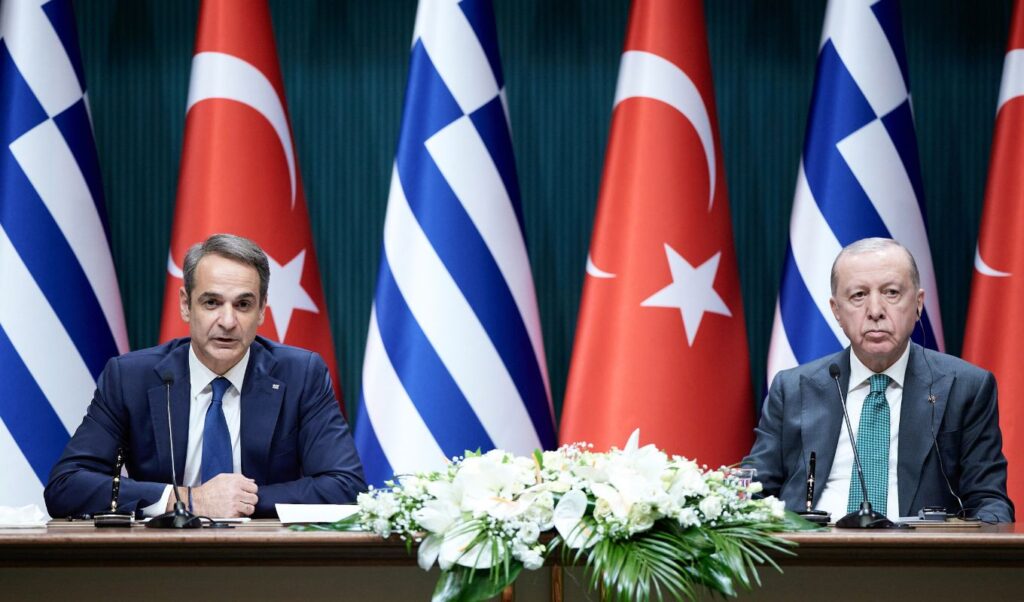
“Calm waters” and open channels of communication were the dual basic objectives of Kyriakos Mitsotakis on his trip to Ankara, which initial indications and information show he achieved, along with a third element: Just months ago, from the podium of the Thessaloniki International Fair, the prime minister had said that Turkey “as long as it insists on casus belli against Greece, as long as it insists on raising issues of ‘gray zones’ in the Aegean, will not enter the SAFE program. Greece will not allow it”.
From Ankara, Mr. Mitsotakis said that “it is time to lift every threat between us”, publicly raising this issue for the first time in front of Erdogan. The prime minister’s reference to “every threat” constitutes an indirect but clear reference to both the casus belli and the “gray zones.”
Assessment of the Mitsotakis-Erdogan meeting: What was discussed regarding EEZ, casus belli, and the 7 landmark agreements
The meeting between Messrs. Mitsotakis and Erdogan at the White Palace preceded this, starting around 3:30 PM (Greek time) and attended by the foreign ministers, Giorgos Gerapetritis and Hakan Fidan, and the diplomatic advisors of the two leaders, Milton Nikolaides and Cagatay Kilits. The delimitation of exclusive economic zones (EEZ and continental shelf) was once again on the discussion table, but again no agreement was reached on the framework within which this crucial issue could ultimately be resolved.
“We know, of course, that significant disagreements exist, with the Greek position remaining firm: that the delimitation of maritime zones – continental shelf and Exclusive Economic Zone – in the Aegean and Eastern Mediterranean constitutes the only difference that could be brought before an international jurisdictional body, based on International Law and specifically the Law of the Sea,” said Kyriakos Mitsotakis, while earlier in his own statements, Tayyip Erdogan had noted that “the issues (without specifying exactly which ones) are not unsolvable on the basis of International Law.”
Positive climate and frank discussion took place
Government sources subsequently emphasized that the meeting, which lasted half an hour, was characterized by a positive climate and frank discussion, during which all issues that have caused disagreements between the two countries were addressed. International and regional issues were also discussed with emphasis on Ukraine and the Middle East. The two leaders, note the same sources, reviewed bilateral relations and agreed that maintaining open channels of communication and improving the climate in bilateral relations benefits both countries and stability in the broader region.
Far from the “poisonous” statements by Omer Celik and Hakan Fidan in recent days, Tayyip Erdogan showed in his statements that he has no intention during this period to add fuel to the fire and, beyond the reference to the “Turkish minority” of Thrace, moved in mild and friendly tones. This specific reference was actually answered by Kyriakos Mitsotakis, who spoke of a religious minority in Thrace. He said that the “Greek Muslims of Thrace live harmoniously with our Christian fellow citizens” and spoke of “bridges of friendship and mutual understanding between our peoples” from the two minorities in Greece and Turkey.
Signatures were made
Significant progress was made on so-called “low politics” issues. At the session of the 6th High Level Cooperation Council (HLCC) between Greece and Turkey, which followed the meeting of the two leaders, seven documents were signed that strengthen and expand bilateral relations:
- Joint Declaration between the Government of the Hellenic Republic and the Government of the Republic of Turkey.
- Memorandum of Understanding for cooperation in the field of Culture.
- Joint Declaration on Cooperation between the Foreign Ministries of Greece and Turkey within the framework of the Black Sea Economic Cooperation Organization.
- Joint Declaration on cooperation between “Enterprise Greece” and “Invest in Turkiye”.
- Joint Declaration on the launch of the bilateral cooperation program in research and technology. This is a joint funding program for innovative ideas in sectors such as life sciences, pharmaceuticals, the agri-food chain, circular industry, and sustainable energy. 110 joint proposals have already been submitted, which will be evaluated by the relevant Joint Interstate Committee to fund the corresponding bilateral cooperation projects.
- Joint Declaration on strengthening bilateral cooperation in earthquake preparedness.
- Joint Declaration on launching ferry connections between the ports of Thessaloniki and Izmir.
In parallel, the Finance Ministers, Kyriakos Pierrakakis and Mehmet Simsek, agreed to conduct two business forums, one in Istanbul and one in Athens, under the auspices of both ministries, to advance cooperation. It’s also worth noting that in the Joint Declaration “the two countries agreed to further strengthen their trade ties and achieve the goal of $10 billion US in bilateral trade volume by the end of the decade,” as well as that in “combating irregular migration” “the two countries emphasized the importance of continuing and further strengthening cooperation in this area.” Cooperation in trade, tourism, and migration-refugee issues is bearing fruit and both governments will invest in its continuation.
The issue of the Israel-Cyprus-Greece electrical interconnection, which has caused tension both at the rhetorical level and in the field, in the Aegean that is, may not have been mentioned in the statements of the two leaders or in the Joint Declaration, but it contains the phrase that “the two countries expressed their determination to evaluate existing cooperation possibilities in the energy sector – especially in electrical energy interconnection and renewable energy sources – with the goal of strengthening regional stability.”