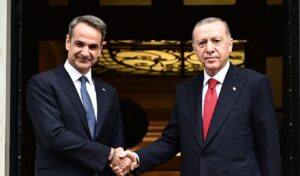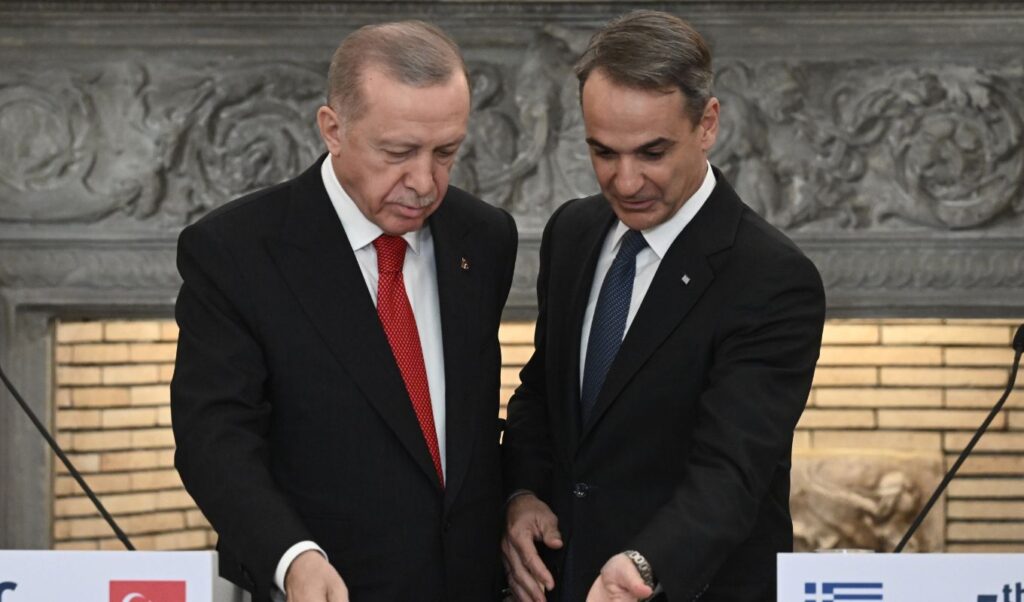
The reconfiguration of the geopolitical map in the Middle East under the unpredictable moves of US President Donald Trump serves as a powerful incentive driving Kyriakos Mitsotakis and Recep Tayyip Erdogan to the dialogue table. In two 24-hour periods, the two leaders will preside over the 6th round of Greek-Turkish dialogue at the High-Level Cooperation Council, demonstrating strong symbolism of good neighborliness with open communication channels between the two countries.
Trump, Middle East and Greek-Turkish relations: Why the negotiating table returns with uncertain prospects, what Kostas Yfantis tells parapolitika.gr
However, on major issues, Athens and Ankara (mainly addressing their domestic audiences) hastened to restate their established positions. Last week, Prime Minister Kyriakos Mitsotakis through two interviews (SKAI, Foreign Policy) and Foreign Minister Giorgos Gerapetritis and Defense Minister Nikos Dendias set the framework of national issues with which they will attend Wednesday’s meeting. Turkey also gave its signal, remaining in its maximalist claims in the Aegean.
As written in the Turkish state agency Anadolu by Altuğ Günal (associate professor in the Department of International Relations at Ege University), Turkey with the NAVTEX it issued “strategically made its position in the Aegean visible.” In an extensive article, he argued that “Turkey’s goal was to clarify its red lines and establish its position ahead of Mitsotakis’ expected visit to Ankara. This was also likely designed as a preemptive move against Greece’s recent renewed tendency to extend its territorial waters to 12 miles.”
“Low” expectations
International Relations Professor Kostas Yfantis argues to parapolitika.gr that there are no great expectations from Wednesday’s meeting: “The expectations are very low, if not minimal, that there could be progress on the major issues of delimitation. Athens does not expect any substantial differentiation from Turkey. So we are very far away. Even from the start of a substantial dialogue process. Because the process exists formally, it is the political dialogue which exists to say that there is a framework for discussion.”
Moreover, Turkish professor Altuğ Günal mentions in his article that “contrary to what is argued in Greek media, Mitsotakis’ visit does not hold a significant place in Turkey’s foreign policy agenda. In the current situation, Turkey’s priorities and areas of focus are very different.”
Indeed, the timing of the meeting casts a heavy shadow. According to International Relations Professor Kostas Yfantis: “The geopolitical situation is very difficult. There is an American President who is not interested in negotiations or rather in substantial lengthy negotiation processes. If we find ourselves – I mean Greek-Turkish issues – on his radar, it is most likely that he will exert pressure and blackmail so that the issue closes as quickly as possible with a very rapid agreement that he likes, a rapid deal as he says, based on American priorities and American interests. Neither Athens of course, but I think nor Ankara would want to start a process under pressure from an unfriendly American administration.”
Important meeting
However, just the fact that Kyriakos Mitsotakis and Recep Tayyip Erdogan have not met since September 24, 2024, is considered significant in itself. The developments that have emerged since then have an impact on Greek-Turkish relations. The change in the Euro-Atlantic alliance with Trump’s new policy, as well as the weakening of NATO’s role in which Greece and Turkey are allied countries, brings about strategic and tactical changes they are called to follow vis-à-vis the superpower. Given the convergence on February 19 of Trump’s “Peace Council” in Washington, the two leaders during their meeting at the White House will have their eyes turned to the other side of the Atlantic as well.