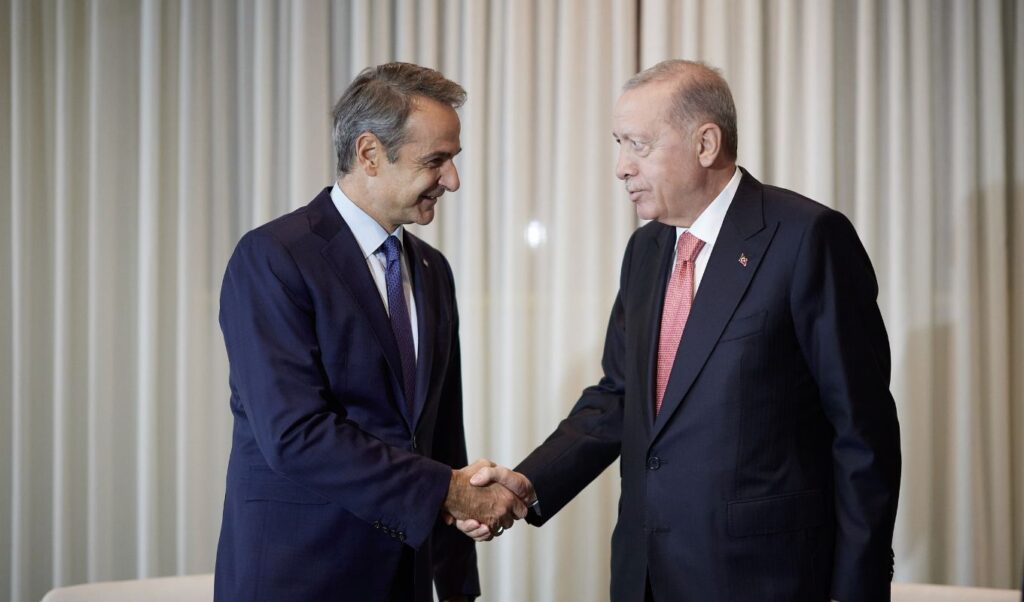
After several postponements, a New York meeting that was canceled at the last minute – with Turkey bearing responsibility – and months of diplomatic hot-and-cold treatment, the time has finally come for the meeting between Kyriakos Mitsotakis and Recep Tayyip Erdogan in Ankara this coming Wednesday, within the framework of the High-Level Cooperation Council (HLCC) between the two countries. Athens is operating under the logic of “we believe in dialogue even when we disagree,” thus categorically responding to those who question the wisdom of this meeting. “Don’t expect any agreement to emerge, a new ‘Athens Declaration,’ for example. We are realists. We are neighbors with Turkey, therefore geography compels us to talk. This way tensions are avoided and don’t escalate into crises,” senior diplomatic circles told “P”.
Mitsotakis-Erdogan meeting: Low expectations
From the reporting, it emerges that expectations are low. However, both sides showed that – this time – they genuinely wanted to find a mutually acceptable date, as well as for the (many) ministers who will participate in the HLCC. Giorgos Gerapetritis was in regular communication with his Turkish counterpart on this matter recently. Regarding the subject of discussions, one thing is certain. Greece and Turkey are not expected to touch upon
the difficult issues, namely the discussion about continental shelf and EEZ delimitation. For its part, Ankara insists that the major issue is territorial waters, with Turkish Foreign Minister Hakan Fidan stating in his interviews grosso modo that it would… help if Greece agreed to a model of gradual extension of territorial waters in the Aegean. “I don’t accept 12 miles, you don’t accept 6 miles. So we stand at certain points, exploratory talks have been held in the past, certain distances have been covered. The Aegean issue is not an unsolvable problem. As long as there is will, this problem can be solved,” Mr. Fidan said characteristically in October, attempting to create an atmosphere and set the agenda a priori.
What he meant, quite simply, is that “we can meet somewhere in the middle,” deliberately ignoring two parameters. First, the fact that he’s talking about an issue that concerns exclusively our country alone. Greece has made clear that it will proceed with extending its territorial waters in the Aegean up to (!) 12 nautical miles, whenever it deems fit and certainly without seeking permission from its neighbor. Second, even if ultimately the Greek government chooses the path of gradual extension, no one knows whether Turkey will abandon its unreasonable and illegal positions (demilitarization of islands, reduced influence of islands, etc.). Having said this, it appears we’re heading toward a discussion that will include “low politics” issues (civil protection, tourism, migration) and cooperation between the ministries of the two countries.
The “thorny issues”
Of course, the climate is not ideal. Apart from the sword of Damocles of the active casus belli, which casts a heavy shadow over every Greek-Turkish meeting, there are certain “thorny issues” that undermine the dialogue of the coming week a priori. Some estimate that the indefinite NAVTEX notices issued by Turkey in recent days, with which it reminds of all its claims and asks the Greek side for coordination on where research and exercises will take place in the Aegean, as well as the inflammatory announcements by the Turkish Defense Ministry, were deliberately “deployed” by Ankara to make Athens cancel the meeting. It was a peculiar blame game that didn’t “work” on the other side. Referring to these specific moves, the prime minister told SKAI that they didn’t surprise him, emphasizing at the same time: “We have our standing position on these NAVTEX and their legally illegal character. And certainly Greece will not need to get permission from anyone if, for example, it wants to make an electrical interconnection between Greek islands in the Aegean.”
Kyriakos Mitsotakis also deliberately emphasized that we don’t need “arbitrators,” referring to the US. Analysts estimate that it’s preferable to… work things out between ourselves, rather than turn the attention of unpredictable President Trump to the region. Because such a thing might make Washington favor a “solution” that wouldn’t necessarily serve the one who has International Law on their side (namely Greece), but would give room to Turkey’s aspirations. It’s worth noting that in the contacts that Nikos Dendias had at the American Pentagon with Defense Secretary Pete Hegseth, as well as in his discussions with people who have key roles in important think tanks, he communicated Greek positions on a series of broader problems concerning our region and the strategic challenges we face as a country.
Published in the newspaper “Parapolitika.”