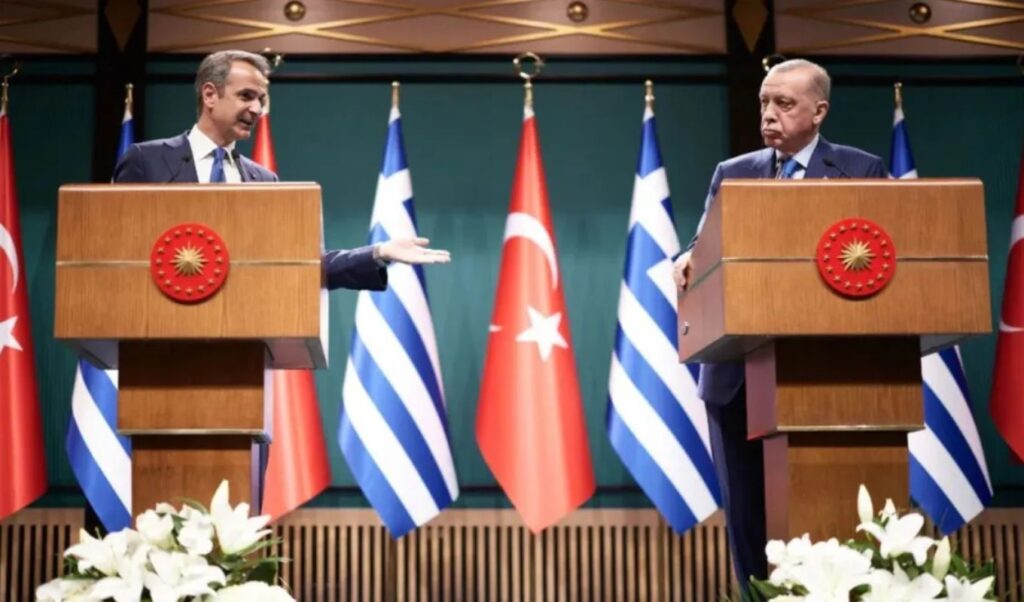
For the first time since December 2023, the High-Level Cooperation Council (HLCC) will convene in Ankara under the presidency of Greek Prime Minister Kyriakos Mitsotakis and Turkish President Recep Tayyip Erdogan. The sixth session of the HLCC is scheduled for next Wednesday, though neither the official agenda nor the number of participating ministers has been announced. What is certain is that the meeting between the two leaders takes place under a charged atmosphere, with Greece and Turkey repositioning their red lines, signaling that neither side intends to deviate from their established positions.
Nevertheless, well-informed sources maintain that the two leaders will address all bilateral issues in their private discussions. From territorial waters in the Aegean and Turkey’s exclusion from SAFE to Ankara’s maintenance of the casus belli and the strategic alliance between Greece, Cyprus, and Israel. Estimates suggest no agreements are expected on any of these outstanding issues.
Kairidis tells parapolitika.gr about Mitsotakis-Erdogan meeting: Goal is open communication channel – Tension reduction is legitimate and beneficial
New Democracy parliamentary spokesperson and International Relations professor Dimitris Kairidis, speaking to parapolitika.gr, argues that “in times of great international tension, the Greek government seeks to maintain a functional communication channel with the Turkish side to avoid adding additional sources of tension within this explosive international environment. Mitsotakis’s visit to Ankara fits within this framework. Expectations for resolving the differences that separate us on continental shelf and EEZ issues can only be limited, and we are certainly not ready to proceed today. However, there are a series of other issues, such as economic and tourism cooperation, where progress exists and can be further developed for the benefit of both peoples. Beyond that, pursuing tension reduction is both legitimate and beneficial. Therefore, with complete confidence in the justice and strength of Greek arguments and the international principles it advocates and upon which it is based, the Greek government approaches this Cooperation Council in Ankara.”
According to diplomatic and government sources, any agreements to be signed will concern so-called “low politics” issues that occupied the Political Dialogue and Positive Agenda sessions held in Athens on January 20.
Syrigos tells parapolitika.gr: Eyes also on the US – Neither side wants third-party intervention in bilateral issues
New Democracy MP and International Law professor Angelos Syrigos, speaking to parapolitika.gr, raises the issue of the American factor: “This meeting happens with both (Mitsotakis – Erdogan) looking at the Americans. Both sides are having this meeting because they don’t want third-party intervention in bilateral issues.” According to Syrigos, both sides will raise issues such as cable laying, placement of Israeli weapons on Greek islands, and SAFE, but he claims “the two leaders are not expected to reach any conclusions.”
However, voices warning of potential negative developments from the consultations are not absent. According to Kairidis, “no one can rule out anything. However, I believe preparations have been made to avoid such a deterioration scenario. I also believe both sides understand the unstable and turbulent international climate and the risks it creates.”
The atmosphere from the Turkish side is not characterized as “friendly” toward our country, as just days before the meeting, the Turkish Defense Ministry issued a statement targeting Kyriakos Mitsotakis. However, for New Democracy parliamentary spokesperson Dimitris Kairidis, this is not unprecedented. As he tells parapolitika.gr, “we have experienced many tensions and crises in the past. But all governments and all political forces that governed the country and conducted foreign policy agree on the need for this structured, defined, and International Law-based dialogue.”
Tense climate ahead of Mitsotakis-Erdogan meeting
In Turkey, pro-government newspapers refer to the tense climate between the two countries, mainly regarding maritime disputes in the Aegean over territorial waters, continental shelf, and maritime jurisdiction areas. Hurriyet notes that “Turkey states that extending territorial waters to 12 miles would significantly restrict its maritime movement in the Aegean Sea and announced that such a move would be considered ‘casus belli’ through a parliamentary decision in 1995.” Daily Sabah emphasizes that “Turkey has repeatedly rejected Greek statements and unilateral moves related to extending territorial waters in the Aegean, saying such actions violate international law and ignore existing disputes.” Yeni Safak maintains that the HLCC “aims at comprehensive review of bilateral relations and strengthening cooperation between the two Aegean neighbors.”
For the record, the High-Level Cooperation Council has been postponed twice since December 7, 2023, when it last convened in Athens and produced the Athens Declaration. It was once scheduled for 2024 and subsequently, exactly one year ago, for February 2025. Since then, one postponement has followed another.