
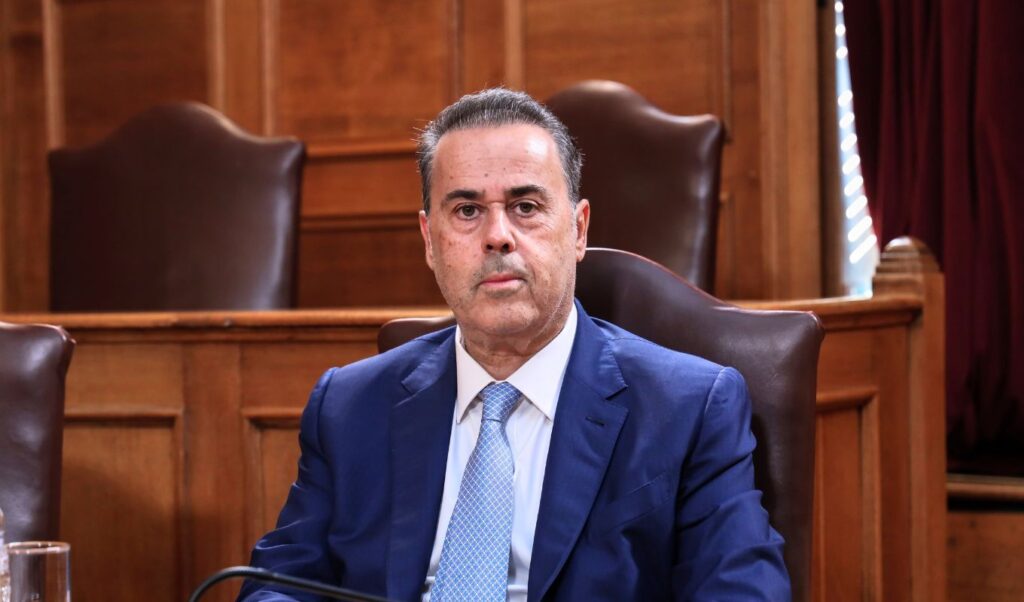
Greece’s Environment and Energy Minister, Stavros Papastavrou, analyzes in an article for Foreign Policy magazine the leading role Greece plays in the new geopolitical chessboard, the importance of energy and the Vertical Corridor, as well as the energy realism promoted by the government. In his article titled “The transatlantic energy relationship is stronger than ever – How to make US-Europe energy ties even more resilient,” Papastavrou emphasizes: 2025 was a defining year in the evolution of the transatlantic energy relationship. What began as an urgent response to Europe’s sudden exposure to serious energy disruptions following Russia’s invasion of Ukraine in 2022, evolved into a long-term strategic restructuring. The 6th P-TEC held in Athens in November highlighted this shift, bringing together energy ministers, senior US officials and private sector leaders to focus on diversifying Europe’s energy supply.
Now, the challenge facing Europe and the United States is to move beyond conceptual alignment and ensure the practical implementation of infrastructure, markets and investments that can sustain Europe’s energy security for decades to come.
Russian natural gas: Europe’s strategic decision for independence
Europe’s decision to loosen its dependence on Russian natural gas, which began in 2022, was strategic and ethical. For years, the continent’s energy model was based on an assumption that proved fragile: cheap Russian supplies were taken for granted. The full consequences of this dependence became undeniable when Russia turned energy into a means of political pressure by restricting pipeline flows, manipulating contractual terms and weaponizing supply disruptions to extract concessions from European states.
Europe chose a different path, recognizing that economic convenience could no longer override strategic vulnerability. In 2021, Russia supplied about 40% of the European Union’s natural gas imports. By 2024, that share had fallen to about 11%. Last week, the EU formally approved binding rules for the complete phase-out of Russian natural gas imports — banning liquefied natural gas (LNG) imports from early 2027 and prohibiting pipeline natural gas imports later that year.
The rise of the US role in Europe’s energy supply
Amid this transition, the United States took decisive action. The increase in American LNG reaching Europe in 2022 and 2023 helped stabilize markets at a moment of great tension, but the significance of the US role has grown far beyond urgent relief. US energy has become a structural pillar of Europe’s security architecture. In 2024, the United States was the EU’s largest LNG supplier, representing nearly 45% of the bloc’s total LNG imports. In 2025, the US share of EU LNG imports approached nearly 60%, underscoring the deepening of transatlantic energy integration.
This progress required sustained leadership from both sides of the Atlantic. The United States recognized that supporting Europe’s energy transition would strengthen both Europe’s resilience and transatlantic alliance cohesion.
The joint statement I issued with US Energy Secretary Chris Wright at the November summit reflects this shift. We emphasized long-term alignment on energy security, cooperation on infrastructure and technology, and a shared view of energy as a pillar of strategic security rather than a transactional commodity. During my visit to Washington in December, this shift was confirmed once again in every meeting I had with White House officials and Congress members.
Greece’s rise in the new energy landscape
Greece’s rise in this new landscape is one of the most significant and less expected developments of recent years. A country once considered peripheral in Europe’s energy system has moved to its center. Greece is now a critical entry point for American LNG into Europe. In 2025, more than 80% of Greece’s LNG imports came from the United States, nearly double the previous year’s level. Meanwhile, the Revythousa LNG terminal outside Athens and the new floating regasification unit in Alexandroupoli have become important stabilizing assets for central and southeastern European states.
This transformation is not a matter of geography. It is the result of Greece’s conscious policy choices, regulatory reform and timely execution. In 2020, Greece imported about 6 billion cubic meters of natural gas and exported virtually none. By 2024, it became a net energy exporter for the first time in its modern history: That year, inflows exceeded 17 billion cubic meters, of which 11 billion were re-exported to neighboring countries. Greece is no longer a consumer at the system’s margins. It is a co-architect of Europe’s new energy map, a nation on which its neighbors increasingly rely for stability, access and connectivity.
This policy change, promoted by the Greek government and our partners throughout the region, already has tangible effects for European consumers. Market instability has decreased as diversified supply reduces vulnerability to external manipulation. Predictions that cutting dependence on Russian natural gas would harm European competitiveness have not materialized.
However, affordability remains a challenge. Although wholesale natural gas prices have fallen from peaks observed in 2022, they remain well above pre-crisis levels, reinforcing the need for adequate supply, competitive LNG markets and cross-border connections that allow energy to flow where it is most needed.
The importance of the Vertical Corridor and next steps
For this reason, Europe is prioritizing construction of the Vertical Corridor, a network of pipelines connecting Greece with Bulgaria, Romania, Hungary, Slovakia, Moldova and Ukraine. When fully operational, it will allow non-Russian natural gas to reach up to 100 million Europeans. For Ukraine, the corridor is not simply an energy project, but a strategic lifeline, anchoring its future in a secure European system. The next steps are expanding commercial memoranda of understanding, harmonizing legislation and accelerating technical upgrades, so the corridor operates as a true backbone of Europe’s diversified supply.
On Greece’s side, we have a market environment that encourages long-term investments. Government and private sector partnerships with companies like ExxonMobil, Helleniq Energy and Energean are advancing offshore exploration, aiming to begin drilling within 18 months in the northwest Ionian Sea. Similarly, the Chevron-Helleniq Energy consortium aims to accelerate seismic surveys in 2026 south of Crete and the Peloponnese.
For Greece, this does not constitute a rejection of the renewable energy transition, but an effort for responsible management of it. Reliable energy provision remains essential during the transition period, especially as Europe faces the triple challenge of decarbonization, affordability and security.
And Greece’s transition to renewables is already in full swing: in 2024, renewable sources provided more than half of the country’s electricity generation, thanks to record additions of wind, solar and hydroelectric capacity. According to the revised national energy and climate plan, Greece targets 82% of electricity generation to come from renewable sources by 2030.
Greece’s realistic energy transition
Greece’s domestic strategy reflects a broader philosophy gaining increasing importance across Europe. Greek Prime Minister Kyriakos Mitsotakis avoided framing energy policy as a choice between ideological purity and practical necessity. Instead, he pursued a balanced path of expanding renewables, modernizing the grid and investing in regional interconnections, while ensuring natural gas remains available and affordable as the continent moves toward its climate goals.
There is also a deeper shift underway. Energy is becoming the hidden foundation of technological power. Artificial intelligence, advanced computing and cloud infrastructure require enormous amounts of reliable and low-cost energy. Access to this energy will help determine which regions lead in innovation and which lag behind.
Europe’s ability to compete in the global AI-based economy depends on securing abundant and stable energy. From this perspective, Greece’s emergence as a regional energy hub directly intersects with Europe’s technological future. The infrastructure and human capital skills being created now are not just drivers of security, but a platform for long-term competitiveness.
Three conditions for further strengthening transatlantic energy cooperation
Overall, these developments underscore the need to quickly transform transatlantic energy cooperation from common intention into tangible results.
First, European governments and EU institutions must invest decisively in LNG infrastructure, including additional regasification and storage capacity. These investments are essential and needed at a rapid pace.
Second, EU member states and regional partners should deepen their participation in regional corridors, including expanded memoranda of understanding for the Vertical Corridor and accelerated licensing for interconnections, which involves simplifying environmental and regulatory approvals, shortening timelines for cross-border infrastructure and harmonizing technical standards, so projects can move from design to construction without delay.
Third, policymakers on both sides of the Atlantic must support stronger economic integration between the US and Europe, institutionalizing cooperation in LNG trade, hydrogen value chains, grid resilience and regulatory alignment. These steps will provide markets with the long-term signals needed to mobilize private capital.
Greece intends to remain a leading factor in this effort. Our unique geographical position at the crossroads of Europe, the Eastern Mediterranean and the Middle East —as well as our global leadership in maritime capacity— brings both substantial opportunities and significant responsibilities. We are committed to continuing to act as a bridge between regions, as a reliable partner for allies and as a constructive voice in shaping Europe’s collective energy future.
The deeper lesson of the current moment is clear. When nations align their priorities, invest in common infrastructure and place trust at the center of their cooperation, they can build resilience even in periods of deep global instability.
The 2025 milestone for the transatlantic relationship and the 2026 task
2025 may ultimately be viewed not only as the year when Europe accelerated its separation from Russian natural gas, but also as the moment when the transatlantic partnership entered a new phase, defined by long-term strategic vision.
The task for 2026 is to transform alignment into sustained progress. Greece, the United States and our European partners must work together, project by project, corridor by corridor – so that the energy connecting our nations ensures prosperity and stability for generations to come.


