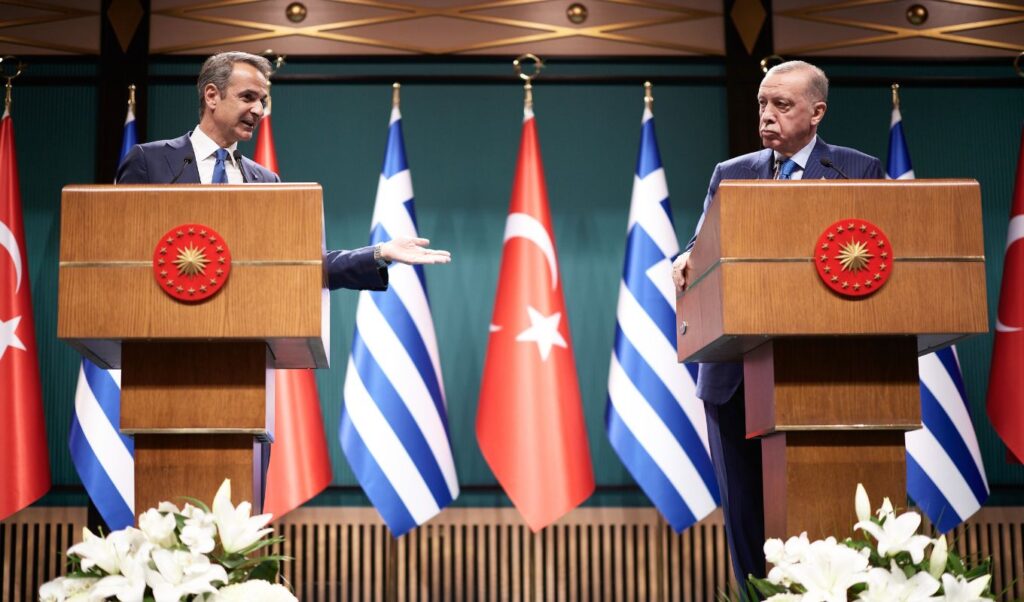
Next week, as all indications suggest, the meeting between Kyriakos Mitsotakis and Recep Tayyip Erdogan will take place in Ankara, after two years of continuous postponements. The conditions under which it will occur are far from ideal, as tensions in Greek-Turkish relations have reached alarming levels following Turkey’s renewed claims in the Aegean through a new Navtex.
Within this framework, Athens is developing concerns about the approach to Ankara, whose pursuits, based on the new emerging international situation, appear maximalist. This is particularly evident with the strengthening of Turkey’s diplomatic role, stemming mainly from its open communication line with American President Donald Trump.
As the meeting date between the two leaders approaches, different voices regarding the approach to Ankara prevail within the New Democracy party.
Former Foreign Minister Dimitris Avramopoulos, in his speech yesterday at an Istanbul think tank (Ekopolitik Foundation), openly advocated for dialogue with the neighboring country, integrating it into a long-term policy implementation that, as he argued, instead of being dragged by circumstances, would transform a geography of friction into a geography of security, prosperity and opportunity. In his statement, the former ND Foreign Minister characteristically said: “We need institutionalized de-escalation. We need permanent channels for incident prevention. We need open lines of real-time direct communication. We need protocols for air and sea interactions. We need confidence-building measures that are functional. We need implementation review and measurable results. Trust is not declared once. Trust is built through consistency and predictability. And there is also the psychological dimension of security. Security is not just capabilities and hard power. It is also soft power.”
Mitsotakis-Erdogan meeting confirmed, but no specific date set yet
Mr. Avramopoulos sounded the alarm about escalating rhetoric, noting that “the easy invocation of ‘casus belli’ is an outdated logic. But its shadow remains heavy. Wars don’t come with notifications. They can start abruptly. That’s why war rhetoric has a real cost. It poisons the atmosphere and limits political space. It undermines the possibility of substantial dialogue based on mutual respect.”
Referring to the Cyprus issue, which constitutes a dark spot in Greek-Turkish relations, Mr. Avramopoulos made extensive reference to the benefits both countries would gain if they shifted their policy and supported the island’s reunification. “A reunified Cyprus would become a cooperation platform. It would cease to be a permanent fault line. It would free political energy from zero-sum logic. It would facilitate economic integration. It would strengthen energy projects and connectivity projects. It would support maritime security and humanitarian coordination,” he argued in his speech.
In contrast to all this, former Deputy Foreign Minister Yannis Valinakis, in his article in Real News, advocated for changing tactics toward Turkey: “The new environment of instability and the latest Navtex should lead to a multifaceted reflection on the followed Greek strategy,” he writes, and poses the question of what positions Greece takes into dialogue: “Dialogue is usually better than heated confrontation. The question, however, is what positions you approach with and what kind of gains you aim for.”
The former Deputy Foreign Minister of Kostas Karamanlis’ government concludes: “From the moment Turkey insists on claiming border changes, undermining with continuous steps Greek sovereignty over island national territory, the margins for continuing ‘calm waters’ and the related approach narrow, which attributes its revisionist aggressiveness to reasons of domestic consumption, hoping to tame it through embraces, commercial cooperation, friendly matches and other means of low politics.”
However, so far, although the Mitsotakis-Erdogan meeting is considered certain by both sides, no specific date has been set yet.