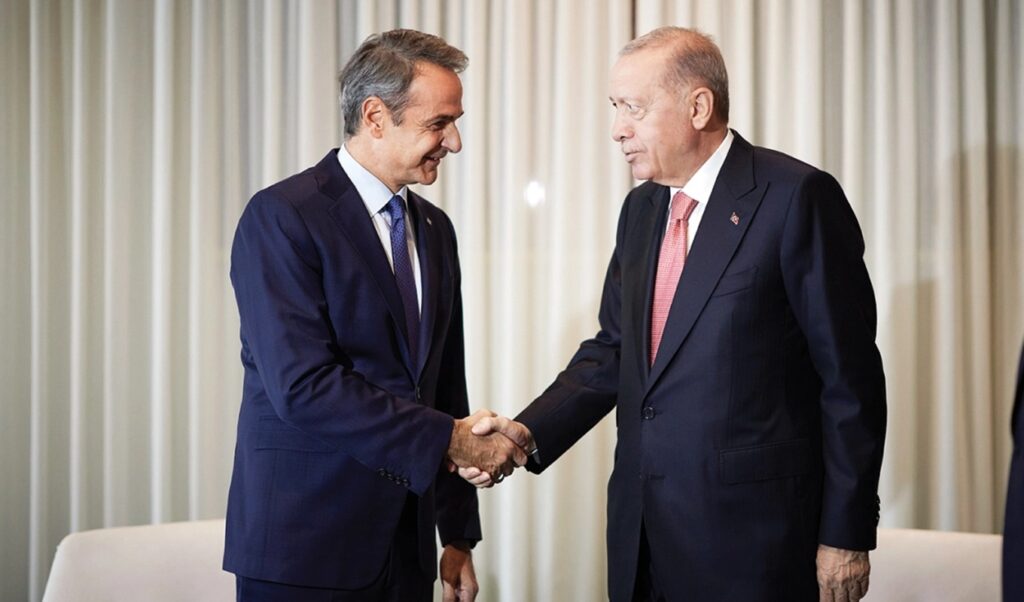
Clouds are gathering over Greece-Turkey relations just days before the highly anticipated meeting between Mitsotakis and Erdogan in Ankara. While the staff of both leaders are seeking the appropriate date, Turkey’s Defense Ministry is undermining the atmosphere, showing that longstanding differences remain and reactions are intensifying.
Turkey on collision course ahead of Mitsotakis-Erdogan meeting: Maritime law experts analyze for parapolitika.gr
Leading maritime law experts, speaking to parapolitika.gr, argue that Turkey’s announcement yesterday that “the NAVTEX we issued are not limited to two years, as claimed by Greek media, but were published without time restrictions” is unprecedented and, as they characteristically state, constitutes “Turkish-style international law.” According to them, this is the first time Turkey has indefinitely restricted half the Aegean Sea by issuing NAVTEX on matters that the Turks claim relate to the Turkish continental shelf, while identifying it with half the Aegean Sea, specifically underwater areas since it refers to the continental shelf. “It’s as if Turkey is clearly stating that the continental shelf belongs to us and you cannot do anything on it without our permission.”
According to the same sources, these Turkish moves are characterized as arbitrary and irrational, attributed to the pressure Turkey is currently facing as it sees Greece’s superiority increasing. Turkey’s reaction yesterday is not independent of the presence in Athens of French Defense Minister Catherine Vautrin and her visit to the Belharra frigate, accompanied by Greek Defense Minister Nikos Dendias. The message Ankara received is of strong Greek-French defense cooperation, which, according to diplomatic circles, provoked the reaction from the Turkish Defense Ministry as it witnessed planning for future mutual military support between Greece and France.
Diplomatic sources also estimate to parapolitika.gr that the escalation of Turkey’s aggressive statements is also interpreted in relation to recent statements by Greek Foreign and Defense Ministers regarding territorial waters extension, following Athens’ moves with the submission of the Marine Spatial Planning and the designation of marine parks in the Ionian Sea and especially in the Aegean Sea.
Meanwhile, the trilateral alliance between Greece, Cyprus, and Israel constitutes a red flag for Ankara, as it considers it directed against Turkey, precisely when Turkey’s open fronts with Israel, Syria, and now Iran are causing instability in its neighborhood. It should also be noted that, despite open communication channels, the Turkish government realizes that expectations for support from Trump are minimal, mainly regarding military equipment, since it has failed, despite efforts made, to extricate itself from the presence of Russian S-400 systems on its territory, which would allow its inclusion in the F-35 program. Within this climate, the Greek side hopes that a summit-level meeting could prove beneficial for both countries, as it would reduce tensions between them, which, in the current geopolitical fluidity, could prove harmful.