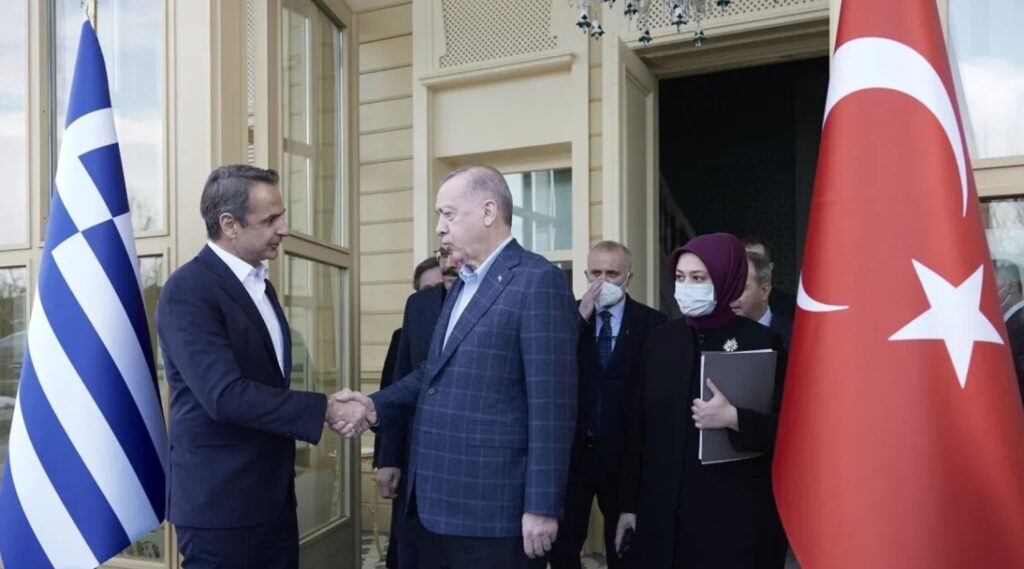
With low-politics topics and without any apparent intention to retreat from the “red lines” drawn by Greece and Turkey, the upcoming meeting between Mitsotakis and Erdogan in Ankara is being prepared for the immediate future. Both Athens and Ankara recognize that the necessity of open communication channels is imperative for resolving bilateral issues. At the same time, the possibility of an American initiative to resolve Greek-Turkish disputes cannot be ruled out, making high-level dialogue necessary, despite the visible likelihood that no results may emerge.
As Ambassador Emeritus Andreas Papastavrou argues to parapolitika.gr, open communication channels constitute by themselves a goal of defusing crises between the two countries and preventing tensions that lead to mistakes. As the experienced diplomat maintains, “dialogue is always useful in principle. That is, let’s not forget that even warring countries in World War II had communication between them in Switzerland. Dialogue is dialogue. It must exist. We don’t know exactly what will be said yet. It hasn’t been clarified exactly what will be said. With his statements a few days ago, Fidan showed that Turkey remains in its positions. At some point we will have to learn to make good calculations. We will have to learn to see our country from the outside and to see our country with the other’s eyes as well, so that we can understand where he’s going or how far he’s going.”
According to Mr. Papastavrou, “if dialogue takes place and the two countries remain in their positions, you understand that we’re not going anywhere. I don’t know if and what has been discussed behind the scenes. I don’t know how far the two countries would be willing to take it. However, if we start talking about a dialogue in which the two countries will keep exactly the positions they go with, then, of course, nothing will come out. But meetings must exist, so we don’t have tensions. We must not forget that tensions should not exist, because mistakes are made in tensions.”
The role of NATO, the Trump factor and the Mitsotakis-Erdogan meeting
The upcoming meeting of the two leaders is expected to be overshadowed by the general uncertainty prevailing on the international chessboard, which also affects geopolitical balances in the Mediterranean and, by extension, the pursuits of Greece and Turkey. Even more so since even the stable presence of NATO, which operates as a balancing factor between the two allied countries, appears to be shaken after Donald Trump’s repeated statements that devalue and weaken its role.
According to Ambassador Emeritus Andreas Papastavrou, “we don’t know yet how NATO will end up, because every day we have a different statement from the American president and we can now see the pattern very well. That is, he magnifies things and then returns to a milder stance. Of course, no one guarantees that this will continue in the same way. Because from a completely volatile pole you cannot expect stability. We don’t have the data that would allow us to have serious conclusions about Trump’s policy regarding NATO or the Mediterranean. Of course, for Greek-Turkish relations, the interview of the American ambassador to Ankara, Tom Barrack, who said those strange things about ‘nation-state’, was more problematic. What is certain is that America’s pursuit in the Mediterranean is maintaining ‘calm waters’, as its policy is transactional and to be implemented it doesn’t want upheavals.”
The Turkish newspaper “DailySabah” also speaks of pursuing the maintenance of calm waters in the Aegean, noting in a related report on the High-Level Cooperation Council (HLCC) that “its convening is seen as strengthening a period of relative calm, with cooperation expected to advance in practical areas such as trade and transport.”